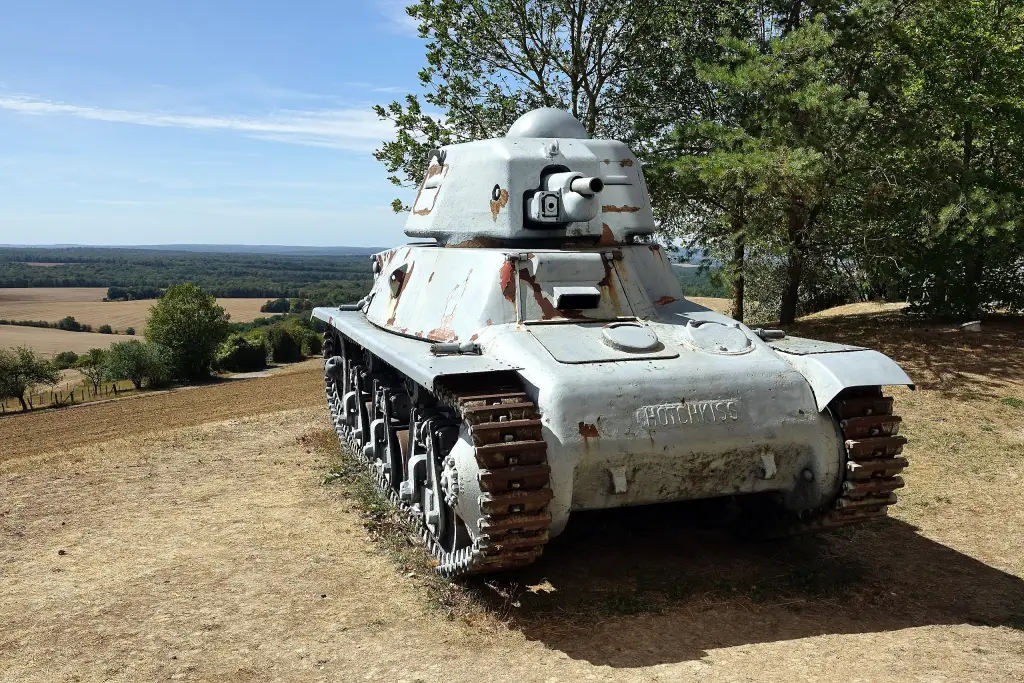
The Hotchkiss H38 belongs to the family of French light tanks that began with the Char léger modèle 1935 H, known as the H35. The improved version of the late 1930s, with a more powerful engine and later a longer 37 mm gun, is usually called the H38 or H39. Designed for the infantry, the tank was rejected by it and taken up instead by the cavalry.
Hotchkiss H38 at a glance
| Type | light tank, improved series of the Char léger modèle 1935 H |
|---|---|
| Role | cavalry light tank in French service |
| Crew | two, driver and commander |
| Length | 4.22 m (13 ft 10 in) |
| Width | 1.95 m (6 ft 5 in) |
| Height | 2.13 m (7 ft 0 in) |
| Weight | 10.6–11.4 t for the H35 |
| Hull | six cast armour sections bolted and cemented together |
| Armour | 34 mm maximum on the H35, against 40 mm specified |
| Armament | 37 mm gun; a longer, more powerful gun from 1940 |
| Built | about 1,200 H35 and H39 tanks in total |
| Users | France, then Germany and its allies with captured vehicles |
The H38 has no article of its own: the English Wikipedia article on the H35 covers the improved 1938–39 series to which the H38 and H39 belong, and this page follows it.
History of the Hotchkiss H38
An infantry tank the infantry rejected
In 1926 the French army decided to give its infantry divisions their own tank battalions, equipped with a light and cheap infantry tank. The Char D1 proved neither particularly light nor cheap, and in 1933 Hotchkiss proposed a lighter design made possible by casting entire hull sections in steel. The specifications of August 1933 asked for 6 long tons and 30 mm of armour all round, raised in June 1934 to 40 mm. Three prototypes were ordered; the third, with a cast APX turret and a redesigned hull, was accepted on 20 September 1935 and a first order for 200 vehicles followed on 6 November 1935.
The improved series
The first production tanks showed that cross-country steering was poor, dangerous to nearby infantry, and the infantry rejected further procurement, accepting only the last hundred for two battalions. For political reasons production could not be stopped, so the first three hundred vehicles went to the cavalry, which used the roads more and minded the handling less; at 28 km/h the H35 was also faster than the 20 km/h Renault R35, although in practice its inferior gearbox made it slower on average. From 1938 an improved version was produced with a more powerful engine, the Char léger modèle 1935 H modifié 39, which from 1940 was also fitted with a longer, more powerful 37 mm gun. This improved series is known under the H38 and H39 designations.
1940 and after
The plan was to make the improved variant the standard light tank, with at least four thousand built to equip new armoured divisions of both the cavalry and the infantry. The defeat of France in June 1940 limited total production of both subtypes to about 1,200 vehicles. For the rest of the war Germany and its allies used captured Hotchkiss tanks in several modifications.
Design and features
- Cast hull: six cast armour sections bolted together and sealed with Aslic, a tar-and-lime compound, allowing sloped armour without shot traps.
- Two-man crew: the driver sat at the right front behind a large cast double hatch, with a round escape hatch in the floor behind him.
- Hard to steer: without the Cleveland differential of its Renault rival, the tank responded unpredictably to changes of direction.
- Armour quality problems: many subcontractors were used, and the armour was at first too soft, then brittle and full of bubbles when hardened.
Hotchkiss H38 versions
- H35: the original Char léger modèle 1935 H, with a 28 km/h top speed and 34 mm of armour.
- H38: the improved version from 1938 with a more powerful engine.
- H39: the modifié 39, which from 1940 also carried a longer and more powerful 37 mm gun.
- Captured vehicles: German and allied conversions of Hotchkiss tanks during the war.
The same firm later built the M201 jeep for the French army, and its pre-war cars such as the 686 came from the same factories. More vehicles are in the Hotchkiss collection.
Sources
- Hotchkiss H35, English Wikipedia: development, armour, improved series, production
- Hotchkiss H35, French Wikipedia: French service
- Hotchkiss H35, Italian Wikipedia: the H35, H38 and H39 designations
- Hotchkiss, Italian Wikipedia: the company’s military production