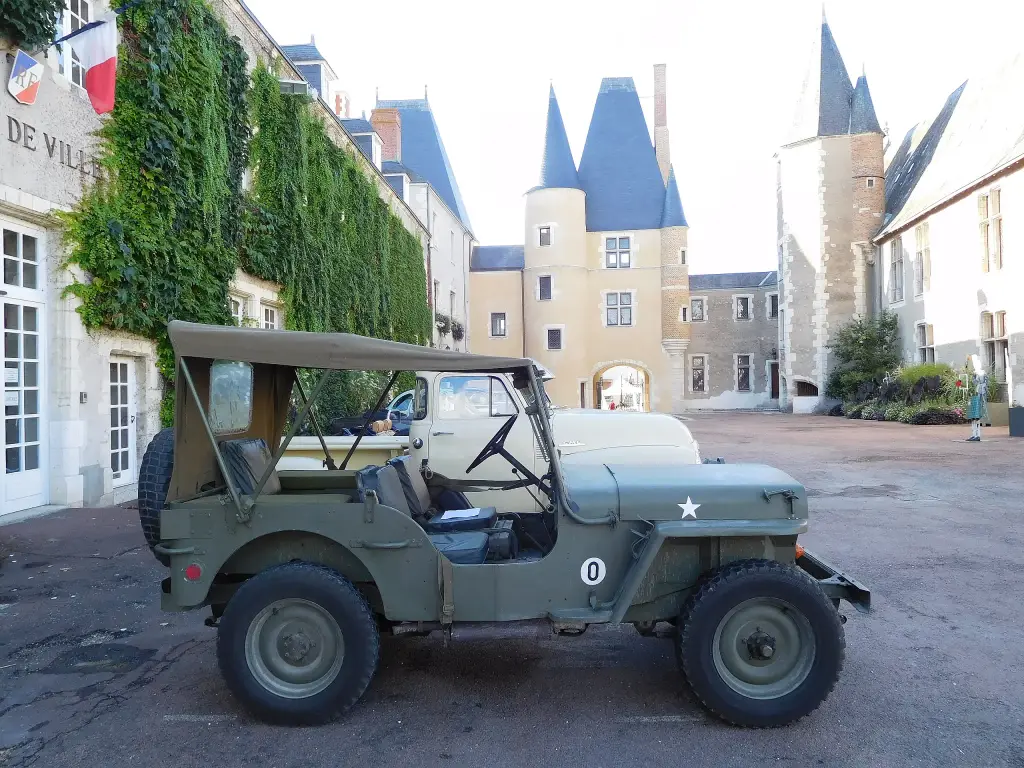
The Hotchkiss M201 was the light all-terrain vehicle of the French army from the late 1950s until the 1980s, and the last of them were retired only in 2000. It began in 1955 as a Second World War jeep built under Willys licence and was little changed when production ended in 1966. In France it was usually called simply «La Jeep».
Hotchkiss M201 at a glance
| Maker | Automobiles Hotchkiss, Stains, north of Paris |
|---|---|
| Production | 1955–1966 |
| Military class | VLTT, véhicule léger tout terrain |
| Engine | Willys Go Devil four-cylinder in-line, petrol |
| Power | 60 hp (44 kW) |
| Structure | light metal frame, two rigid axles on leaf springs |
| Drive | rear axle, front axle selectable |
| Gearbox | three speeds and reverse, plus a low crawler ratio |
| Body | no roof or doors, four seats, folding windscreen |
| Built | 27,628 by 1966 |
| In French service | until 2000 |
History of the Hotchkiss M201
From rebuilt jeeps to a French jeep
Directly after the Second World War the United States Army gave the French government 22,000 Willys Jeeps and Ford GPWs, but only about half were usable. In 1946 the E.R.G.M., the army’s motor vehicle reserve establishment, began rebuilding them at Maltournée in what is now Seine-Saint-Denis, breaking up the worst vehicles for spares and then assembling quasi-new jeeps from the surplus, a process that continued until 1978. From 1949 the army meant to replace them with the Delahaye VLR, but only 9,623 were built before Delahaye ran out of money in 1955 and its assets passed to Hotchkiss. Hotchkiss had supplied parts to the Maltournée operation and had built jeeps under Willys licence, including 70 CJ-3Bs for civilian buyers in 1954, so the army turned to it for a permanent supply.
Production at Stains
In 1955 Hotchkiss built 465 jeeps, sold as Hotchkiss Licence MBs; from 1956 the vehicle was called simply the M201. Military orders grew towards the end of the decade, with 2,696 delivered in 1959 alone, while the civilian market remained small: 366 examples of the civilian JH-101 in 1959 against 987 in 1958. In January 1961 the civilian version was homologated as the JH-102 with few obvious differences. For 1962 Hotchkiss offered the Peugeot Indenor diesel engine introduced in the Peugeot 403 in 1959; that year the army took 4,370 vehicles and civilian buyers only 269. By 1966, when production ended, 27,628 M201s had been built, mostly at Stains. Outside the army the jeeps were used chiefly in agriculture and forestry.
Thirty years of service
In 1981, with 8,000 jeeps still in use, the army decided to replace the M201 with the Peugeot P4, developed with Mercedes. Nearly two decades passed before the last M201 was taken out of French service in 2000. The vehicle was defined by the military as a VLTT, a light all-terrain vehicle, and standard examples served mostly as staff cars or radio cars.
Design and features
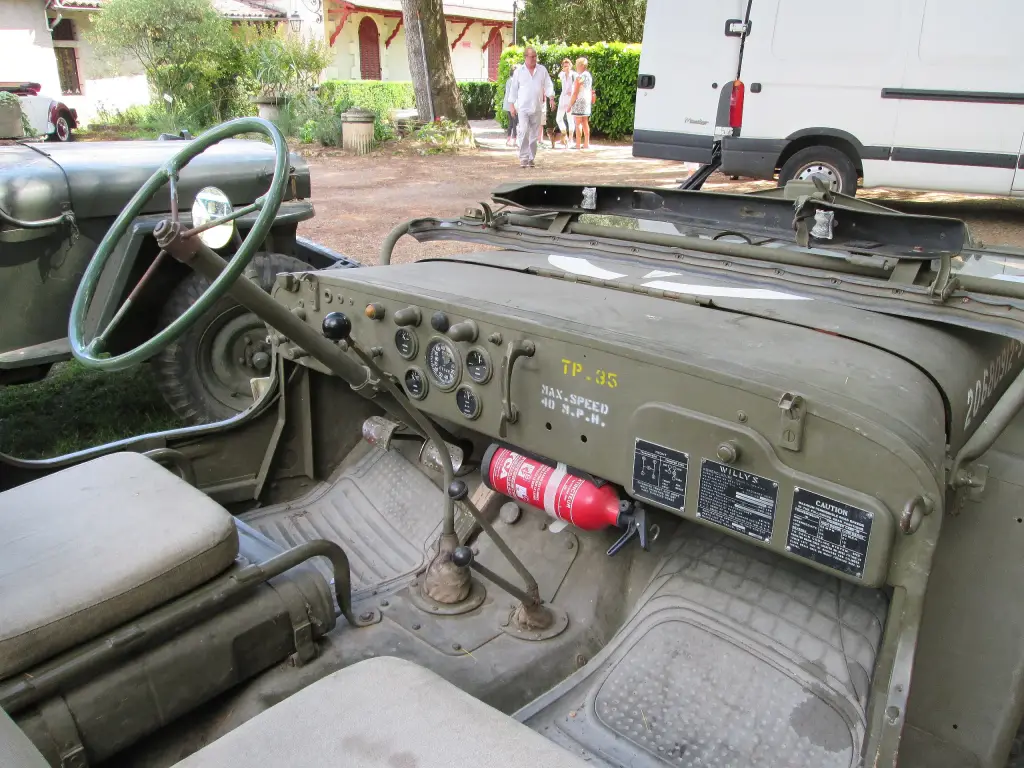
- Simple structure: a light metal frame with two rigid axles on leaf springs, and a gearbox beside the driver.
- Willys-derived engine: a modified Go Devil four rated at 60 hp.
- Real off-road gearing: rear-wheel drive on the road, selectable front drive and a crawler ratio for the rough, with no limited-slip differential but low weight.
- Open body: no roof or doors, four seats, a load area at the back and a windscreen that folded forward over the bonnet.
Hotchkiss M201 versions
- M201: the military vehicle, the standard version of the type.
- JH-101: the civilian version from 1955.
- JH-102: the civilian version homologated in January 1961.
- Diesel: from 1962 with the Peugeot Indenor engine.
- Sahara: a strengthened chassis, firmer rear springing, an extra toolbox under the grille and a second fuel tank under the passenger seat for North Africa.
- Special roles: launch vehicle for anti-tank guns or rockets, and some with surveillance radar dishes.
The M201 was the army’s light vehicle long before the Hotchkiss H38 tank had become a museum piece, and it kept the marque alive after car production stopped in 1954. More Hotchkiss vehicles are in the Hotchkiss collection.
Video: Willys Hotchkiss M 201
Video on YouTube.
Sources
- Hotchkiss M201, English Wikipedia: production, structure, service
- Hotchkiss M 201, Italian Wikipedia: licence history, end of production
- Hotchkiss, Italian Wikipedia: the Willys agreement and the company’s end