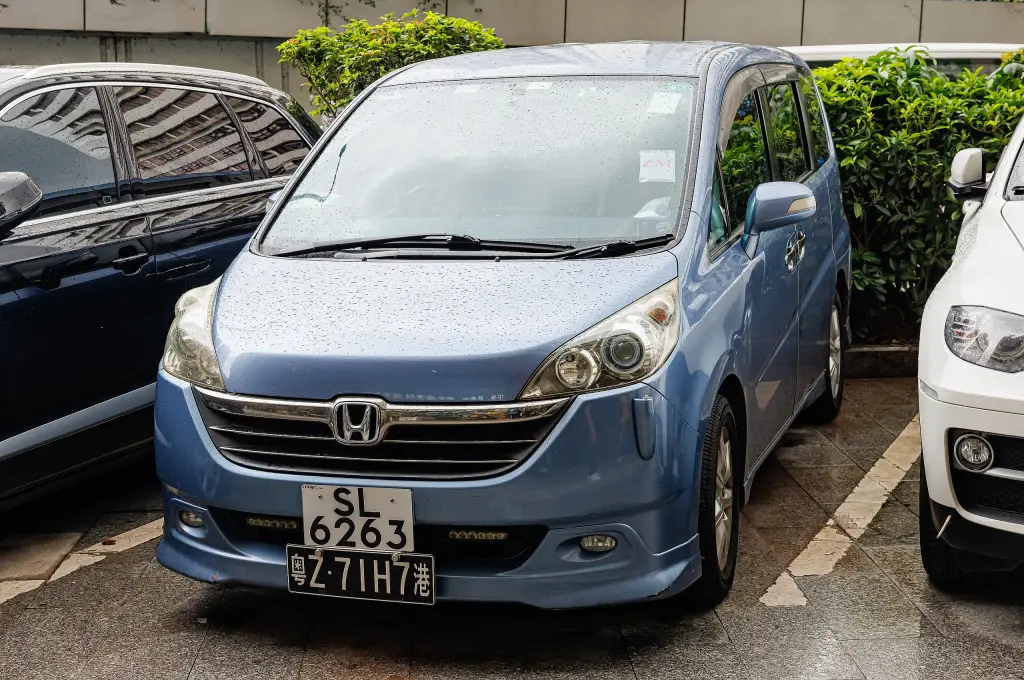
The Honda Stepwgn is a minivan produced by Honda since 1996. In contrast to the Odyssey and the Stream, it has a taller, more upright greenhouse and can seat eight people instead of seven. For its first two generations the car had one door on the driver’s side and two on the passenger’s side.
Honda Stepwgn at a glance
| Maker | Honda |
|---|---|
| Produced since | 1996 |
| Class | minivan |
| Seats | eight |
| First show car | F-MX, Tokyo Motor Show 1995 |
| Japanese sales | from 8 May 1996 |
| Base | Honda Civic, to reduce costs |
| First engine | 2.0-litre inline four |
| First gearbox | four-speed automatic |
| 1997 update | ABS and dual airbags standard |
| Doors, first two generations | one driver’s side, two passenger side |
| Dealer networks | Primo, Verno and Clio from 1997 |
Based on one source, the English Wikipedia article on the Stepwgn.
History of the Honda Stepwgn
A cheaper minivan

The first-generation Stepwgn appeared at the Tokyo Motor Show as the F-MX in 1995, and Japanese sales began on 8 May 1996. At the time most Japanese minivans had the engine mounted under the cabin; the Stepwgn used a more conventional two-box layout and was based on the Civic to reduce costs. The passenger side had a sliding door for easier access. To improve profitability Honda used further cost reductions, including only one engine and transmission option, a two-litre inline four and a four-speed automatic, and a design that reduced the use of steel panels and parts.
Updates and special versions
Changes for 1997 standardised ABS and dual SRS airbags across the range and added convenience features; Japanese models then went on sale in August 1997 through Honda’s Primo, Verno and Clio networks. The Stepwgn Almas, whose name comes from the Spanish alma, meaning heart or soul, had a second-row seat lift for elderly and physically handicapped passengers. The Stepwgn Field Deck of 1998, sold from January that year, had a pop-up observation tent and fibre-reinforced plastic body for outdoor leisure. A facelift in May 1999 altered the headlights and moved the rear licence plate down.
Second generation
A second generation followed in 2001, continuing the tall body and passenger-side door layout of the original.
Design and features
- Eight seats: one more than the Odyssey and Stream.
- Two-box layout: engine in front rather than under the cabin.
- Civic base: cost-saving platform sharing.
- Passenger-side sliding door: easy access from the kerb.
Honda Stepwgn versions
- Stepwgn (1996): the first generation.
- Stepwgn Almas (1997): with a second-row seat lift.
- Stepwgn Field Deck (1998): the outdoor version with a tent.
- 1999 facelift: revised lights and rear plate.
- Second generation (2001): the next model.
The Stepwgn is Honda’s largest people carrier above the Odyssey and Stream, and shares its platform thinking with the Civic. More Hondas are in the Honda collection.
Sources
- Honda Stepwgn, English Wikipedia: launch, layout, updates, special versions