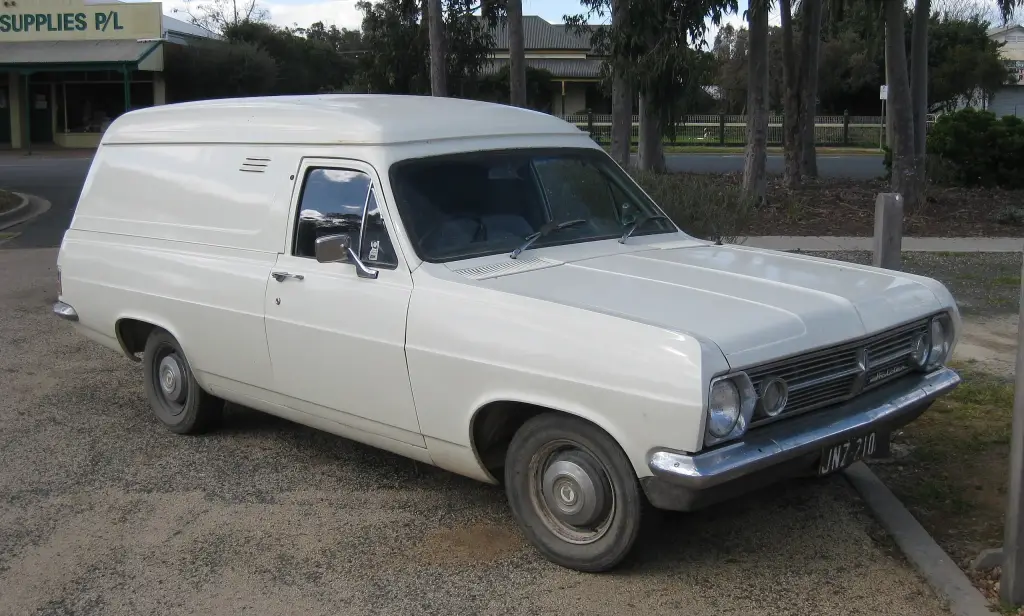
The Holden panel van was the closed-body load carrier sold alongside the Holden utility. It shared the utility’s front sheet metal, chassis and engines, but carried a boxed rear body instead of an open load tray, and it was part of the Holden commercial range from the 1950s until the 1980s.
Holden panel van at a glance
| Maker | Holden, Australia |
|---|---|
| Type | closed-body commercial vehicle, based on the Holden utility |
| Utility range | Holden Utility built from 1951 to 2000 |
| Early vans | sold alongside the grey-motor utilities of the 1950s |
| Sandman | sports-oriented utility and panel van, 1974–1980 |
| One Tonner | cab chassis utility built 1971–1984 |
| Utility generations | 50-2106, FJ, FE, FC, FB, EK, EJ, EH, HD, HR, HK, HG, HT, HQ, HJ, HX, HZ, WB |
| Return in 1990 | Holden Utility (VG), based on the VN Commodore |
| Replaced by | Holden Ute, from 2000 |
The panel van is covered only briefly in the English Wikipedia article on the Holden Utility, which is the source used here. Based on one source.
History of the Holden panel van
Part of the utility family
Holden’s panel van was never a separate platform. It was built on the same commercial line as the Holden utility, a coupé utility that Holden produced from 1951 to 2000, and it used the same front bodywork, chassis and engines. The first Holden utility was the 50-2106 of 1951, based on the 48-215, with a 2.1-litre grey six producing 45 kW (60 hp), a three-speed manual gearbox, 9-inch drum brakes and a payload of 356 kg. The van followed the same model cycles as the utes through the FJ, FE, FC, FB, EK, EJ, EH, HD and HR series.
The commercial range also included the One Tonner, a cab chassis derivative introduced in 1971 with a payload of over 1,016 kg, and sold alongside the utilities into 1984.
The Sandman
The best known panel van of the range was the Holden Sandman, produced from 1974 to 1980 as a sports-oriented vehicle in both panel van and utility variants. It turned the load carrier into a lifestyle vehicle, a role the van body suited because the boxed rear could be fitted out rather than loaded with goods.
Later vans
The last of the traditional panel vans went with the end of the HZ series in 1980, when the Kingswood passenger range and the Kingswood panel van were dropped in favour of the smaller Commodore. When Holden restarted utility production in 1990 with the VG based on the VN Commodore, the range again consisted of utilities rather than vans, and it continued through the VP of 1992, the VR of 1993 and the VS of 1995 to 2000 before the Holden Ute took over in 2000. In South Africa the Holden utility was sold as the Chevrolet El Camino from 1968 to 1978 and the One Tonner as the Chevrolet El Toro.
Design and features
- Closed body: the same front end as the utility, with a boxed load area behind.
- Shared engines: grey sixes in the 1950s, red sixes and Holden V8s later.
- Sandman trim: a sports-oriented panel van and utility from 1974 to 1980.
- Long model run: the van followed the utility through every series from the 1950s to 1980.
Holden panel van versions
- Early panel vans: the grey-motor vans of the 1950s and early 1960s.
- Sandman (1974–1980): the sports panel van and utility.
- One Tonner (1971–1984): the cab chassis load carrier of the same range.
- Later utilities (1990–2000): VG, VP, VR and VS, without a van body.
The panel van belonged to the Holden Ute family and shared its range with the Holden Kingswood commercials. More cars are in the Holden collection.
Video: Supercharged L98 Holden Panel Van smokes up
Video by Fullboost on YouTube.
Sources
- Holden Utility, English Wikipedia: utility range, Sandman, One Tonner, exports