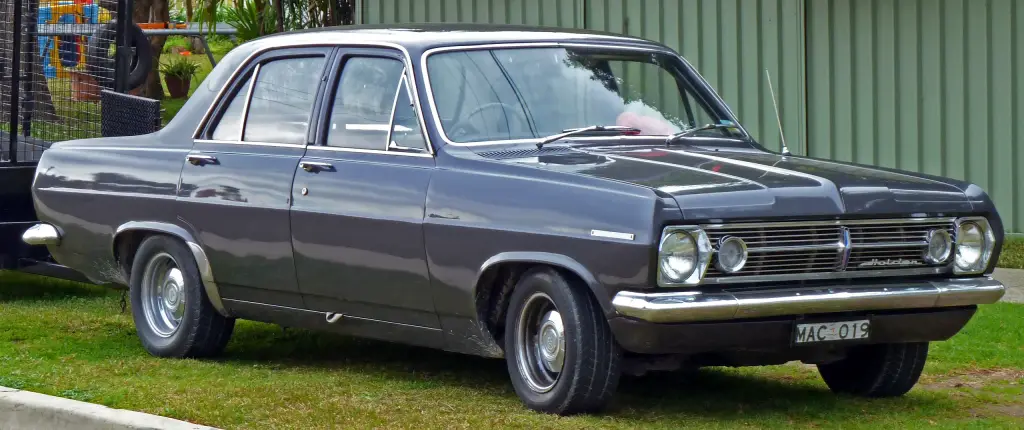
The Holden HR was manufactured in Australia from April 1966 until January 1968, replacing the Holden HD. It combined a restyled body and revised suspension with a safety upgrade that made front seat belts, windscreen washers and reversing lights standard across the range.
Holden HR at a glance
| Maker | Holden, Australia |
|---|---|
| Production | April 1966 – January 1968 |
| Replaced | Holden HD |
| Replaced by | Holden HK |
| Body changes | reworked roofline, larger rear window, revised tail lights |
| Chassis | revised ball joint front suspension, wider track |
| Six-cylinder engines | 161 cu in (2.6 L) 114 bhp and 186 cu in (3.0 L) 126 bhp |
| Optional engine | 145 bhp X2 twin carburettor, 186S from June 1967 |
| Compression | 9.2:1, with a low-compression 8.2:1 option |
| Gearboxes | three-speed column manual, two-speed Powerglide, Opel four-speed from 1967 |
| Prices at launch | A$2286 Special sedan, A$2856 Premier wagon |
| Built | 252,352 |
No free photographs of the Holden HR were found for this page. Based on one source.
History of the Holden HR
New shape, better suspension
The HR was released in April 1966 as the replacement for the HD. Besides a revised grille it had a reworked roofline and a larger rear window on the sedans, revised tail lights on sedans and wagons, and changes to almost every exterior body panel. Underneath there was a revised ball joint front suspension and a wider track, while inside the trim was improved and Premier models gained a woodgrain finish.
The safety upgrade
Six months after the launch, all models received a safety upgrade with front seat belts, windscreen washers, reversing lights, padded sun visors and a shatterproof interior rear-view mirror.
Models and engines
The passenger range offered four-door sedans and five-door station wagons in three trim levels: the Standard Sedan (HR 215), Standard Station Sedan (HR 219), Special Sedan (HR 225), Special Station Sedan (HR 229), Premier Sedan (HR 235) and Premier Station Sedan (HR 239). The commercials were a two-door coupé utility (HR 2106) and a two-door panel van (HR 2104).
The two versions of the inline six-cylinder red motor came across from the HD with more capacity and a higher 9.2:1 compression ratio. The 114 bhp 161 cu in (2.6 L) six was standard in all models except the Premiers, and the 126 bhp 186 cu in (3.0 L) six was standard on Premiers and optional elsewhere. A 145 bhp twin-carburettor X2 version of the 186 was initially optional on all models and was replaced by the 145 bhp 186S in June 1967 after Holden used up the remaining X2 intake manifolds; the new engine had a single two-barrel carburettor. A lower-compression 8.2:1 version of the 161 was also offered.
Gearboxes, exports and the end
A three-speed column-change manual with synchromesh on the top two gears was standard, a two-speed Powerglide automatic was optional, and an Opel four-speed manual was offered from June 1967. For South Africa the car was fitted with the longer Chevrolet 194 cu in (3.2 L) and later 230 cu in (3.8 L) six, which required the firewall to be scalloped out; that engine came with a fully synchronised column-shift three-speed manual from Opel in West Germany, and the South African Holden Special had power front disc brakes from 1967.
A total of 252,352 vehicles were produced before the HR was replaced by the Holden HK in January 1968. The HR was also the first Holden assembled at General Motors New Zealand’s new Trentham plant in 1967.
Design and features
- Restyled body: new roofline, larger rear window and new tail lamps.
- Ball joint suspension: revised front suspension with a wider track.
- Safety equipment: belts, washers and reversing lights became standard in late 1966.
- X2 and 186S: twin-carburettor performance options of 145 bhp.
- South African six: Chevrolet 194 and 230 engines with a scalloped firewall.
Holden HR versions
- Standard Sedan and Station Sedan (HR 215, 219): the base models with the 161 six.
- Special Sedan and Station Sedan (HR 225, 229): the mid-range pair.
- Premier Sedan and Station Sedan (HR 235, 239): woodgrain trim and the 186 six.
- Utility (HR 2106) and Panel Van (HR 2104): the two commercial bodies.
- X2 and 186S: the 145 bhp twin-carburettor option and its single-carburettor successor.
The HR came between the Holden EH era and the larger Holden Kingswood that followed the HK. More cars are in the Holden collection.
Video: Turbo LS1 HR Holden
Video by STREET MACHINE on YouTube.
Sources
- Holden HR, English Wikipedia: models, engines, safety update, exports