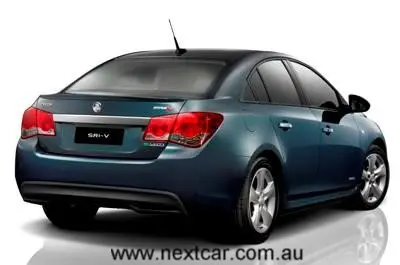
The name Holden Cruze covered two quite different cars. The first, sold in Australia from 2002 to 2006, was a small high-riding vehicle derived from the Suzuki Ignis. The second, sold from 2009 to 2016, was General Motors’ global compact car, developed mainly by GM Korea, and it replaced the Holden Astra in the small-car slot of the range.
Holden Cruze at a glance
| Maker | Holden for the first car, GM Korea for the second |
|---|---|
| First Holden Cruze | 2002–2006, based on the Suzuki Ignis |
| First car engines | 1.3 or 1.5-litre, five-speed manual or four-speed automatic |
| First car drive | front-wheel drive, all-wheel drive optional |
| Concept | Chevrolet YGM1, Tokyo Motor Show 1999, engineered by Holden |
| Second Holden Cruze | 2009–2016 |
| Internal code | J300 |
| Platform | GM Delta II, front-wheel drive |
| Body styles | four-door sedan, five-door hatchback from 2011 |
| Hatchback design | by Holden in Australia |
| Replaced | Holden Astra |
| Renamed | Holden Astra Sedan in 2016 |
No free photographs of the Holden Cruze were found for this page. Based on one source.
History of the Holden Cruze
The first Cruze: a Suzuki in disguise
General Motors first used the Cruze name between 2001 and 2008 in Japan, Australia and New Zealand. Announced as the Chevrolet YGM1 concept at the Tokyo Motor Show in 1999, that car was derived from the subcompact Suzuki Ignis five-door hatchback. Despite the Chevrolet badge the styling and most of the engineering were the work of GM’s Australian arm, Holden, which also came up with the nameplate. It came with a 1.3 or 1.5-litre engine and a five-speed manual or four-speed automatic, with front-wheel drive standard and all-wheel drive optional. The production car was revealed in October 2001 and built by Suzuki in Japan; it was sold in Australia as a Holden and in New Zealand as a Chevrolet from 2002 to 2006. Chevrolet marketed the high-riding car as a light-duty SUV, while Suzuki sold the same vehicle as an ordinary passenger model.
The second Cruze: a global compact
In 2008 GM introduced the compact Cruze, internally the J300, developed mainly by GM Korea and intended to replace the Chevrolet Cobalt, the Daewoo Lacetti and the Holden Astra. It was built on the front-wheel drive Delta II platform, with a global design and engineering team in which GM Daewoo in South Korea played the leading role alongside Opel in Germany. The programme ran for 27 months at a cost of US$4 billion and 221 prototypes were tested in Australia, Canada, China, South Korea, Sweden, the United Kingdom and the United States.
The body structure was 65 percent high-strength steel, with MacPherson struts at the front and a torsion beam rear axle instead of the more costly multi-link layout of some rivals. Steering was rack and pinion with a 10.9-metre turning circle, and the brakes used ventilated front and solid rear discs. Noise and vibration work included an isolated four-point engine mount, sound damping in the dashboard, luggage compartment, decklid, doors, carpet and headlining, and a triple-layer door sealing system.
The hatchback and the end
A five-door Cruze hatchback appeared as a concept at the Paris Motor Show in October 2010 and went on sale in Europe in mid-2011; Holden in Australia was responsible for its design and development. In Australasia the Cruze was sold as a Holden between 2009 and 2016. In 2016 the sedan was restyled and renamed the Holden Astra Sedan for that market, and when production in South Korea ended in 2018 GM Korea also stopped supplying that car.
Design and features
- Two separate cars: a Suzuki-based light vehicle from 2002 and a GM global compact from 2009.
- Holden engineering: the first car’s styling and most of its engineering came from Holden.
- Delta II platform: front-wheel drive with MacPherson struts and a torsion beam rear axle.
- Australian hatchback: the five-door body was designed and developed by Holden.
- High-strength steel: 65 percent of the J300 body structure.
Holden Cruze versions
- Holden Cruze (2002–2006): Suzuki Ignis-based, 1.3 or 1.5-litre engines.
- Cruze sedan (2009–2016): the J300 compact with four doors.
- Cruze hatchback (from 2011): five-door body developed by Holden.
- Holden Astra Sedan (2016): the restyled Cruze sedan under a new name.
The Cruze replaced the Holden Astra in the small-car range below the Holden Commodore. More cars are in the Holden collection.
Sources
- Chevrolet Cruze, English Wikipedia: both Holden-badged cars, engineering, dates