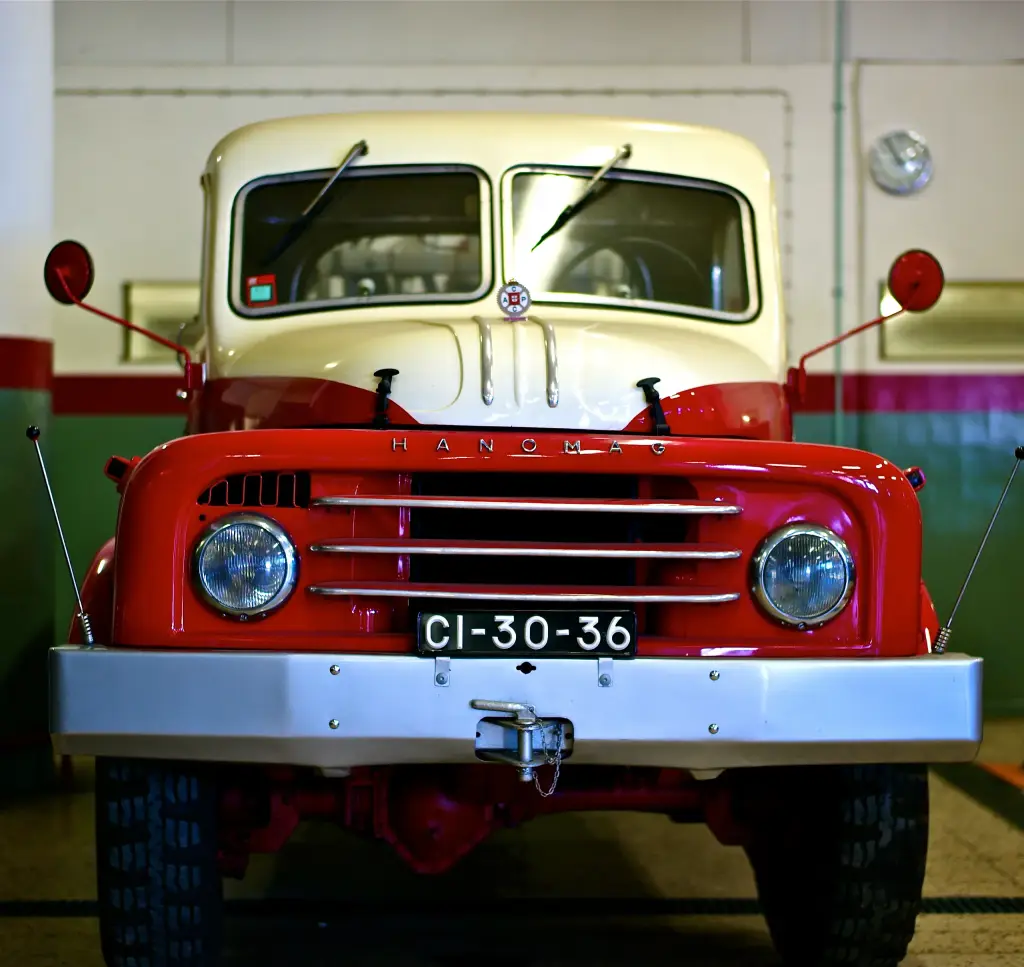
The Hanomag L 28 was the first completely new commercial vehicle Hanomag developed after the Second World War. Launched in 1950, the light truck with its American-style alligator hood helped to get West German transport moving again, and its all-wheel-drive derivative, the A-L 28, stayed in production until 1971.
Hanomag L 28 at a glance
| Maker | Hanomag, Hanover |
|---|---|
| Production | 1950–1960 (L 28); 1953–1971 (A-L 28) |
| Class | light truck |
| Payload | 1.5–3 tonnes |
| Engine | 2.8-litre four-cylinder diesel, 50–70 PS |
| Supercharger | Roots blower from 1953 |
| Gearbox | ZF four-speed (A-L 28) |
| Top speed | 72 km/h (A-L 28) |
| Bodies | platform, panel van, box body, minibus |
| Built | about 6,000 A-L 28 |
History of the Hanomag L 28
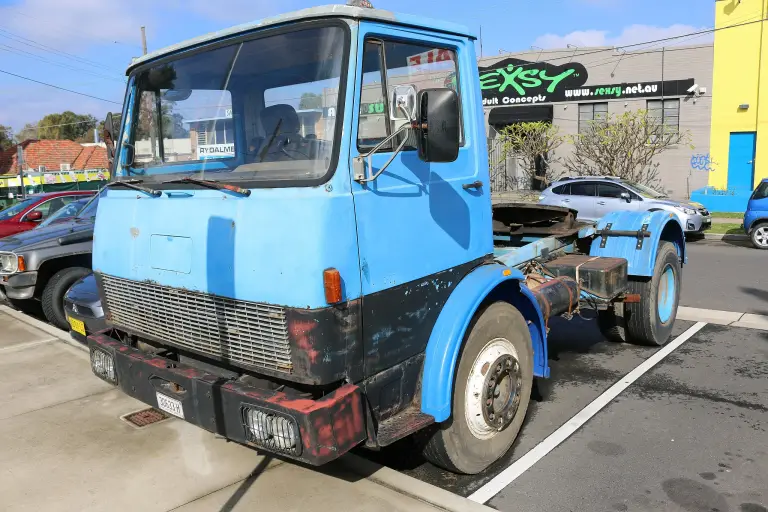
The L 28 appeared in 1950 as a modern long-hood truck with a so-called alligator hood modelled on American practice and headlights integrated into the front rather than standing free, which gave it a modern appearance for the time. Similar styling soon appeared on the Opel Blitz (1952) and Borgward B 1500 (1954). The truck was designed at first for 1.5 tonnes of payload; over the years versions for 2, 2.5 and 3 tonnes followed, and in 1956 a 1.75-tonner replaced the 1.5- and 2-tonne models. The whole range was powered by Hanomag diesels of initially 50 PS, with 65 and 70 PS units for the larger models. Platform trucks, closed panel vans and separate box bodies were common, and a minibus version with bodywork from outside coachbuilders was also available.
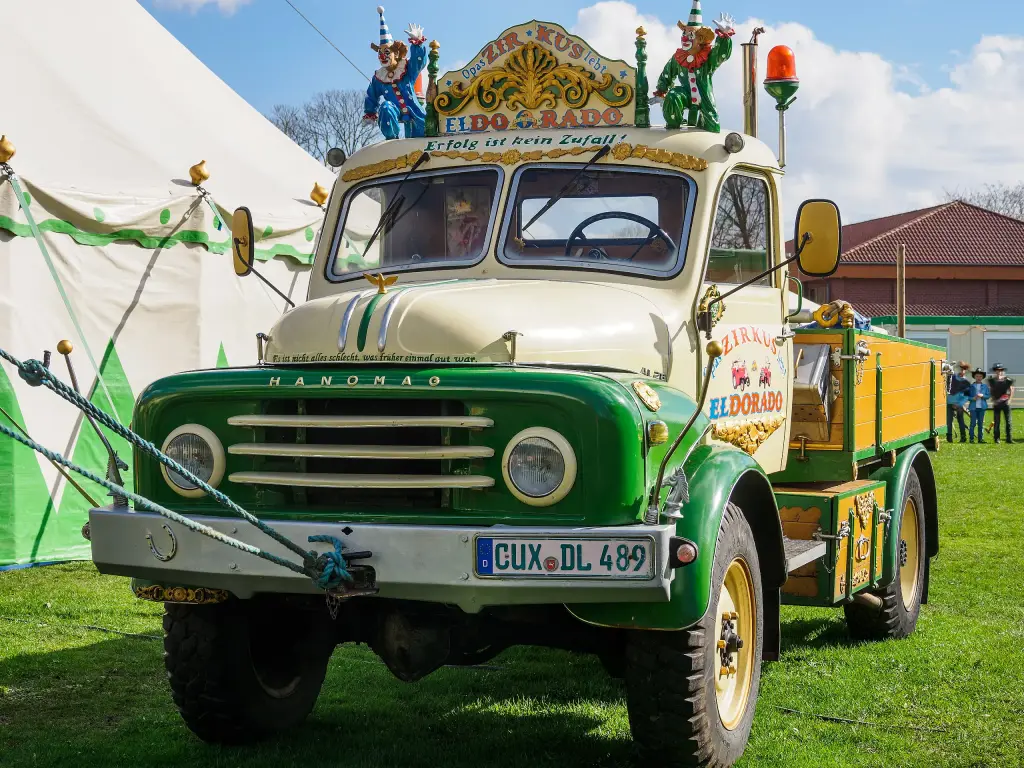
The water-cooled inline four-cylinder diesel of 2.8 litres received a Roots supercharger driven by a V-belt in 1953. The sound of the Hanomag D-28 engines was known for its striking diesel nailing and the singing of the blower. In 1955 the cab received front-hinged instead of rear-hinged doors, and in its last years a large curved panoramic windscreen that made the cab look much more modern. Between 1958 and 1960 the L 28 was gradually replaced by the forward-control Kurier, Garant and Markant, named according to weight.
In 1958, after Rheinstahl had taken over Hanomag, the new company Rheinstahl-Hanomag built a technically independent derivative of the rear-wheel-drive L 28: the all-wheel-drive A-L 28. It used parts of the L 28, the 65 and 70 PS Hanomag diesels, the cab and the front panel, but sat much higher and looked compact. It was built with platform bodies and above all with open and closed box bodies as radio, command, equipment and personnel vehicles, and was bought in large numbers by the Bundesgrenzschutz, the riot police and relief organisations such as the THW; with some of them it remained in service until 2014. Only a few went to civilian buyers. The type stayed in the programme until 1971, eleven years longer than the rear-wheel-drive L 28, and received a new, wider hood in 1964. Many were later converted into off-road motorhomes.
The A-L 28 came in 1.5- and 2.5-tonne versions, as the civilian A-L 28 Z and as an all-wheel-drive group vehicle. About 6,000 were built between 1953 and 1971, with a peak of 1,657 vehicles in 1963. It used the 2.8-litre diesel of the 3-tonne L 28, rated at 70 PS at 2,800 rpm, and a ZF four-speed gearbox (AKS-25) with a countershaft and simultaneous engagement of the front-wheel drive. Second and third gears were synchronized. With an empty weight of 3,860 kg the top speed was 72 km/h and the climbing ability 69 per cent; the brakes were a hydraulically operated dual-circuit system with air assistance, one circuit on the front axle and one at the rear. The vehicles ran on single tyres or, at the rear, twin tyres.
On 1 April 1969 the commercial-vehicle divisions of Hanomag and Henschel-Werke merged into Hanomag-Henschel Fahrzeugwerke GmbH within the Rheinstahl group. Daimler-Benz acquired 51 per cent and the rest of the capital at the end of 1970. The last A-L 28 were built under the Hanomag-Henschel name, and in 1974 the brand disappeared from the truck market. On film, an L 28 plays a major role in the 1993 German road movie Wir können auch anders …, and an A-L 28 appears in the 2018 short film CHAINED.
Design and features
- Alligator hood: American-inspired styling with headlights integrated into the front.
- 2.8-litre diesel: 50 to 70 PS, supercharged by a Roots blower from 1953.
- Wide payload range: from 1.5 to 3 tonnes, with a 1.75-tonner added in 1956.
- Modern cab updates: front-hinged doors from 1955 and a panoramic windscreen later.
- A-L 28 all-wheel drive: a high-riding derivative bought by police and relief services.
Hanomag L 28 versions
- L 28 (1950): the rear-wheel-drive light truck with 1.5 to 3 tonnes payload.
- 1.75-tonner (1956): replaced the 1.5- and 2-tonne versions.
- A-L 28 (1953): the all-wheel-drive derivative with 65 and 70 PS diesels.
- A-L 28 Z: the civilian version of the all-wheel-drive truck.
- A-L 28 group vehicle: radio, command, equipment and personnel bodies for the authorities.
- Minibus: a passenger version with bodywork from outside coachbuilders.
The L 28 was replaced by the Kurier, Garant and Markant, and its later relatives carried the Hanomag-Henschel name. The F-series continued the light-truck line. More models are in the Hanomag collection.
Video: Hanomag L28, 1959, 2,2t
Video by Miniworkshop on YouTube.
Sources
- Hanomag L 28, English Wikipedia: launch, payloads, engines, A-L 28 design
- Hanomag L 28, German Wikipedia: cab changes, A-L 28 history, production figures