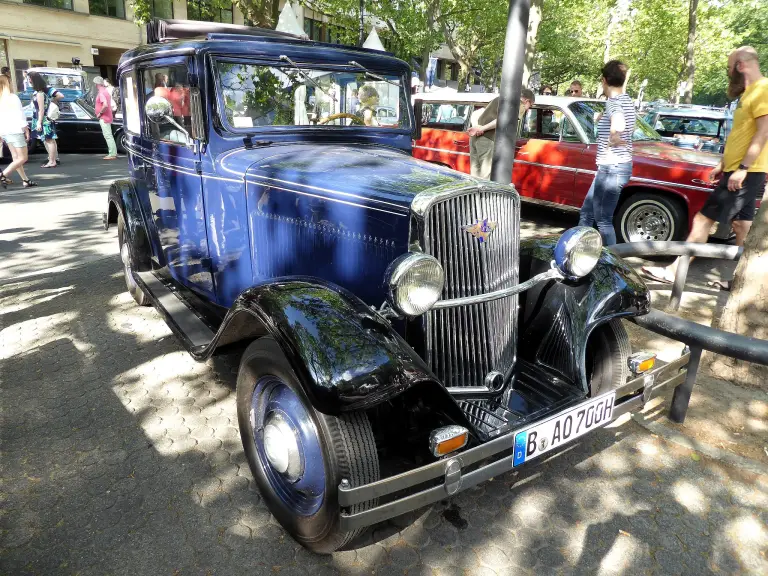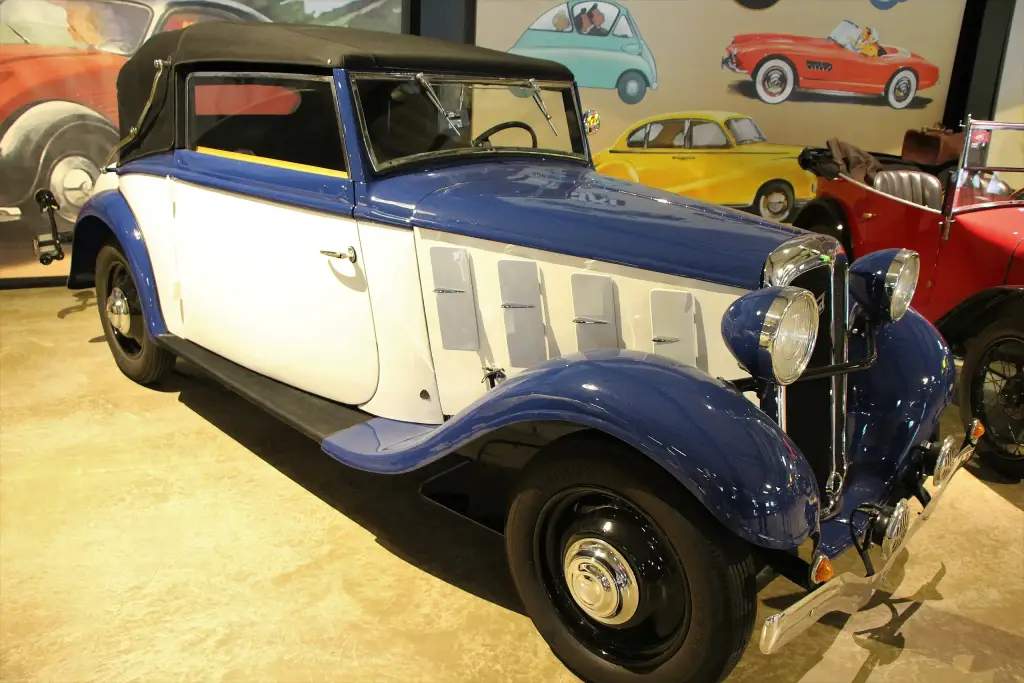
The Hanomag Rekord was Hanomag’s first mid-size car, produced in Hanover from 1933 until 1940. It was one of the first mass-produced cars available with a diesel engine, and its streamlined diesel record car of 1939 showed what the small oil engine could do.
Hanomag Rekord at a glance
| Maker | Hanomag, Hanover |
|---|---|
| Production | 1933–1940 |
| Class | mid-size car |
| First shown | autumn 1933 as the 6/32 PS |
| Named Rekord | February 1934 |
| Petrol engine | 1.5-litre four-cylinder, 32–35 PS |
| Diesel engine | 1.9-litre four-cylinder, 35 PS |
| Gearbox | four-speed ZF |
| Top speed | about 100 km/h |
| Bodywork | Ambi-Budd “Jupiter” all-steel |
| Built | 19,104 |
History of the Hanomag Rekord
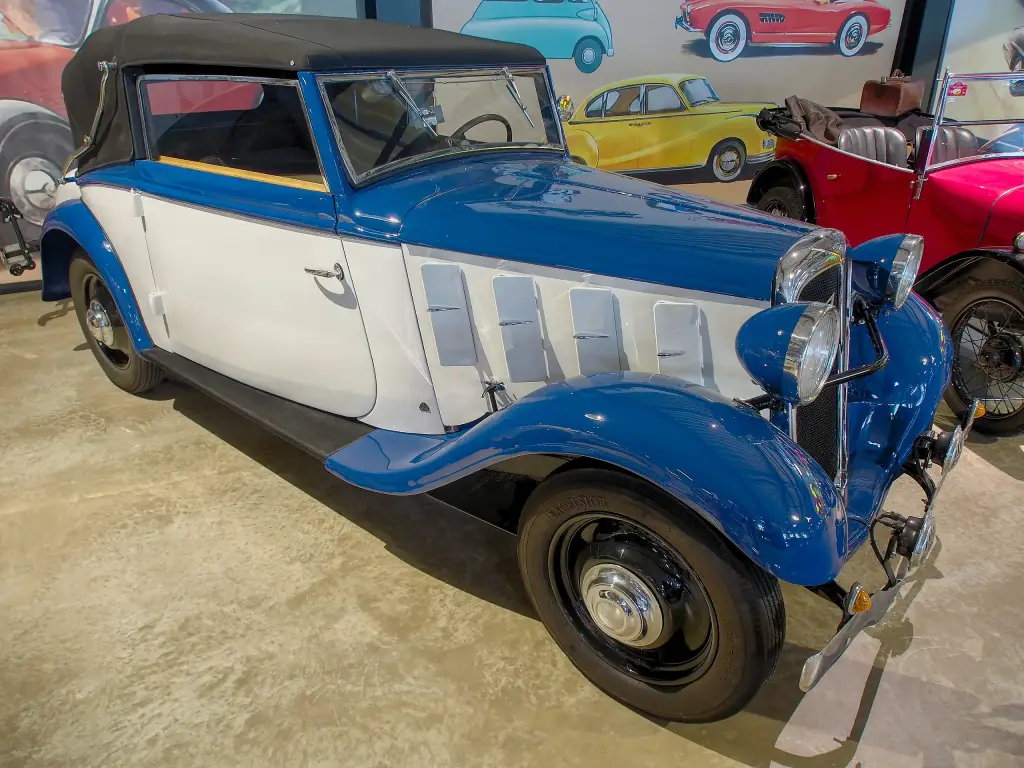
The Rekord was Hanomag’s first mid-size car, positioned between the smaller Hanomag Garant and the larger Hanomag Sturm. It was introduced quietly in autumn 1933 as the 6/32 PS intermediate model, of which 1,251 were built by 1934. When Hanomag changed from tax-horsepower designations to model names in early 1934, the car was officially presented as the Rekord in February 1934. Compared with the 6/32 PS it had a slightly longer wheelbase, independent front suspension and a proper cooling water pump instead of the earlier thermosiphon system. Unusually for Hanomag, it was offered as a four-door saloon with or without a B-pillar.
In February 1936 Hanomag announced a diesel version at the Berlin motor show, at the same time as the Mercedes-Benz 260 D; it was thus among the first series-production passenger cars with a diesel engine, although unlike the Mercedes it was not immediately available. The prototype engine, designed by Lazar Schargorodsky, displaced 1,634 cc and produced 32 PS; the production version had an 80 mm bore, 1.9 litres, a gear-driven camshaft and 35 PS. Series production began in 1938. A six-cylinder prototype was built but not put into production. The four-door diesel saloon cost 4,875 Reichsmark. Sources differ on the number built: about 2,500 according to Norbye, 1,097 according to Polaschek, while the German Wikipedia gives 1,074 for the later Typ 19 K.
For 1937 the Rekord received a facelift with a “streamlined” rear, perforated rims, a fuel tank moved from the engine compartment to the back and enlarged from 32 to 54 litres, and a higher compression ratio. Power of the petrol engine rose from 32 PS at 3,000 rpm to 35 PS at 3,500 rpm, but the car remained ponderous and slow with a top speed of about 100 km/h. Total production of the petrol-engined Rekord came to 18,114 cars; with the diesel versions Hanomag built 19,104 Rekords.
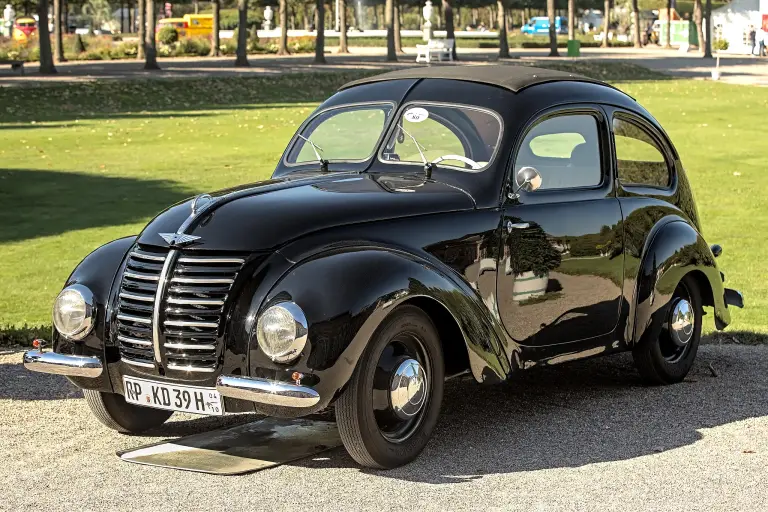
In 1938 Hanomag built the “Hanomag-Diesel-Stromlinien-Sportwagen” with an aerodynamically optimised aluminium body designed by Járay Pál and built by Wendler in Reutlingen. Its engine was tuned to 40 PS. On 8 and 9 February 1939 the Hanomag engineer Karl Haeberle drove it on the Dessau–Bitterfeld autobahn at an average of 155.954 km/h and a top speed of 165 km/h; the German Wikipedia credits the driver Karl Häberle with four world records. The car was destroyed in the war and a replica was built in 2013 from photographs and drawings.
Design and features
- First Hanomag mid-size car: the Rekord sat between the Garant and the Sturm.
- Early diesel option: a 1.9-litre four-cylinder diesel announced in 1936, among the first in a production car.
- Jupiter bodywork: all-steel bodies by Ambi-Budd in saloon, coupé, cabriolet and tourer forms.
- Independent front suspension: a transverse leaf spring and single upper wishbones per wheel.
- Diesel record car: a 40 PS streamlined car averaged 155.954 km/h in February 1939.
Hanomag Rekord versions
- 6/32 PS (Typ 15), 1933–1934: the intermediate model that preceded the Rekord name.
- Rekord (Typ 15 K), 1934–1936: the first car to carry the Rekord name, 32 PS.
- Rekord facelift (Typ 15 K), 1937–1938: streamlined rear, 35 PS, larger fuel tank.
- Rekord Diesel (Typ D 19 A), 1937–1938: the 1.9-litre diesel, 35 PS.
- Diesel (Typ 19 K), 1938–1940: the renamed diesel model, the last Rekords built.
The Rekord was the larger stablemate of the Garant and was replaced in the range by the 1,3 Liter. More models are in the Hanomag collection.
Sources
- Hanomag Rekord, English Wikipedia: models, diesel history, record car, chassis
- Hanomag Rekord, German Wikipedia: production figures, 6/32 PS, diesel details