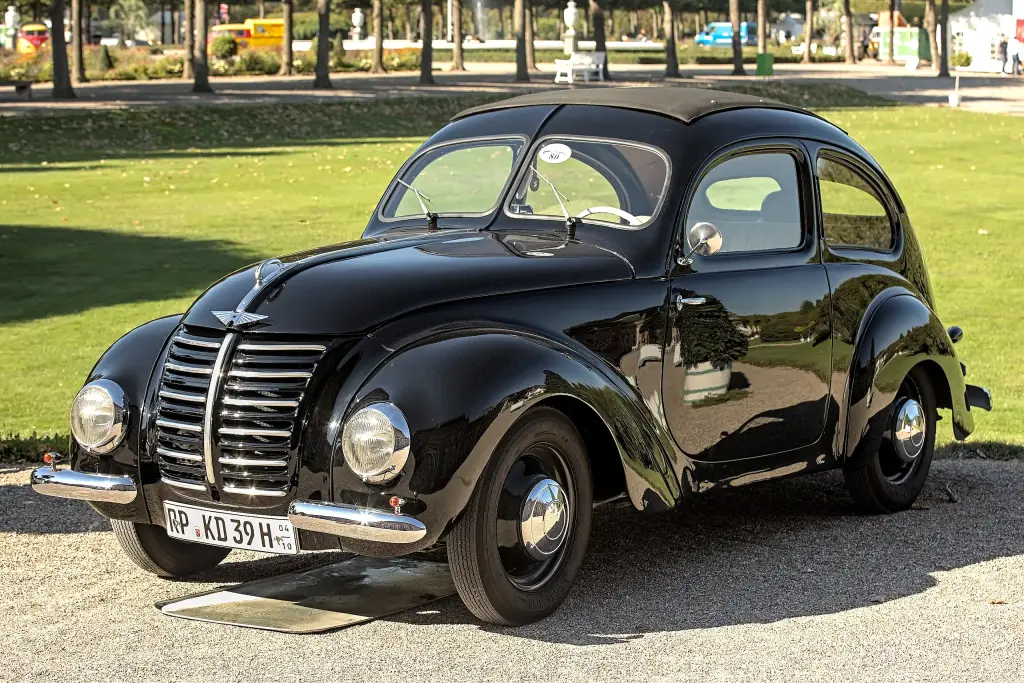
The Hanomag 1,3 Liter was a small family car introduced in spring 1939 as the successor to the Hanomag Garant and Kurier. Its streamlined all-steel unitary body and 100 km/h cruising speed made it one of the more advanced small cars in Germany on the eve of the Second World War.
Hanomag 1,3 Liter at a glance
| Maker | Hanomag, Hanover |
|---|---|
| Production | 1939–1941 |
| Predecessors | Hanomag Garant and Kurier |
| Engine | 1.3-litre four-cylinder OHV, 32 PS |
| Gearbox | four-speed, fully synchronized |
| Top speed | 100 km/h continuous |
| Body | two-door saloon, all-steel unitary |
| Price | 3,175 Reichsmark |
| Fuel tank | 35 litres |
| Range | over 400 km |
| Built | 9,187 |
Based on one source: the German Wikipedia article on the Hanomag 1,3 Liter.
History of the Hanomag 1,3 Liter
Hanomag presented the 1,3 Liter in spring 1939 as the replacement for its Garant and Kurier models. The car was a two-door saloon with a self-supporting all-steel body in streamlined form; from the A-pillars backwards it resembled the Volkswagen Beetle, although the front was considerably longer, which distinguished it in side view. Because of a crease pressed into the roof, the public nicknamed it “Stahlhelm” — steel helmet.
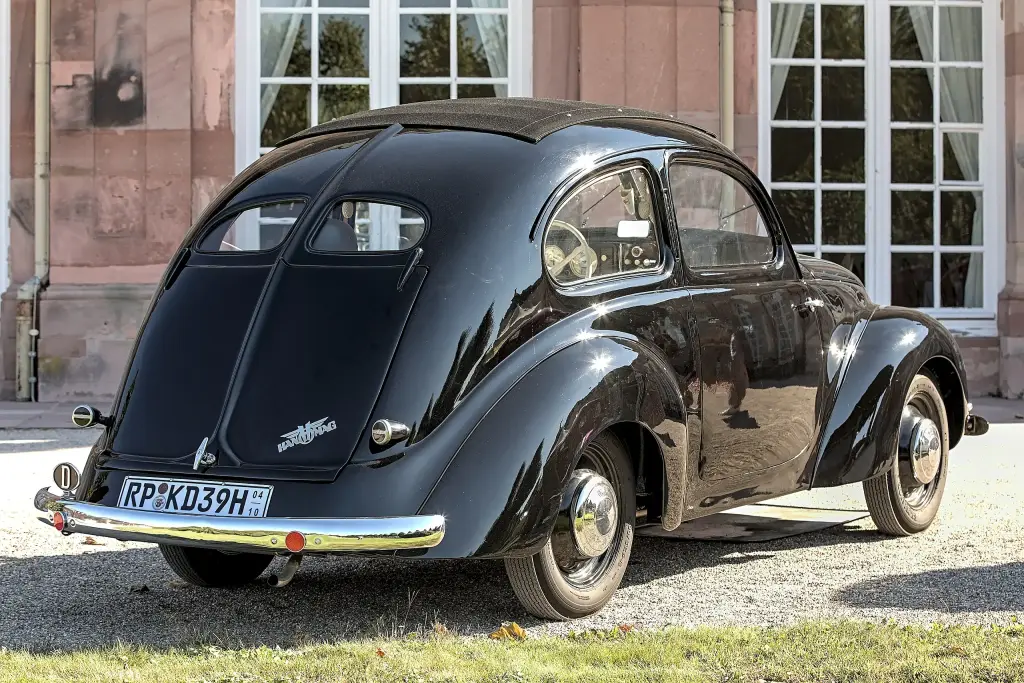
The engine was a front-mounted four-cylinder OHV unit of 1.3 litres producing 32 PS. Power went to the rear wheels through a fully synchronized four-speed gearbox with the gear lever on the transmission tunnel. At a continuous speed of 100 km/h the car was considered “autobahnfest” — fit for the motorway. The front wheels were individually suspended on rubber torsion elements, the rigid rear axle hung on semi-elliptic longitudinal leaf springs, and the brakes were hydraulic. A central lubrication system was operated by a foot pedal at prescribed mileage intervals.
Only one body style was offered: a two-door saloon with rear-hinged doors at 3,175 Reichsmark. The windows had crank drives, the 35-litre tank allowed a range of more than 400 kilometres on 72-octane fuel, and the boot — accessible from outside with a hydraulically held lid — carried the spare wheel, a comfort feature that rivals such as the Opel Olympia did not offer.
Production ended with the war in 1941 after 9,187 cars. It could not be restarted afterwards because the metal presses were in the Soviet occupation zone. The planned successor, the Hanomag Partner shown at the 1951 Frankfurt show — a three-cylinder two-stroke coupé with front-wheel drive — never reached series production. Volvo bought a 1,3 Liter to study its unitary body and drew on it for the Volvo PV 444.
Design and features
- Streamlined unitary body: a self-supporting all-steel shell with a Beetle-like rear and a much longer front.
- 32 PS 1.3-litre engine: enough for a 100 km/h continuous speed, which made the car “autobahnfest”.
- Fully synchronized gearbox: a four-speed unit with the lever on the transmission tunnel.
- External boot: a hydraulically held lid with the spare wheel inside.
- Central lubrication: operated by a foot pedal at prescribed intervals.
Hanomag 1,3 Liter versions
- 1,3 Liter Limousine (1939–1941): the only production body, a two-door saloon with rear-hinged doors.
- Stahlhelm: the public nickname for the roof crease, not a separate version.
- Hanomag Partner (1951): the planned successor, a three-cylinder two-stroke coupé shown at the IAA that never entered production.
The 1,3 Liter replaced the Garant and Kurier, and the larger Rekord was its stablemate in the Hanomag range. More models are in the Hanomag collection.
Sources
- Hanomag 1,3 Liter, German Wikipedia: design, engine, equipment, price, production