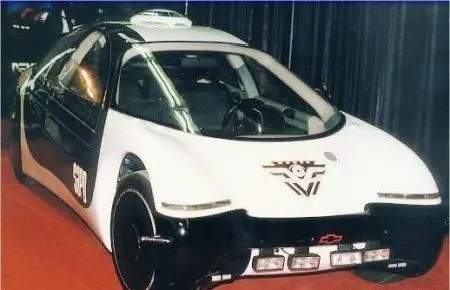
The General Motors Ultralite was a 1992 low-emission concept car intended to demonstrate the benefits of advanced materials and low fuel consumption. Its carbon-fibre body weighed only 420 lb, and the whole car 1,400 lb, which helped it reach 88 miles per US gallon in EPA testing.
General Motors Ultralite at a glance
| Maker | General Motors |
|---|---|
| Year | 1992 |
| Type | low-emission concept car |
| Body | gull-wing doors, no B-pillar |
| Shell | carbon fibre, fabricated by Scaled Composites |
| Shell weight | 420 lb (191 kg) |
| Total weight | 1,400 lb (635 kg) |
| Engine | 1.5 L three-cylinder two-stroke, 111 hp (83 kW) |
| Performance | 0-60 mph in under eight seconds; 135 mph (217 km/h) |
| Fuel economy | 88 mpg-US by the EPA; 100 mpg at a steady 50 mph |
| Drag coefficient | 0.19 |
| On screen | Demolition Man (1993), seaQuest DSV, Bicentennial Man (1999) |
Based on one source, the English Wikipedia article on the General Motors Ultralite.
History of the General Motors Ultralite
A concept for low emissions
The General Motors Ultralite was a 1992 low-emission vehicle concept car built to demonstrate the benefits of advanced materials and low fuel consumption. Rather than previewing one production model directly, it was a laboratory on wheels for lightweight construction and aerodynamic efficiency.
Carbon fibre and low drag
The carbon fibre shell was fabricated by Scaled Composites and weighed only 420 pounds (191 kg); the complete car weighed 1,400 pounds (635 kg). It had gull-wing doors and no B-pillar, and its drag coefficient of 0.19 was significantly lower than that of production cars of the decade. The shape was reminiscent of the Ford Probe concept, and the Ultralite foreshadowed the production General Motors EV1 electric vehicle and other later models.
Fuel economy and performance
The EPA rated the car at 88 miles per US gallon (2.7 L/100 km), and at a steady cruising speed of 50 mph it could achieve 100 miles per US gallon (2.4 L/100 km). A three-cylinder 1.5-litre two-stroke engine produced 111 hp (83 kW), enough for a top speed of 135 mph (217 km/h) and acceleration from 0 to 60 mph in less than eight seconds.
On screen
The unusual design brought the Ultralite film work. It appeared most prominently as the squad cars of the fictional San Angeles Police Department in the 1993 film Demolition Man, and it also featured in the second episode of the second season of seaQuest DSV and in the 1999 film Bicentennial Man.
Design and features
- Carbon-fibre shell: a 420 lb body built by Scaled Composites, less than a third of the weight of the complete car.
- Very low drag: a coefficient of 0.19, well below contemporary production cars.
- Gull-wing doors: a show-car gesture combined with the absence of a B-pillar.
- Economy first: 88 mpg from the EPA and 100 mpg at a steady 50 mph.
- Design influence: the shape pointed towards the later General Motors EV1.
General Motors Ultralite versions
- Ultralite concept (1992): the only car built, with a three-cylinder two-stroke engine.
- Film cars: examples used as police vehicles in Demolition Man.
- Design legacy: the aerodynamic lessons reappeared in the EV1.
The Ultralite belongs with the other General Motors concept cars such as the gas-turbine Firebird and the Autonomy chassis. More of them are in the General Motors collection.
Sources
- General Motors Ultralite, English Wikipedia: design, weights, engine, fuel economy, film appearances