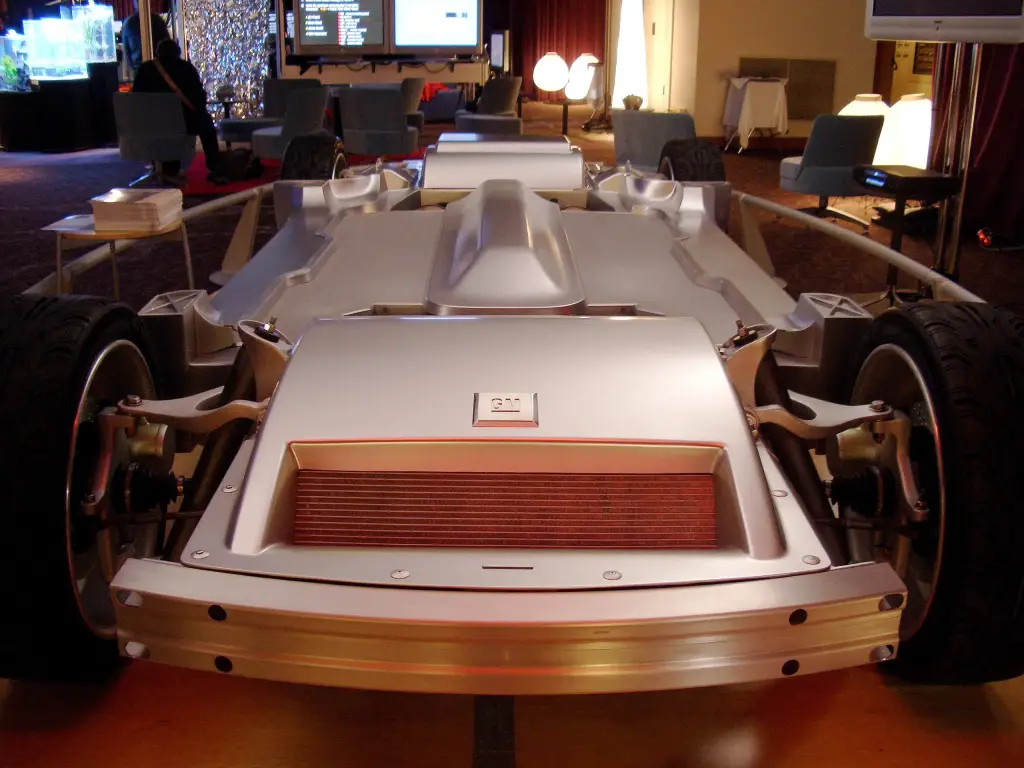
The General Motors Autonomy is the skateboard chassis concept that put the whole drivetrain of a car into a flat floor between the wheels. General Motors built its Hy-wire show car on it in 2002, and the arrangement allowed the same platform to carry a sedan, a minivan or a small bus.
General Motors Autonomy at a glance
| Maker | General Motors |
|---|---|
| Shown | 2002 |
| Type | fuel-cell concept chassis |
| Layout | flat skateboard holding fuel cell, tanks and motor |
| Fuel cell | 94 kW continuous, 129 kW peak |
| Hydrogen storage | three compressed tanks in the chassis |
| Motor | three-phase electric |
| Top speed | 160 km/h (100 mph) |
| Weight | 1,814 kg (4,000 lb) |
| Control | drive-by-wire, no mechanical linkage |
| Bodies | interchangeable sedan, minivan or small bus |
| Production target | GM said in 2003 it could be viable by 2010 |
Based on one source, the English Wikipedia article on the General Motors Hy-wire, the running concept car built on the Autonomy chassis.
History of the General Motors Autonomy
The skateboard chassis
General Motors’ Autonomy concept placed the whole propulsion system in a flat floor between the wheels. Because the hydrogen fuel cell, its tanks and the electric motor sat in this skateboard, there was no conventional engine block or transmission coupled to the steering column and pedals through mechanical linkages. The arrangement lowered the centre of gravity and, more importantly, standardised the drivetrain, so designers could fit a four-door sedan, a minivan or even a small bus on the same platform, changing only the upper body and the position of the seats. The skateboard itself contained crumple zones like those of a conventional car.
The Hy-wire show car
The best-known car built on the chassis was the Hy-wire, short for hydrogen drive-by-wire, which General Motors introduced in January 2002. GM asked schoolchildren to name the car and one of them suggested Hy-wire. Its fuel cell produced 94 kilowatts continuously and up to 129 kilowatts for short periods, fed by three tanks of compressed hydrogen in the chassis; with its three-phase electric motor the 1,814 kg vehicle reached 160 km/h.
Drive-by-wire
With no mechanical connection between the controls and the drivetrain, the driver’s seat and the steering and throttle controls did not have to be fixed in place. Cameras replaced mirrors and several LCD screens gave the driver feedback. The 2003 concept had a single control interface that could be operated from either front seat, and the 2004 design put the two front seats on a rotating platform so that driver and passenger could swap places. In 2003 General Motors said it was confident that it could produce a commercially viable model by 2010.
Design and features
- Skateboard layout: fuel cell, hydrogen tanks and motor all in the floor.
- Interchangeable bodies: the same chassis could carry a sedan, a minivan or a small bus.
- Drive-by-wire: steering and throttle work electronically, with no mechanical linkage.
- Flexible interior: the driver’s seat and controls could be moved or shared between front seats.
- Cameras instead of mirrors: rear views shown on LCD screens.
General Motors Autonomy versions
- Autonomy chassis (2002): the skateboard platform itself.
- Hy-wire (2002): the first running concept car on the chassis.
- 2003 concept: a single control interface usable from either front seat.
- 2004 concept: front seats on a rotating platform.
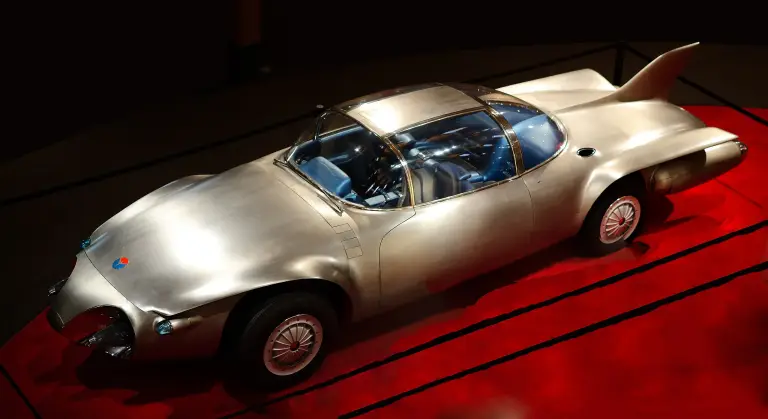
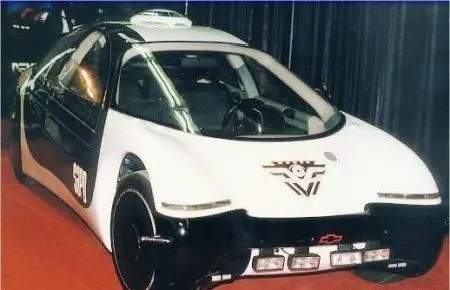
The Autonomy followed earlier General Motors experiments such as the gas-turbine Firebird, and the lightweight Ultralite showed the same interest in new materials. More are in the General Motors collection.
Sources
- General Motors Hy-wire, English Wikipedia: skateboard layout, fuel cell output, drive-by-wire, 2003 and 2004 concepts