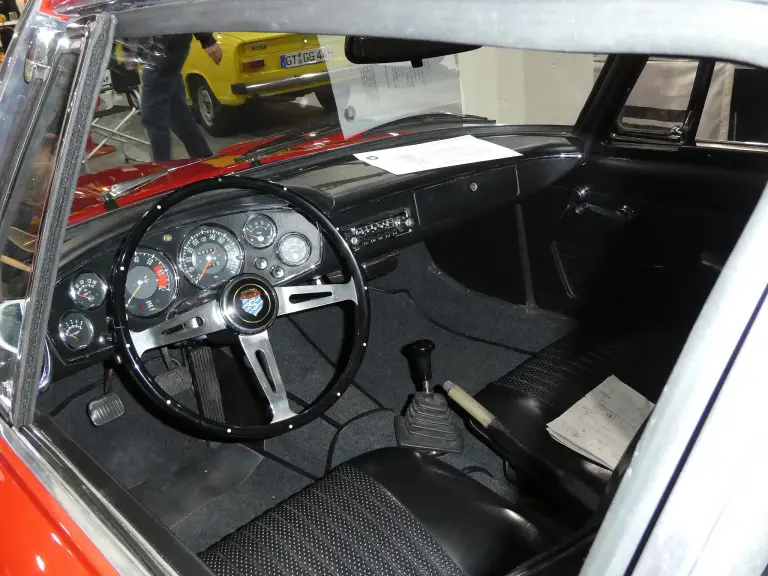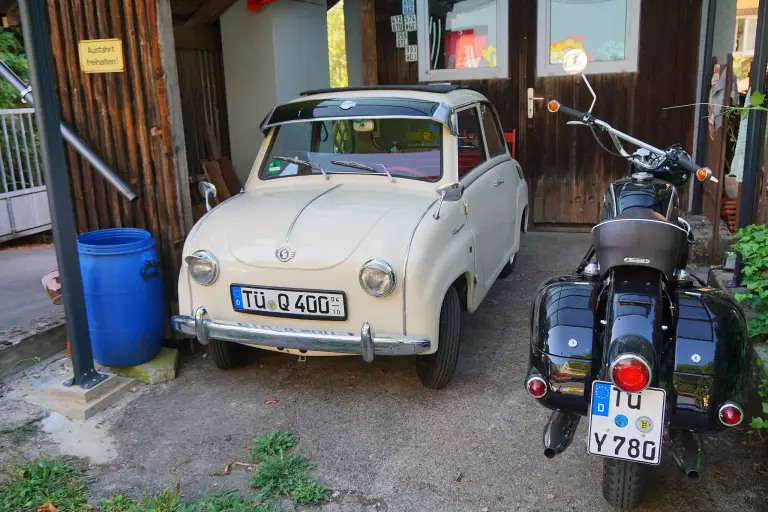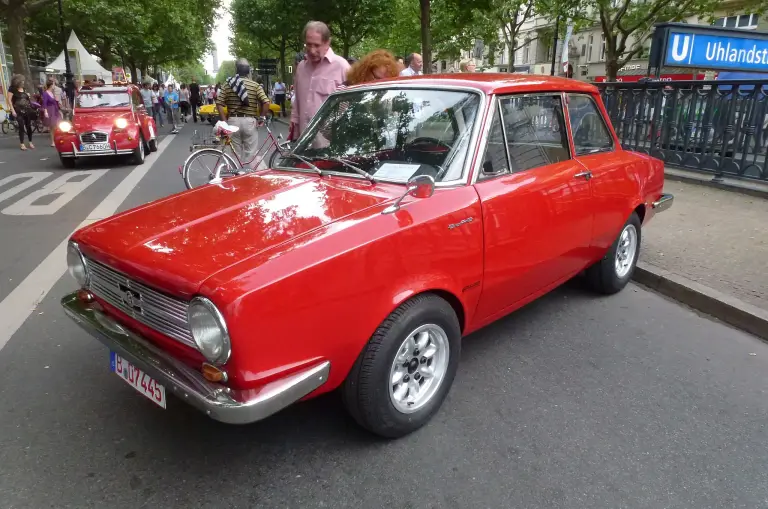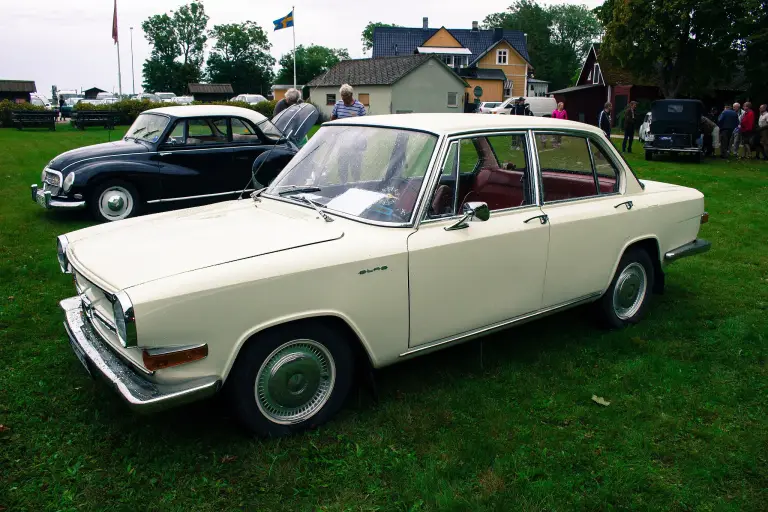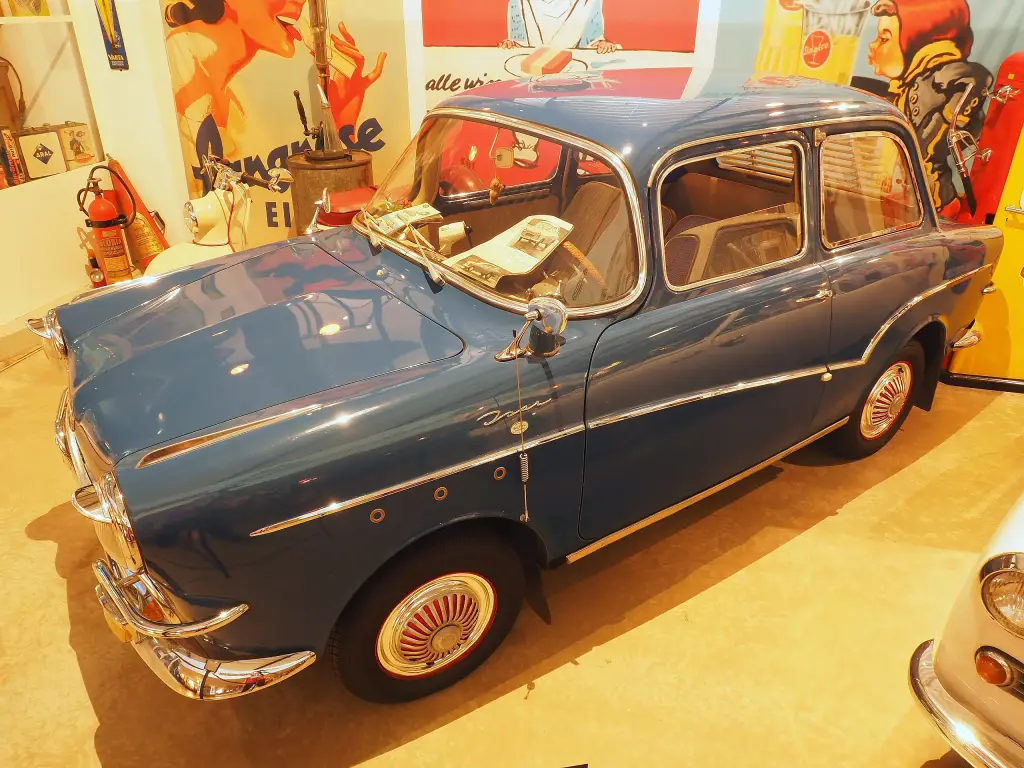
The Glas Isar was a small two-door four-seater built by Hans Glas GmbH at Dingolfing. It reached the public in September 1957 as the Goggomobil T600, was renamed the Isar in November 1959, and stayed in production until the end of summer 1965.
Glas Isar at a glance
| Maker | Hans Glas GmbH, Dingolfing |
|---|---|
| Production | 1958–1965 |
| First shown | September 1957, Frankfurt Motor Show, as the Goggomobil T600 |
| Also sold as | Glas Isard in some export markets |
| Body styles | two-door saloon; three-door estate (K600/K700) |
| Engine, T600 | 584 cc air-cooled two-cylinder boxer, 20 PS |
| Engine, T700 | 688 cc boxer, 30 PS |
| Top speed | 98 km/h (T600), 110 km/h (T700) |
| Weight | about 650 kg |
| Dimensions | 3,430 mm long to 1960, 3,455 mm after; wheelbase 2,000 mm |
| Built to July 1960 | 16,940 T600/K600 and 25,092 T700/K700 |
| Built after facelift | 15,069 T600/K600 and 31,460 T700/K700 |
History of the Glas Isar
A larger Goggomobil
The car shown at the 1957 Frankfurt Motor Show was a prototype, and it differed from the production car in one important respect: it used front-wheel drive. Series production of the Goggomobil T600 began in 1958. Glas initially described the new model simply as a “big Goggomobil”, because until then only the tiny Goggomobil was known as a passenger car from Dingolfing. In November 1959 the T600 and the more powerful T700 became the Glas Isar T600 and Isar T700, named after the river that flows through Munich and past Deggendorf, where Glas had its headquarters.
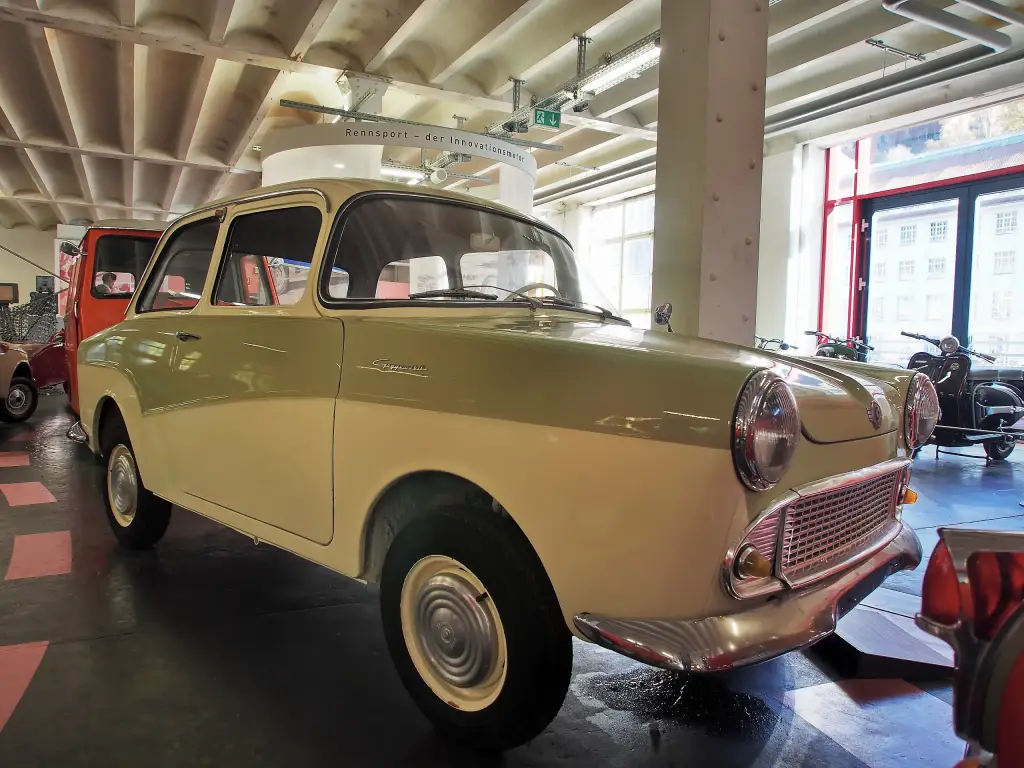
Front-wheel drive abandoned
The front-driven prototype was unstable: the engine sat far ahead of the front axle and high above the front-wheel drive train in a relatively light car. Moving the engine back would have meant redesigning the body, for which neither time nor money was available, so the decision was taken to switch to rear-wheel drive. The gearbox, designed for front-wheel drive, could not be redesigned either; it was simply turned round, which gave the driver a back-to-front gear change with first and third towards the rear and second and fourth towards the front. The space above the low boxer engine was used for the spare wheel, carried in a cradle under the bonnet.
Facelift and teething troubles
The T600’s 584 cc engine produced 20 PS at 5,000 rpm for a top speed of 98 km/h; the T700’s 688 cc unit gave 30 PS at 4,900 rpm and 110 km/h. Unusually for an economy car of the period, the T600 had a 12-volt electrical system when contemporary Volkswagens and German Fords still used 6 volts. In August 1960 all four versions were revised: the cars grew 25 mm in length through new tail-light housings, the roof was raised slightly at the rear for a larger back window, and the weakest variants were rated at 19 PS with a 105 km/h top speed. Early cars suffered badly: aluminium castings in the engine housings deformed at high temperatures and fuel consumption could double, while bodies flexed enough on bad roads to crack and, in extreme cases, to let the panoramic windscreen pop out of its frame. Export cars were often badged Isard, the Pyrenean chamois, and Isard Argentina built the model under licence.
Design and features
- Monocoque body: a steel shell without a separate chassis, stiffened from 1959 by box sections beside the floor.
- Boxer engines: air-cooled two-cylinder units of 584 cc and 688 cc, mounted at the rear.
- Transatlantic styling: wrap-around windscreen, small tailfins and a two-tone paint finish.
- 12-volt electrics: advanced for a small car in 1958; VW and Ford stayed with 6 volts for another decade.
- Estate version: the three-door Isar K600 and K700 joined the range with the 1959 name change.
Glas Isar versions
- Goggomobil T600 (1957–1959): the original 584 cc car, still badged as a Goggomobil.
- Goggomobil T700 (1958–1959): 688 cc, 30 PS and 110 km/h.
- Isar T600/T700 (1959–1965): the same cars after the name change.
- Isar K600/K700 (1959–1965): three-door estate versions.
- 1960 facelift: longer body, new tail lights, larger rear window; weaker variants 19 PS.
- Isard: export name used in several countries, with licence production in Argentina.
The Isar was the bigger brother of the Goggomobil, and its chassis was later lengthened for the Glas 1004. More cars from Dingolfing are in the Glas collection.
Video: ISARD T 700
Video on YouTube.
Sources
- Glas Isar, English Wikipedia: origins, prototype, production dates
- Glas Isar, German Wikipedia: facelift, production numbers, export