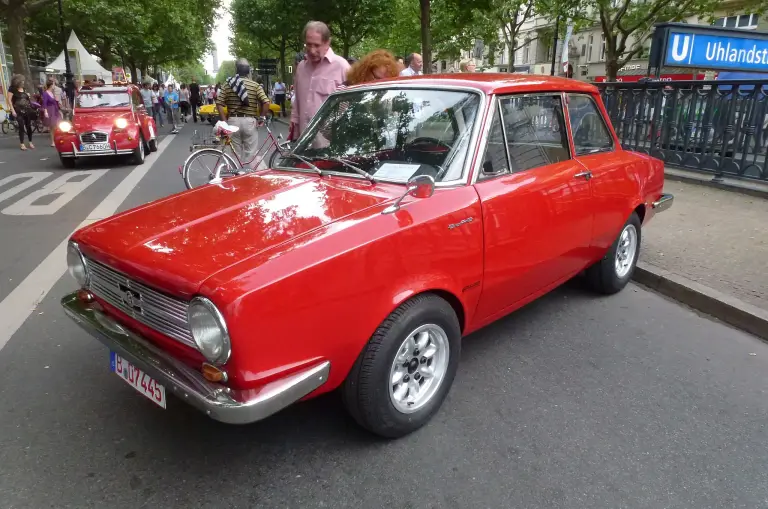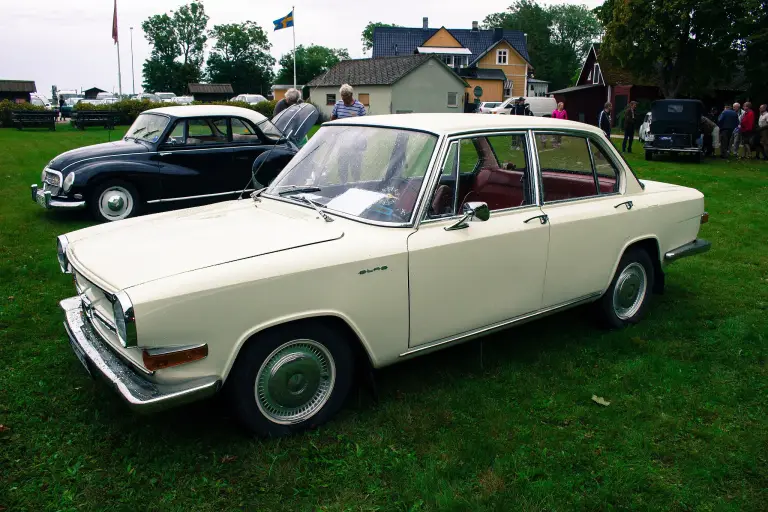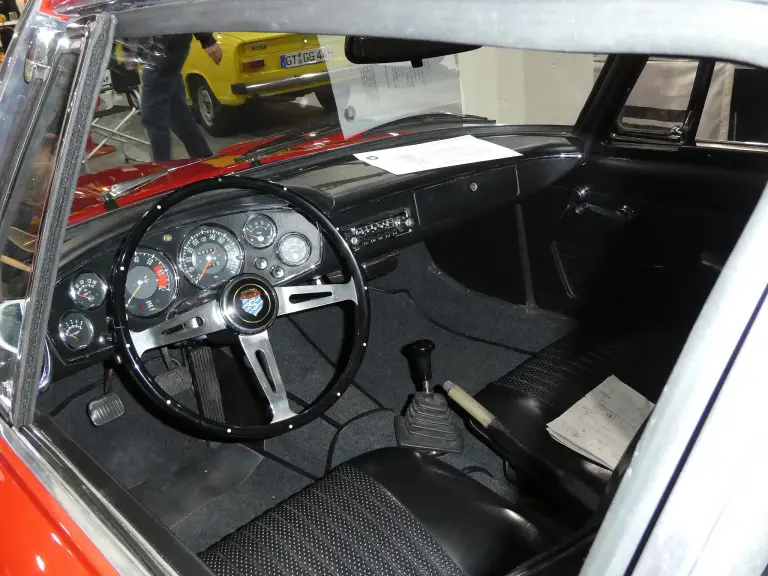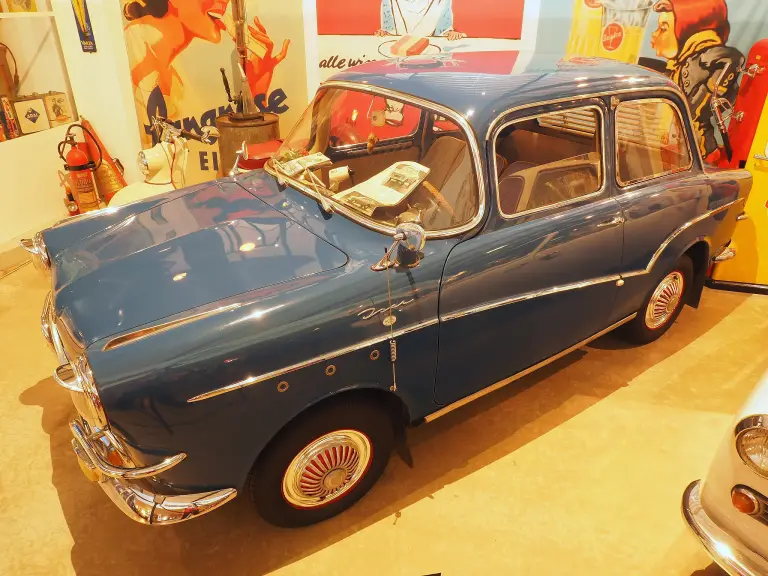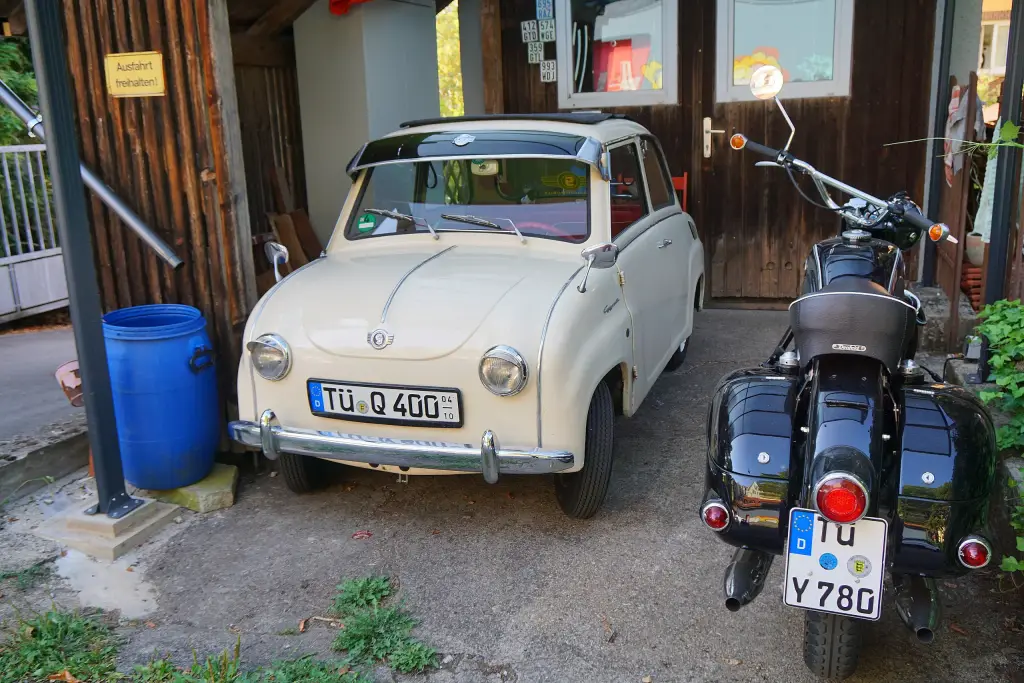
Goggomobil was a series of microcars produced by Hans Glas at the Bavarian town of Dingolfing between 1955 and 1969. Glas built three models on the same platform — the T saloon, the TS coupé and the TL van — and together they made the small company one of the best-known names in German motoring.
Goggomobil at a glance
| Maker | Hans Glas GmbH, Dingolfing |
|---|---|
| Production | 1955–1969 |
| Models | T saloon, TS coupé, TL van and pickup |
| Engine | air-cooled two-stroke twin, 245/250, 298/300 and 392/400 cc |
| Power | 13.6 hp (TS 250), 15 hp (TS 300) |
| Top speed | 75–95 km/h |
| Gearbox | four-speed manual; Getrag pre-selector optional |
| Layout | rear-mounted engine, rear-wheel drive |
| Dimensions, TS | 2,910 mm long, 1,300 mm wide, 1,200 mm high, 1,800 mm wheelbase |
| Weight | 415–420 kg |
| Built | 284,491: 214,313 saloons, 66,511 coupés, 3,667 vans and pickups |
History of the Goggomobil
From farm machinery to microcars
Glas was a manufacturer of agricultural machinery when motorcycle makers ran into crisis in the 1950s and their customers began to ask for “a roof over their heads”. The company developed a small four-seat saloon, and the first series cars left the line in early 1955. The body, designed by Hans and Andreas Glas with the former aircraft engineer Karl Dompert, had originally been planned with a single front door; the idea was dropped a few weeks before production in favour of two side doors, reportedly at the suggestion of the racing driver Schorsch Meier, a friend of the Glas family. At first the car was available only in “Sahara beige”. The name came from “Goggo”, the pet name of a grandson of Hans Glas, which had already been used for the company’s scooter.
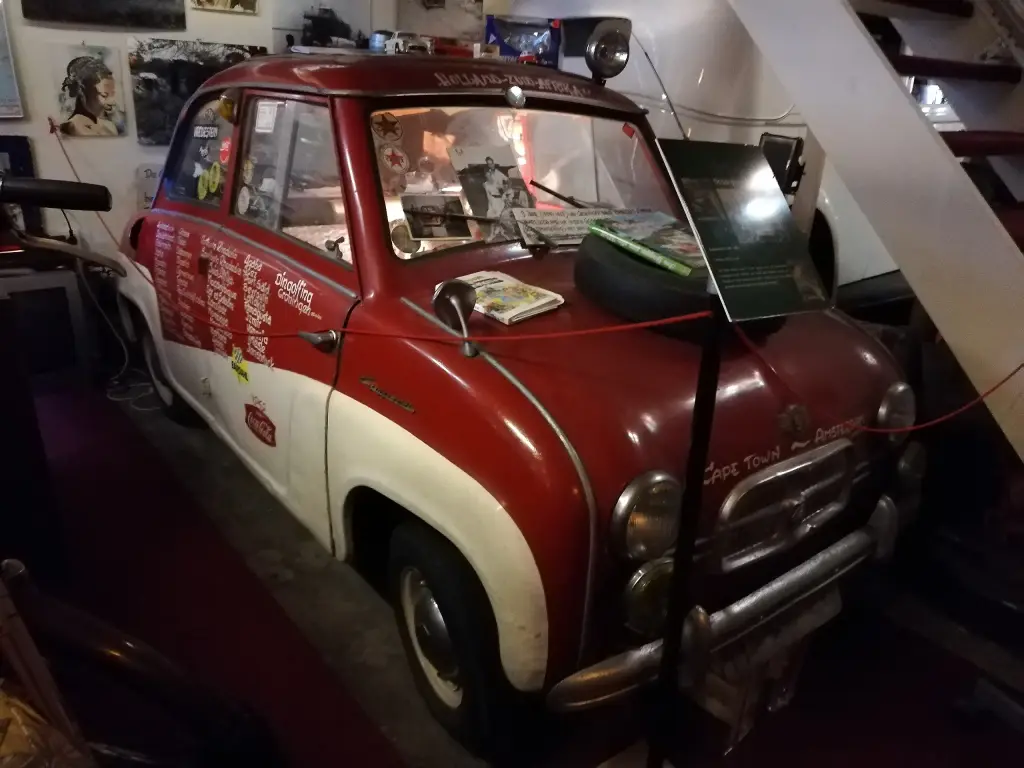
T, TS and TL
The Goggomobil T250 was introduced at the 1954 IFMA bicycle and motorcycle show, a conventional two-door saloon with a rear-mounted 245 cc air-cooled two-stroke twin. It was revised in 1957: two windscreen wipers replaced one, sliding door windows gave way to wind-up windows, and the T300 and T400 arrived with larger engines. The TS 2+2 coupé was presented at the 1957 IFMA show alongside the improved T saloon, with a panoramic rear window and always priced ten to twenty percent above the saloon. The TL Transporter followed in 1956, built largely at the request of the German Federal Postal Service, which bought more than 2,000 of them between 1957 and 1965; it had sliding front doors and came as a van or a pickup, often used by municipal services as snowploughs or street sweepers. The last design change to the T came in 1964, when rear-hinged “suicide” doors were replaced by front-hinged doors. Saloon production ended on 30 June 1969.
Engineering and export
The engine sat behind the rear wheels, with a four-speed gearbox bolted to it and a short central lever in an open gate; the shift pattern was an unusual transverse H, with first and third on the left. A Getrag “Selectromat” pre-selector gearbox was optional at extra cost, operated by a small lever on the dashboard and triggered by the clutch pedal. The 250 cc engine meant the car could be driven by holders of the old German class 4 licence for vehicles up to 250 cc, which helped sales. Goggomobils were exported to the United States as special editions with the 400 cc engine, an automatic petrol-oil mixer and 7-inch sealed-beam headlights; through the Continental Car Combine they cost between 995 and 1,495 dollars, and 539 were sold in the USA in 1958 and 579 in 1959. In Australia, Buckle Motors of Sydney built some 700 Goggomobil Darts between 1957 and 1961 and about 5,000 Goggomobils in total under licence, with fibreglass bodies. Total production was 284,491 cars, and the last one was built on 30 June 1969, two and a half years after BMW took over Hans Glas.
Design and features
- Two-stroke twin: a simple air-cooled engine of 250, 300 or 400 cc mounted behind the rear wheels.
- Pre-selector gearbox: the optional Getrag Selectromat, with a small lever on the dashboard.
- Three body styles: saloon, 2+2 coupé and the TL van or pickup.
- Postal service favourite: more than 2,000 TL Transporters went to the German Federal Postal Service.
- Licence-friendly 250 cc: the smallest engine could be driven on the old class 4 licence.
Goggomobil versions
- T250, T300, T400: the two-door saloon with 245/250, 298/300 and 392/400 cc engines.
- TS250, TS300, TS400: the 2+2 coupé with a panoramic rear window.
- TL Transporter: van or pickup with sliding front doors, 3,667 built.
- US export edition: 400 cc engine, automatic oil mixer and sealed-beam headlights.
- Goggomobil Dart: Australian fibreglass sports car by Buckle Motors, about 700 built.
The Goggomobil was the first car from Dingolfing; its bigger brother was the Glas Isar, and the later four-cylinder range began with the Glas 1004. More cars from Dingolfing are in the Glas collection.
Sources
- Goggomobil, English Wikipedia: models, engines, production split, export
- Goggomobil, German Wikipedia: history, gearbox, US sales, Australian licence