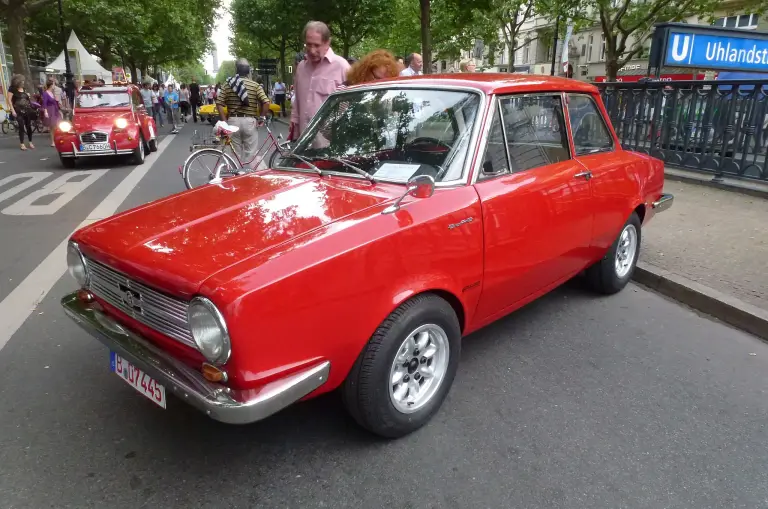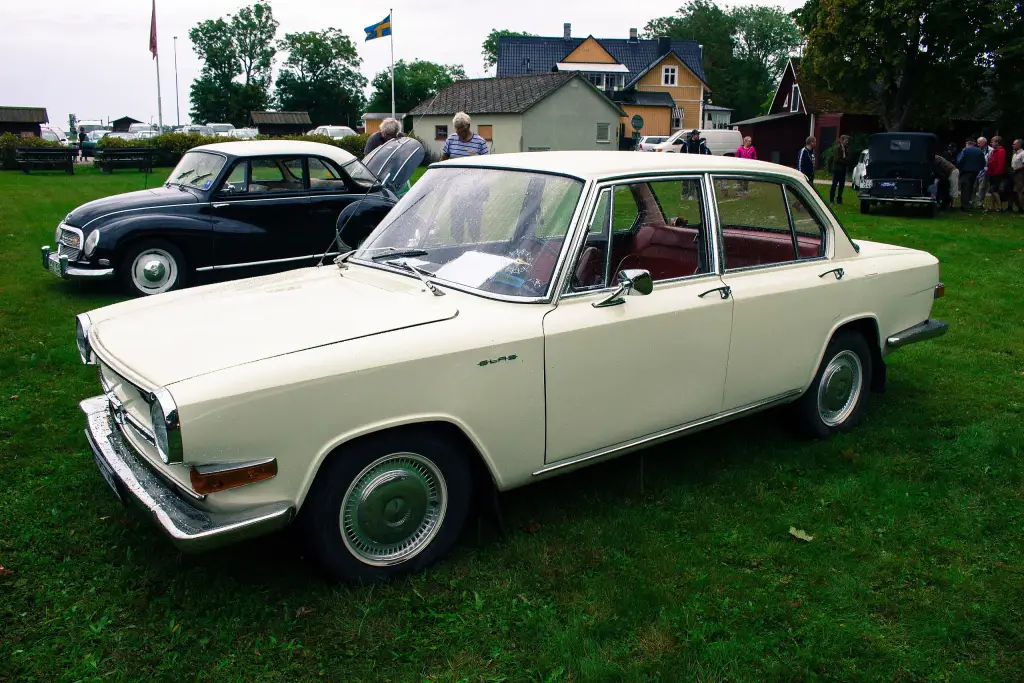
The Glas 1700 was a middle-class four-door saloon produced by Hans Glas GmbH at Dingolfing. Frua of Moncalieri designed the body, the engine was a bored-out four-cylinder with an overhead camshaft, and production ran from August 1964 until December 1967, when the company was already part of BMW.
Glas 1700 at a glance
| Maker | Hans Glas GmbH, Dingolfing |
|---|---|
| Also called | Glas 1500 (1963 prototype) |
| Production | August 1964 – December 1967 |
| Body designer | Frua, Moncalieri |
| Engine | 1,682 cc four-cylinder, overhead camshaft |
| Power | 80 PS from 1964, 85 PS from September 1965 |
| 1700 TS | 100 PS, twin carburettors, 170 km/h |
| Top speed | 150–155 km/h |
| Gearbox | four-speed manual; automatic from 1966 |
| Dimensions | 4,415 mm long, 1,610 mm wide, 2,500 mm wheelbase |
| Built | 13,792 saloons, including 928 TS and 284 automatics |
History of the Glas 1700
From Hansa 1300 to Glas 1500
After the success of the 1300 GT, which Frua had designed in 1963, Glas ordered a new four-door middle-class saloon from the same Piedmontese coachbuilder. Frua had recently developed a successor to the Goliath 1100 for Borgward, the Hansa 1300, which never entered volume production after Borgward’s bankruptcy. The car Frua now drew for Glas was very similar, and both featured the Hofmeister kink that had become a hallmark of BMW designs. Glas bored its existing 1,290 cc unit out to 1,489 cc, and in this form, with a claimed 70 PS, the car appeared as the Glas 1500 at the Frankfurt Motor Show in September 1963.
The 1700 and the 1700 TS
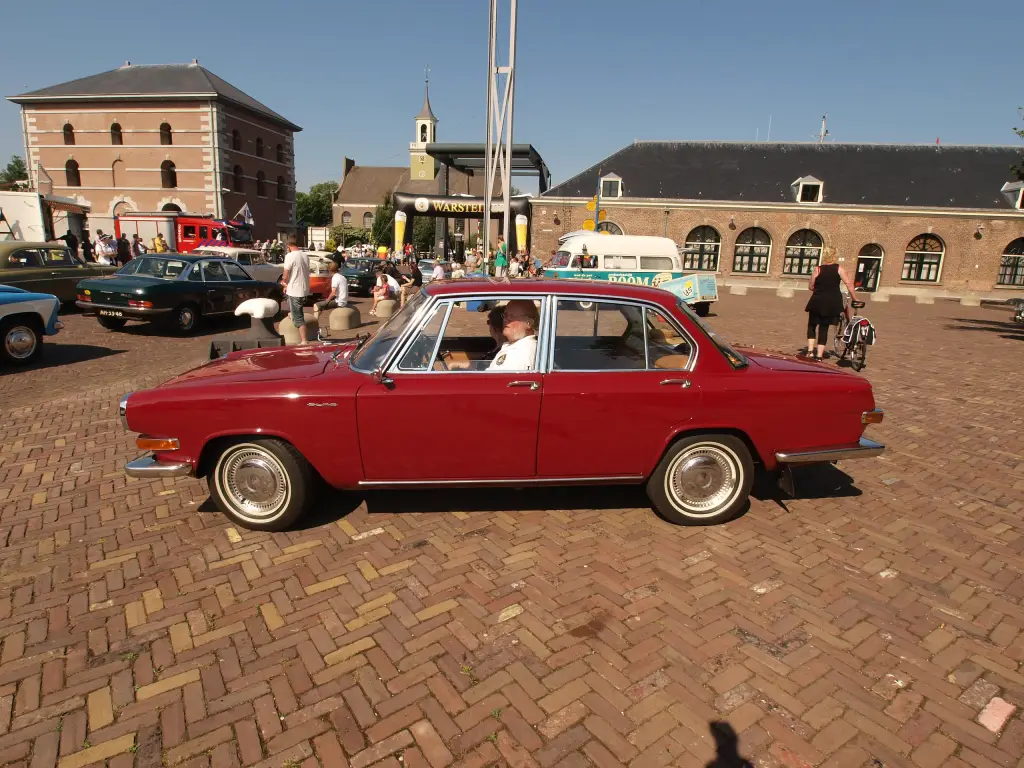
As with earlier Glas models, the show car was far from ready for volume production. The 1,489 cc engine proved too weak for a sporting middle-class saloon, just as BMW had found that its 1500 needed the 1800. A year after the launch, the car reappeared as the Glas 1700: the engine had grown to 1,682 cc through a longer stroke and produced 80 PS at 4,800 rpm, for a claimed 150 km/h. Series production began in August 1964, though volumes stayed limited by a lack of investment capital. In September 1965 standard power rose to 85 PS at 4,900 rpm and top speed to 155 km/h. At the same show Glas added the 1700 TS, with twin carburettors and a compression ratio raised from 8.5:1 to 9.5:1 or 9.7:1; it claimed 100 PS at 5,500 rpm and 170 km/h.
Under BMW
Glas never had the money to compete with the Opel Rekord or the BMW 1800/2000 on equal terms. BMW took over Glas in 1966 and valued the Dingolfing site, which it developed into its largest car plant, but it had no reason to keep the low-volume Glas saloons alive: the last Glas 1700 was built in December 1967. The Frua body had an afterlife in South Africa, where BMW combined it with BMW engines and underpinnings as the BMW 1800 GL and 2000 GL between 1968 and 1973, later as the BMW 1804 and 2004, with new cars still available in late 1975. Cars derived from the Glas 1700 were also assembled in Rhodesia as the BMW Cheetah.
Design and features
- Frua styling: a four-door body with the Hofmeister kink at the rear window, closely related to the still-born Hansa 1300.
- Belt-driven camshaft: the overhead camshaft was driven by a toothed rubber belt, a Glas speciality.
- TS engine: twin carburettors and higher compression lifted output from 85 to 100 PS.
- Optional automatic: advertised from the start, but the first car with the company’s own automatic gearbox was built only in 1966.
- Modern running gear: double wishbone front suspension, disc front brakes and a Panhard rod on the rear axle.
Glas 1700 versions
- Glas 1500 (1963): the single prototype shown at Frankfurt, with a 1,489 cc engine.
- Glas 1700 (1964–1967): the standard saloon, 80 PS and later 85 PS.
- Glas 1700 TS (1965–1967): twin-carburettor engine, 100 PS, 170 km/h.
- Automatic (1966–1967): 284 cars with the Glas automatic transmission.
- South African BMWs: BMW 1800 GL/2000 GL, then 1804/2004, and the Rhodesian BMW Cheetah.
The 1700 shared its engine with the Glas GT coupé, and its engineering grew out of the smaller Glas 1304. More cars from Dingolfing are in the Glas collection.
Video: glas 1700 kaasuttelua
Video on YouTube.
Sources
- Glas 1700, English Wikipedia: design, engines, production, South Africa
- Glas 1700, German Wikipedia: technical details, dimensions, production numbers