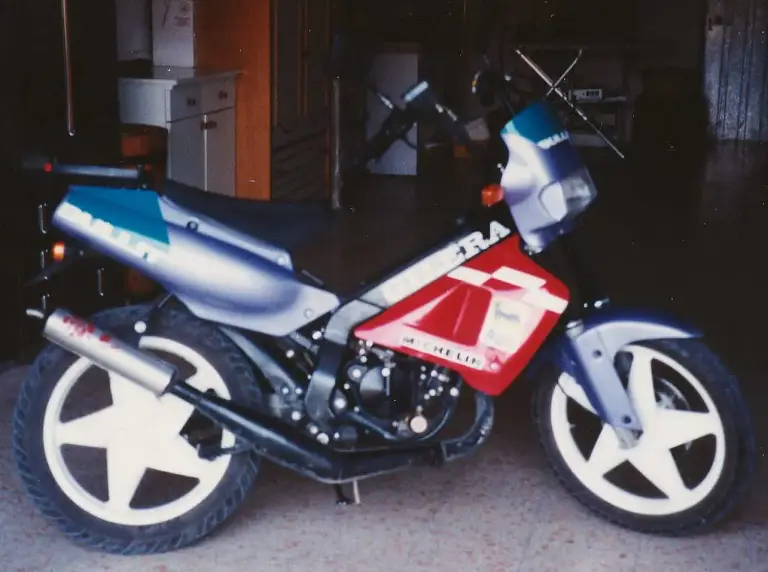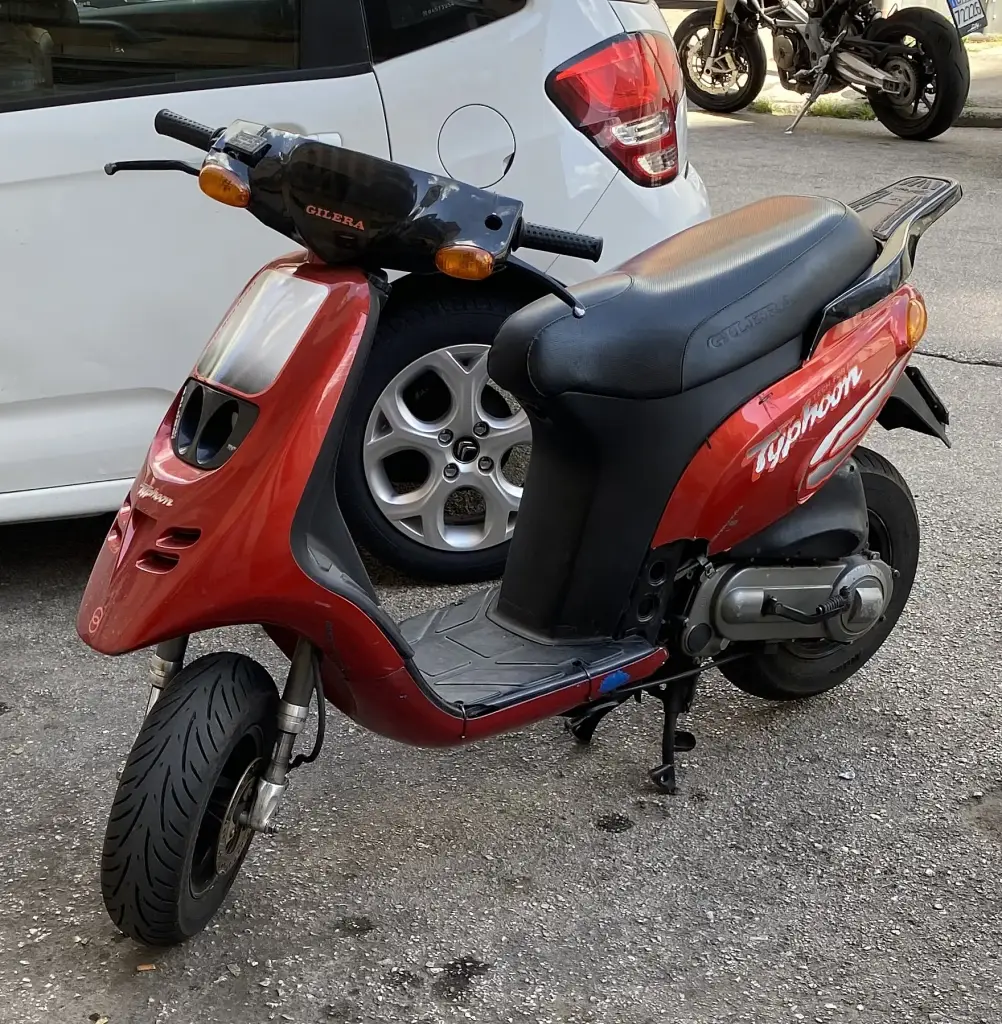
The Gilera Typhoon was presented at Bellagio on 15 April 1993 as a sporty scooter that could also cope with light off-road use. With semi-knobbly tyres, a shark-nose front and Piaggio’s long engine block, it was the group’s answer to the MBK Booster and sold more than 75,000 examples in Europe in a single year.
Gilera Typhoon at a glance
| Maker | Gilera, Piaggio group |
|---|---|
| Presented | 15 April 1993, Bellagio |
| Sold as a Gilera | 1993–2000 |
| Engines, first series | 50, 80 and 125 cm³ two-strokes |
| Engines, second series | largest capacity became a four-stroke |
| Tyres | semi-knobbly, wide section, 10-inch wheels |
| Front suspension | Showa upside-down fork |
| Rear suspension | single shock offset in the frame |
| Brakes | semi-hydraulic front disc, rear drum |
| Sales | over 75,000 in Europe in one year |
| Twin model | Gilera Storm, from April 1994 |
based on one source (Italian Wikipedia, article on the Piaggio Typhoon, which began life as the Gilera Typhoon).
History of the Gilera Typhoon
Launch
The Gilera Typhoon was presented on 15 April 1993 at Bellagio. It was a sporty scooter, also suited to short distances on unpaved ground. The first series had 50, 80 and 125 cm³ two-stroke engines, while in the second series the largest capacity was replaced by a four-stroke of the same size.
Towards the end of the 1990s it was the Piaggio group’s main weapon against the MBK Booster, whose technical traits it followed. The Typhoon used wide, high-shouldered semi-knobbly tyres on 10-inch rims, which made uneven ground easier to deal with.
Chassis and engines
The chassis consisted of a Showa upside-down fork in front, while at the rear a single shock absorber was mounted offset in the frame. Using the long version of the Piaggio engine block, with a longer distance between the wheels than the standard unit, improved stability compared with other Piaggio mopeds of the time. Braking was a semi-hydraulic front disc and a rear drum.
The two-stroke engines were single-cylinders with forced air cooling of 49.7 or 124.7 cm³, in cast iron or aluminium respectively, with crankcase reed induction and a CVT transmission. The four-stroke used a Piaggio Leader engine of 124.9 cm³, an air-cooled two-valve single with a single overhead camshaft and a CVT.
Style and the Storm
The line is marked by the characteristic shark-nose front, while at the rear the bodywork was shared with the first series of the Piaggio NRG scooter. After the Typhoon’s great success, with more than 75,000 examples sold in Europe in one year, from April 1994 Gilera also sold the twin Storm: that model had a more road-going character, with 13-inch wheels and smoother tyres instead of knobbly ones, and only the 50 cm³ engine.
Change of badge
In 2000 the Typhoon range lost the Gilera badge and was sold as a Piaggio. In 2006 the Typhoon was renewed with a new screen, new mirrors and the new Piaggio HI-PER2 engine. In 2007 a Gilera-badged version appeared again, so the machine was sold both as the Piaggio Typhoon and as the Gilera Storm, the only differences being the 12-inch wheel and the 50 cm³ engine of the Gilera. Production of the first-generation Typhoon ended in 2010, when the new generation took over, while the Gilera Storm was built until 2011.
A second generation arrived at the end of 2010 with larger dimensions, completely new and more aerodynamic styling, 12-inch knobbly wheels and engines of 49.4 cm³ two-stroke and 124 cm³ four-stroke, and it stayed in production until 2020. The 125 two-stroke version was the quickest of the first generation: the same frame as the 50 with a stiffer bar around the engine mount, about 13 hp, 115 km/h and 96 kg dry, with an automatic oil mixer driven by a belt from the crankshaft that used about a litre of oil every 2,300 km. Its cylinder had six transfer ports but no pneumatic exhaust valve, and a well-known Malossi kit of 172 cm³, sold as the “180 Malossi”, could take it past 25 hp.
Design and features
- Shark-nose front: the styling feature that made the Typhoon recognisable.
- 10-inch semi-knobbly tyres: wide-section rubber for light off-road use.
- Long Piaggio engine block: a longer wheelbase for better stability than other Piaggio mopeds.
- Two engine families: 50, 80 and 125 two-strokes, then a 125 four-stroke Leader.
- Tuning potential: the 125 two-stroke could be taken past 25 hp with a Malossi 172 kit.
Gilera Typhoon versions
- Typhoon 50, 80 and 125 (1993): two-stroke first series.
- Second series: largest capacity replaced by a four-stroke of the same size.
- Gilera Storm (1994): road-going twin with 13-inch wheels and a 50 engine.
- Piaggio Typhoon (from 2000): the same scooter under the Piaggio badge.
- Gilera Storm again (2007): 12-inch wheel and 50 engine.
The Typhoon competed with the Stalker and shared its market with the faster Runner. More models are in the Gilera collection.
Video: Project Gilera Typhoon
Video by Andrey Mercea on YouTube.
Sources
- Piaggio Typhoon, Italian Wikipedia: Gilera launch, chassis, engines, Storm, change of badge, 125 details