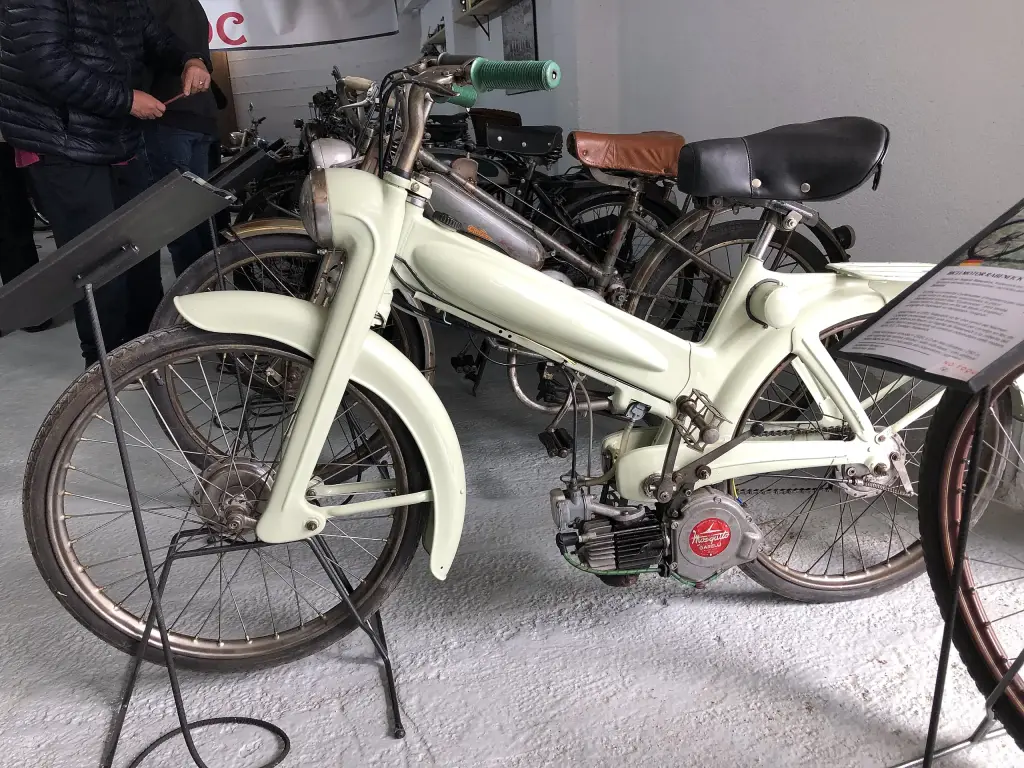
The Garelli Mosquito was an auxiliary engine for bicycles produced by the Milanese firm from 1946 to 1960. Built in about two million examples, it was the most widespread engine of its kind in Europe.
Garelli Mosquito at a glance
| Maker | Garelli, Sesto San Giovanni |
|---|---|
| Production | 1946–1960 |
| Type | auxiliary engine for bicycles |
| Designer | Carlo Alberto Gilardi |
| Displacement | 38.5 cc (38-A) |
| Power | 0.8 hp |
| Weight | about 4 kg |
| Fuel tank | 2 litres, oil and petrol mixed at 6–7% |
| Price in 1946 | 22,600 lire, about €730 at 2014 values |
| Built | about 2,000,000 |
| Licence production | Spain, France, Britain, Argentina, Hungary as the Dongo |
Based on one source (Italian Wikipedia). The original record’s video is no longer available.
History of the Garelli Mosquito
An idea born on a bicycle
The idea of a bicycle auxiliary engine came to the Milanese engineer Carlo Alberto Gilardi in the middle of the 1930s, when he had to cover long distances by bicycle with a toolbox, servicing the industrial machines his father sold. After graduating in engineering, studying privately at Freiburg, he joined Radaelli as a designer when the Second World War broke out, and there he realised that solutions used in reciprocating compressors could be applied to small combustion engines.
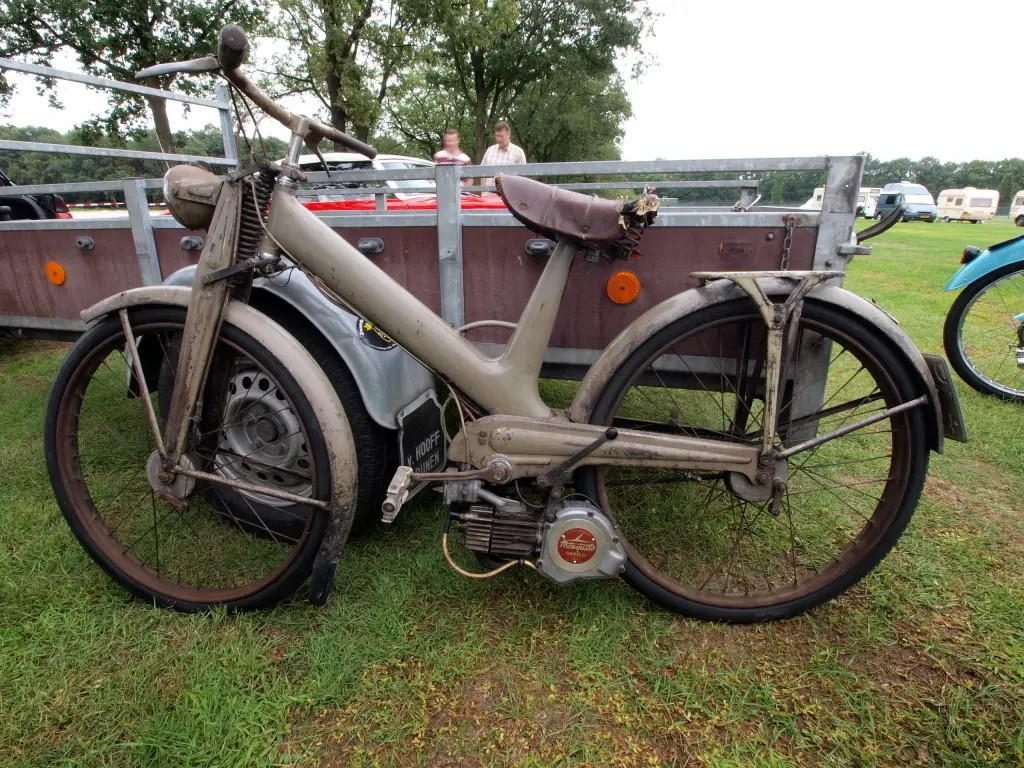
The project
Gilardi designed and patented a two-stroke engine in which the crankshaft is essentially a large pin with an eccentric for the connecting rod, with the flywheel and the transmission roller on its sides. On paper it was the auxiliary engine with the smallest transverse bulk ever built, less even than the distance between the pedal mounts of an ordinary bicycle, so it could be fitted within their span. He had no money for prototypes or series production. In January 1945 he was hired by Garelli and showed the project to Adalberto Garelli, who had himself been working on a moped since before the end of the war. The two engineers spent weeks improving the distribution and preparing the parts for production, and agreed that the engine would be built and sold under the Garelli name with a royalty for Gilardi.
On the road
In September 1945 the prototype was fitted to a touring bicycle and tested severely by its designer over long distances; in two months he covered more than 15,000 km, making countless small changes between journeys. In the first months of 1946 the engine went on sale as the Mosquito — the English form of zanzarino, the nickname the Garelli workers gave it because it ran so quietly. The price was 22,000 lire plus 3% purchase tax, 22,600 lire in all, about €730 at 2014 values, including the engine, a painted steel tank and the mounting brackets. A Garelli worker earned about 9,000 lire a month, so two and a half months of wages were needed to escape what the first advertisement called the slavery of the pedals.
Demand and licence production
The success overwhelmed the company’s distribution. In the first months of production dealers from half of Italy besieged the Sesto San Giovanni factory, collecting engines as they left the assembly line; the works turned out little more than 100 a day, hardly enough for Lombardy, while orders came from all over Italy and from abroad. A new factory was built in Naples and licences were granted in Spain, France, Britain, Argentina and even Hungary, where the engine was renamed Dongo after the slight longitudinal sway allowed by the elastic final drive. The 38-A of 1946, the first of the series, had the 38.5 cc two-stroke with a roller elastic transmission, usually a Dell’Orto carburettor, 0.8 hp, a weight of about 4 kg, a 2-litre tank and a 6–7% oil mixture, with a consumption of 80 to 100 km per litre.
Design and features
- Extreme compactness: the layout allowed the engine to sit inside the pedal span of an ordinary bicycle.
- Quiet running: the workers named it after a mosquito for its low noise.
- Cheap to run: 80 to 100 km per litre and a 2-litre tank.
- Licence production: built in Spain, France, Britain, Argentina and Hungary as well as Italy.
Garelli Mosquito versions
- 38-A (1946): the first version, 38.5 cc, 0.8 hp, about 4 kg.
- Licence-built copies: produced in Spain, France, Britain and Argentina.
- Hungarian Dongo: local name for the licence-built engine, after its slight sway.
Later Garelli mopeds are described in the Garelli Gulp and Garelli Capri articles, and the firm’s racing history in the Garelli 125 GP article. More machines are in the Garelli collection.
Sources
- Garelli Mosquito, Italian Wikipedia: design history, 38-A specification, price, production and licences