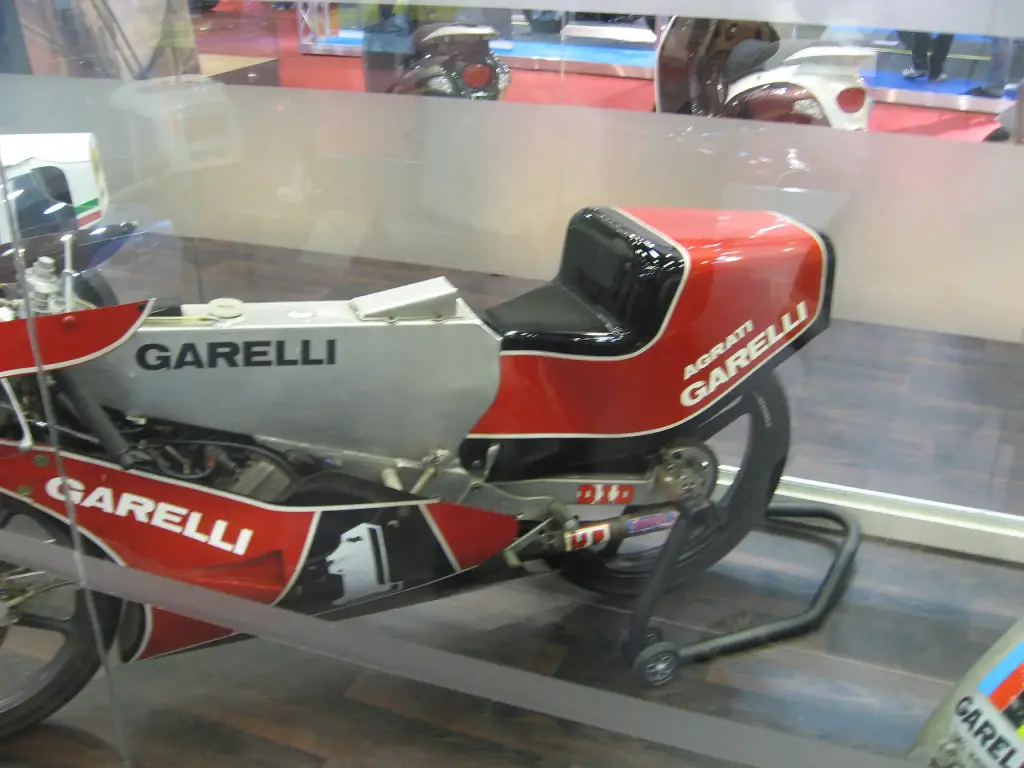
The Garelli 125 GP was the Italian firm’s 125 cc Grand Prix racer of 1982–1987. It began as the Minarelli with which Ángel Nieto had won the 1979 and 1981 titles, and it went on to give Garelli six rider championships in six seasons.
Garelli 125 GP at a glance
| Manufacturer | Garelli, Sesto San Giovanni (Milan) |
|---|---|
| Class | 125 cc Grand Prix racing |
| Seasons | 1982–1987 |
| Based on | Minarelli 125, world champion in 1979 and 1981 |
| Debut | Argentine Grand Prix 1982, won by Ángel Nieto |
| Rider titles | six: Nieto 1982–84, Gresini 1985–86, Cadalora 1987 |
| Constructors’ titles | 125 cc class, 1982–1987 |
| Grands Prix | 75 starts, 44 wins |
| 1985 chassis | aluminium monocoque, steering head angle 26 degrees |
| Successor | 1988 single-cylinder, raced until mid-1990 |
The Italian article is the main source; the English company article confirms the championship years.
History of the Garelli 125 GP
From Minarelli to Garelli
The Garelli 125 GP was in practice the Minarelli 125 that Ángel Nieto rode to the 125 cc world title in 1979 and 1981. Only the colours changed, together with a mechanical anti-dive system on both wheels and disc brakes of smaller diameter. After the death of Vittorio Minarelli, the founder of the Bologna firm, Minarelli sold its whole racing department to Garelli, with which it already had an agreement to supply engines for a 125 cc road model; the department moved from Bologna to Sesto San Giovanni.
Six seasons, six titles
The new Garelli made its debut at the 1982 Argentine Grand Prix, the first race of the season, and won with Nieto. At the end of the year the Spaniard was world champion again, with his team-mate Eugenio Lazzarini second. The machine stayed unchanged through 1983 and 1984 and gave Nieto two more titles. At the 1983 Austrian Grand Prix a set of aerodynamic updates developed in the wind tunnel of the FIAT research centre at Orbassano was introduced.
1985: new frame and new colours
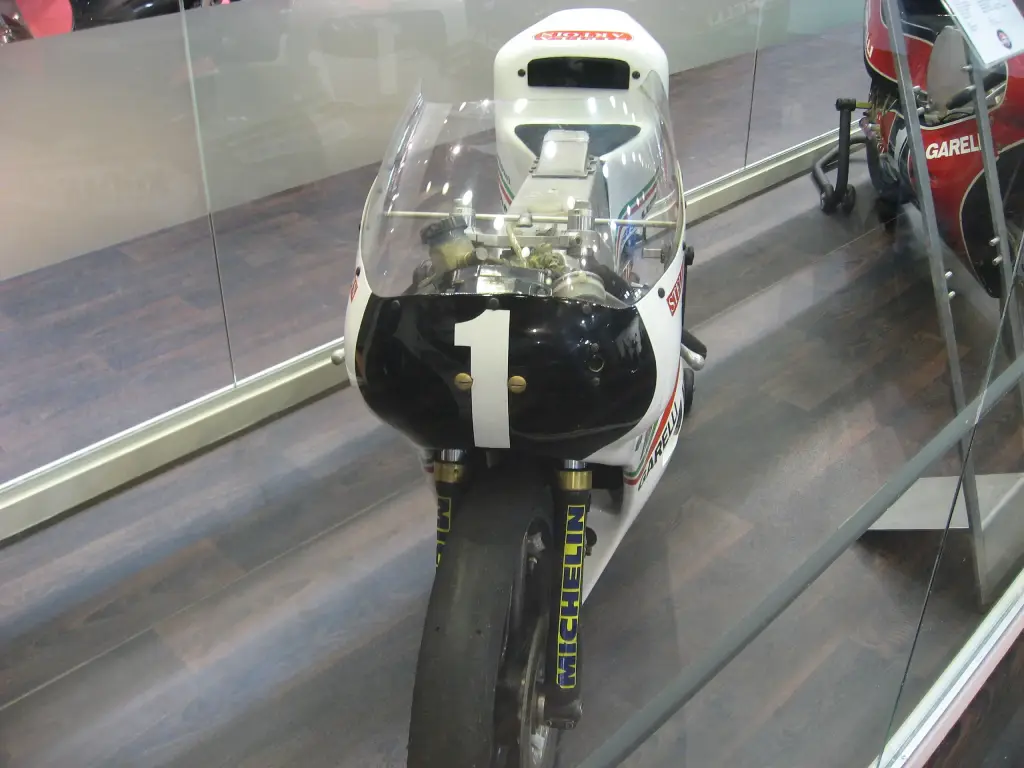
For 1985 the monocoque frame was made in aluminium instead of steel, the steering head angle went from 27.5 to 26 degrees for better handling, a steering damper was added, and the suspension suppliers changed from Marzocchi to Forcella Italia at the front and White Power at the rear. The team passed to the Italian federation as Team Italia, with Lazzarini as sporting director and Fausto Gresini and Ezio Gianola as riders, and the bikes changed from red and black to white with a green-white-red tricolour stripe. Three more titles followed up to 1987, two for Gresini and one for Luca Cadalora.
The end of the line
With the rule changes at the end of 1987 Garelli built a single-cylinder machine for 1988, using an engine derived from one cylinder of the 250 GP bike of 1985. It was never as competitive as its predecessor and was withdrawn in the middle of the 1990 season, as results faded and the Lombard company ran into financial trouble.
Design and features
- Racing pedigree: a direct descendant of the Minarelli that Nieto took to two world titles.
- Winning record: 44 victories from 75 Grand Prix starts between 1982 and 1987.
- Italian titles: three rider championships (1985, 1986, 1988), a constructors’ title in 1985 and the 1988 European championship.
- Aerodynamics: wind-tunnel work at FIAT’s Orbassano centre from the 1983 Austrian Grand Prix.
Garelli 125 GP versions
- 1982–1984: red and black livery, steel monocoque frame, Marzocchi suspension.
- 1985–1987: white livery with tricolour stripe, aluminium frame, steering damper, Forcella Italia and White Power suspension.
- 1988–1990: single-cylinder machine derived from the 250 GP engine, less successful and retired in mid-1990.
The 125 GP was the factory racer of the marque whose mopeds are described in the Garelli Gulp and Garelli Mosquito articles. More machines are in the Garelli collection.
Video: Garelli 125 GP among other 125 cc racers
Video by Alain Payrissat on YouTube.
Sources
- Garelli 125 GP, Italian Wikipedia: development, seasons, riders, titles
- Garelli Motorcycles, English Wikipedia: championship years, place in the company’s history