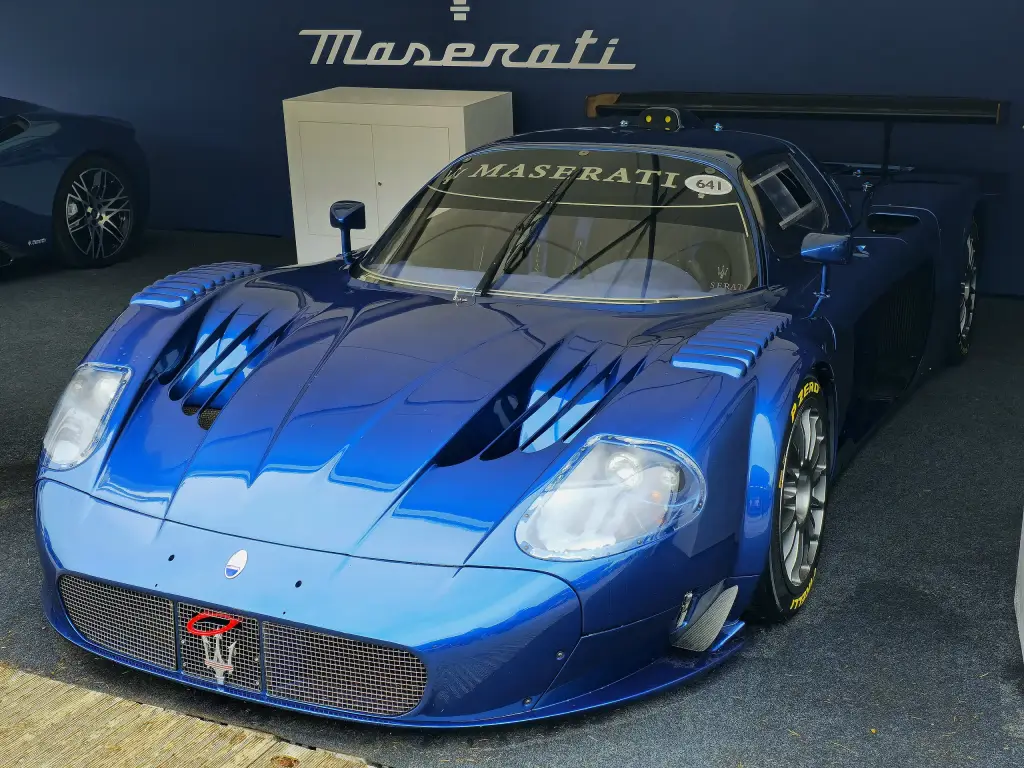
The Maserati MC12, internally Tipo M144S, is a limited-production two-seater sports car built from 2004 to 2005 to allow a racing variant to compete in the FIA GT Championship. Fifty road cars were made, plus twelve racing cars, for a total of 62. It was developed to signal Maserati’s return to racing after 37 years.
Maserati MC12 at a glance
| Maker | Maserati, Modena |
|---|---|
| Project code | Tipo M144S |
| Production | 2004–2005 |
| Base | Ferrari Enzo chassis and engine |
| Road cars | 25 in 2004, 25 in 2005 |
| Racing cars | 12 |
| Total built | 62 |
| Engine | 5,998 cc 65-degree V12, 232 kg, dry sump |
| Power | 630 PS (463 kW) at 7,500 rpm |
| Torque | 652 N·m at 5,500 rpm |
| Top speed | 330 km/h |
| 0–100 km/h | 3.8 seconds |
Based on one source: the English Wikipedia article on the MC12.
History of the Maserati MC12
Under the direction of Giorgio Ascanelli, Maserati began developing an FIA GT-eligible race car. The car that became the MC12 was first called the MCC, for Maserati Corse Competizione, and was to be developed alongside a road version called the MCS, for Maserati Corse Stradale. Frank Stephenson, then director of Ferrari-Maserati concept design and development, did most of the body styling, but the initial shape was developed in wind tunnel testing from an idea presented by Giorgetto Giugiaro. The MCC had a very similar body to the MC12 but with key differences, most notably the rear spoiler. Andrea Bertolini was chief test driver throughout development, and some testing was done by Michael Schumacher, who often tested the MCC at Fiorano. The MCC name was set aside once Maserati established the official name, MC12.
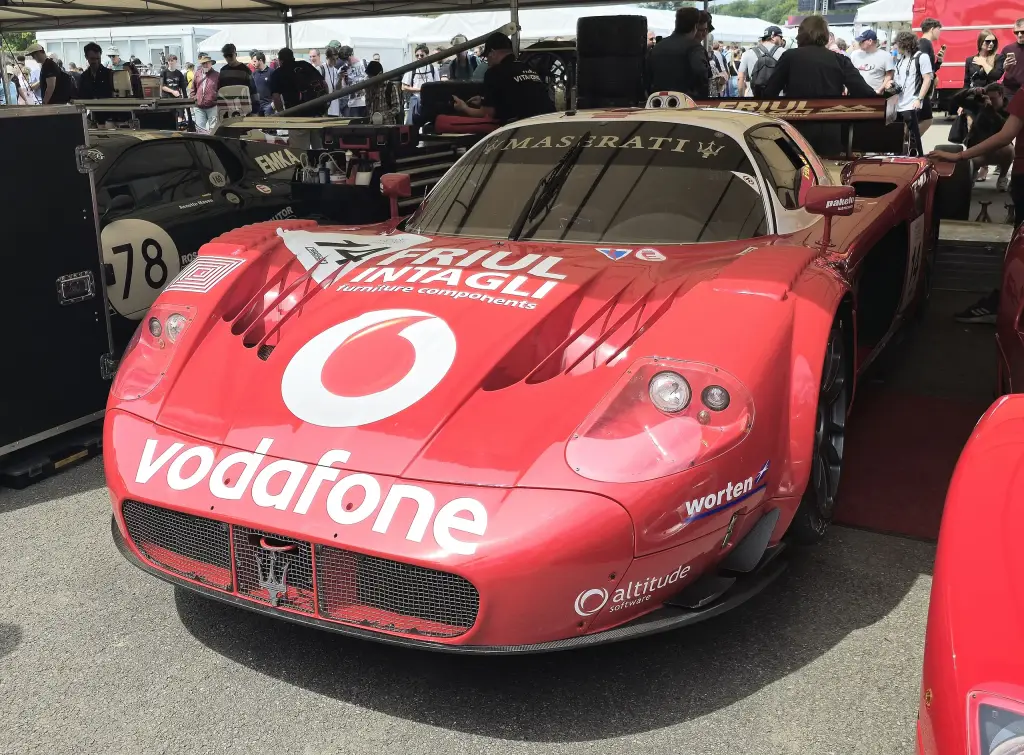
The car is based heavily on the Ferrari Enzo, using a slightly modified version of the Ferrari F140 V12, the same gearbox under the name Maserati Cambiocorsa, and the same chassis and track. The windscreen is the only externally visible component shared with the Enzo; the MC12 has a unique body that is wider, longer and slightly taller, which creates greater downforce along with that of the two-metre rear spoiler.
Homologation and racing
The road version was produced to homologate the race car, because FIA GT requires at least 25 road cars. Three GT1 race cars were entered in the FIA GT Championship with great success, and Maserati began racing the MC12 towards the end of the 2004 season, winning the race at the Zhuhai International Circuit. The racing MC12s were entered in American Le Mans Series races in 2005 but exceeded the size restrictions and consequently paid weight penalties. The cars entered production in 2004 with 25 built, and a further 25 were built in 2005 after the FIA changed the rules and reduced the maximum length allowed; the second batch is 150 mm shorter than the originals. With the addition of the 12 racing cars, just 62 were ever produced. Compared with the Enzo, the MC12 is slower to accelerate, needs a longer braking distance and has a 20 km/h lower top speed of 330 km/h against 350 km/h.
Design and interior
The MC12 is a two-door coupé with a targa roof, although the detached roof cannot be stored in the car. The mid-rear layout, with the engine between the axles but behind the cabin, keeps the centre of gravity in the middle and improves stability and cornering. Standing weight distribution is 41 per cent front and 59 per cent rear, and at 200 km/h the downforce shifts the balance to 34 per cent front and 66 per cent rear. The body is made entirely of carbon fibre and was extensively tested in the wind tunnel; the rear spoiler is 2 m wide but only 30 mm thick, the underside is smooth and the rear bumper has diffusers to exploit ground effect, while air is drawn into the engine bay through a scoop on top of the cabin. The interior mixes gel-coated carbon fibre, blue leather and silver Brightex synthetic material, with the characteristic Maserati oval clock and a blue ignition button, but it has been criticised for having no radio or place to fit an aftermarket sound system. The car is available only in the white-and-blue colour scheme, a tribute to the America Camoradi racing team that drove Maserati Birdcages in the early 1960s, though bespoke colours cost extra. It is wider and longer than a Hummer H2, making it one of the longest production supercars ever built, and the lack of a rear window makes parking difficult. The longitudinally mounted 5,998 cc 65-degree V12, derived from the Enzo, weighs 232 kg, has four valves per cylinder, dry-sump lubrication and an 11.2:1 compression ratio, producing 652 N·m at 5,500 rpm and 630 PS at 7,500 rpm.
Design and features
- Enzo underneath: the Ferrari Enzo chassis, gearbox and a modified F140 V12.
- Homologation special: 25 road cars were required for FIA GT, and 50 were built.
- Carbon-fibre body: a two-metre rear spoiler just 30 mm thick and a smooth underbody.
- White and blue only: a tribute to the Camoradi racing team.
- Huge footprint: wider and longer than a Hummer H2.
Maserati MC12 versions
- MC12 road car (2004): the first batch of 25 cars.
- MC12 road car (2005): a second batch of 25, 150 mm shorter.
- MC12 GT1 (2004–2005): the racing version, 12 built.
The MC12’s white-and-blue livery honoured the Maserati Birdcage and the Camoradi team, and it was followed much later by the GranTurismo MC racing programme. More cars are in the Maserati collection.
Sources
- Maserati MC12, English Wikipedia: development, homologation, design, engine