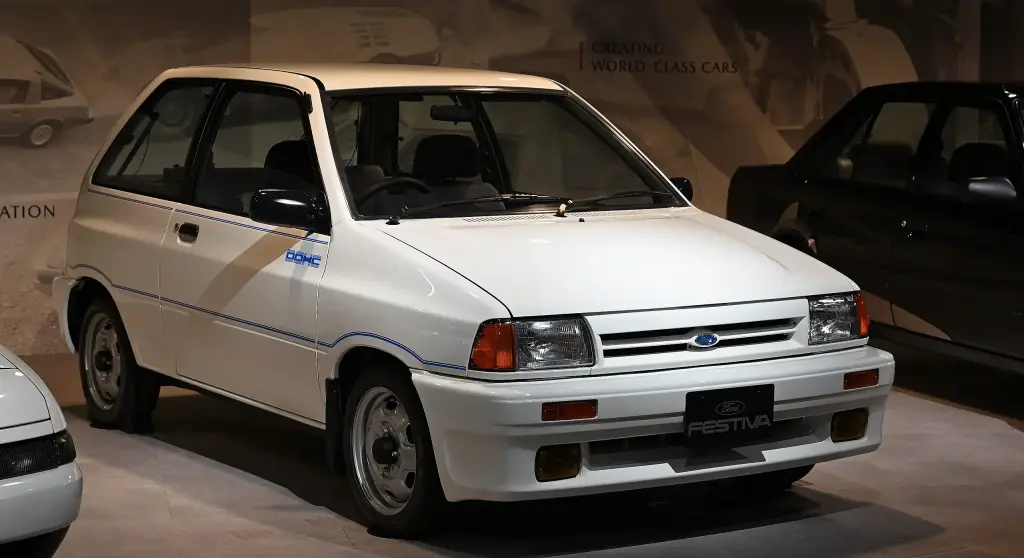
The Ford Festiva was a four-seat front-wheel-drive subcompact designed by Mazda and manufactured in South Korea by Kia under licence. Ford sold it from 1986 to 2002 over three generations, and roughly 350,000 of the Kia-built cars were sold in the United States.
Ford Festiva at a glance
| Maker | Kia Motors, South Korea, for Ford |
|---|---|
| Design and engineering | Mazda, on the DA platform |
| Ford sales | 1986–2002 |
| Generations | three |
| First generation | WA, launched in Japan in February 1986 |
| First engines | 1.1 and 1.3 litres |
| US engine | 1.3-litre B3 four |
| US trims | L, L Plus, LX, then GL from 1991 |
| Kia twin | Kia Pride |
| Second generation | Ford Aspire in North America, Kia Avella elsewhere |
| Name from | the Spanish word for festive |
This page is based on English Wikipedia only.
History of the Ford Festiva
A Mazda for Ford, built by Kia
Ford asked Mazda to design and engineer a small car, and the result was the Festiva, built on Mazda’s DA platform with B-series four-cylinder engines. The three-door hatchback was launched in Japan in February 1986 as a Ford Festiva with 1.1 and 1.3-litre engines, sold through Ford’s Autorama dealership network. It used front-wheel drive, rack-and-pinion steering, independent front suspension with struts, coil springs and a sway bar, and a torsion beam rear axle. It was facelifted in 1989 with a new grille insert and tail lamp lenses. In Japan the range included L, L Special, S, Ghia and Canvas Top levels, and at the 1986 Tokyo Motor Show Ford showed GT and GT-X versions with a twin-cam 1.3 and a bonnet bulge, which went on sale on 1 December 1986.
The Kia Pride and North America
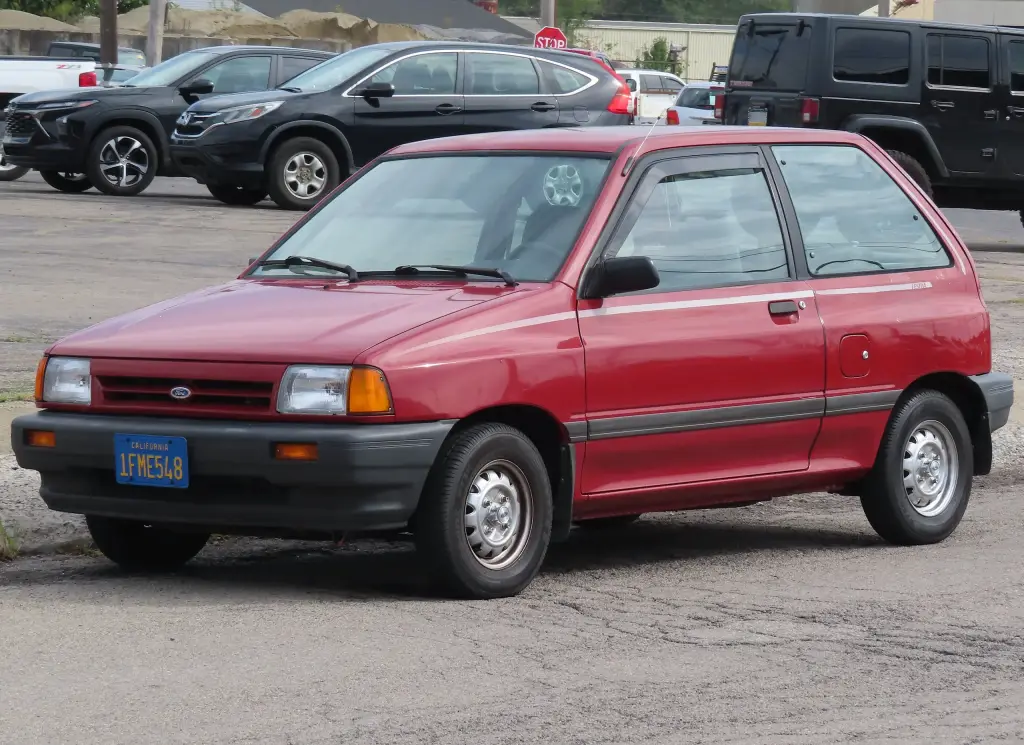
From mid-1986 Kia Motors in South Korea built the Festiva under licence as the Kia Pride. Exports to the United States under the Ford Festiva name began in late 1987 for the 1988 model year, and Canadian sales started in January 1989 through Ford and Mercury dealers. American buyers had one engine, the 1.3-litre B3, and three trims: L, L Plus and LX, the base cars with a four-speed manual overdrive gearbox and the LX with five speeds, alloy wheels, remote mirrors and a cassette radio. A 1990 facelift brought fuel injection, a five-speed manual or optional three-speed automatic and motorised front seat belts. Roughly 350,000 Kia-built Festivas were sold in the United States. Australasia and Europe took the first version between 1987 and 1991 as the Mazda 121, and from 1991 Australasian sales used the Ford Festiva name while Europe kept the Kia Pride.
Three generations
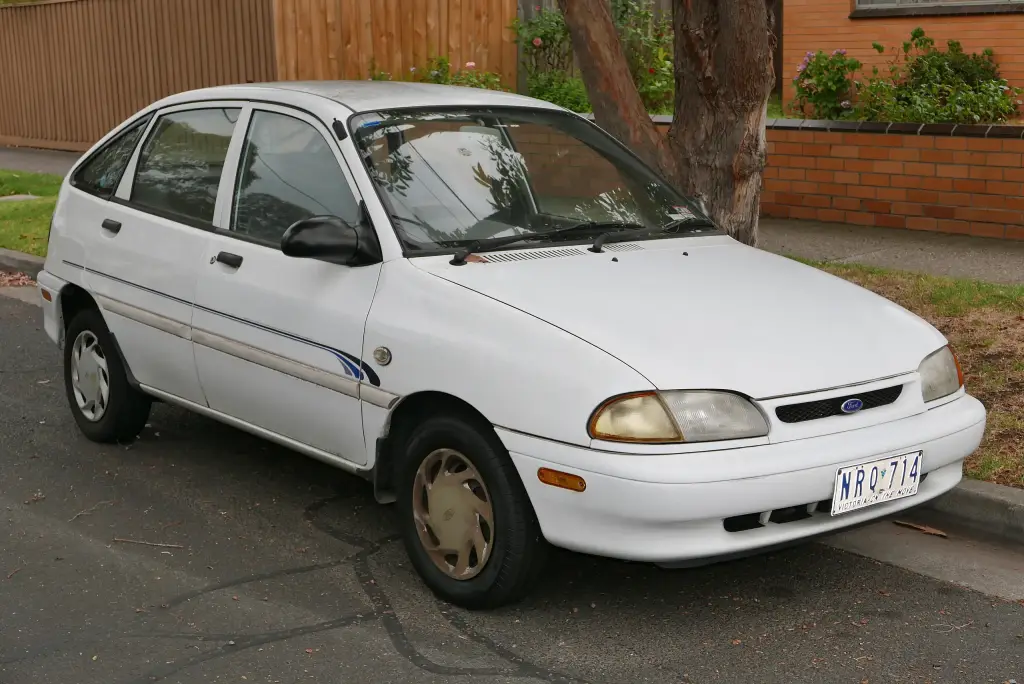
The second generation arrived in 1993 and was sold for model years 1993 to 2000 as the Ford Aspire in North America and the Kia Avella elsewhere, while the first generation overlapped it in production. The third generation of 1996 to 2002 was a badge-engineered Mazda Demio, sold mainly in Japan and rarely with Ford badges elsewhere. The first generation’s safety record was poor: the 2008 Monash University Used Car Safety Ratings gave it two out of five stars, “worse than average” among light cars. The name Festiva comes from the Spanish word for festive.
Design and features
- Mazda engineering: DA platform and B-series engines.
- Korean production: built by Kia and also sold as the Kia Pride.
- Simple running gear: front-wheel drive with struts and a torsion beam.
- Cheap transport: the LX was the only trim with a five-speed gearbox at launch.
Ford Festiva versions
- Festiva WA (1986–1993): the first generation, also the Kia Pride and Mazda 121.
- GT and GT-X (1986): Japanese twin-cam versions with a bonnet bulge.
- Festiva L, L Plus and LX: the North American trims.
- Festiva GL (1991): the combined trim after the range was simplified.
- Ford Aspire (1993–2000): the second generation in North America.
- Third generation (1996–2002): a rebadged Mazda Demio for Japan.
The Festiva was the small car Ford sold below the Fiesta in some markets, and its North American replacement, the Aspire, was sold until 2000. More Ford vehicles are in the Ford collection.
Sources
- Ford Festiva, English Wikipedia: origins, generations, markets, trims