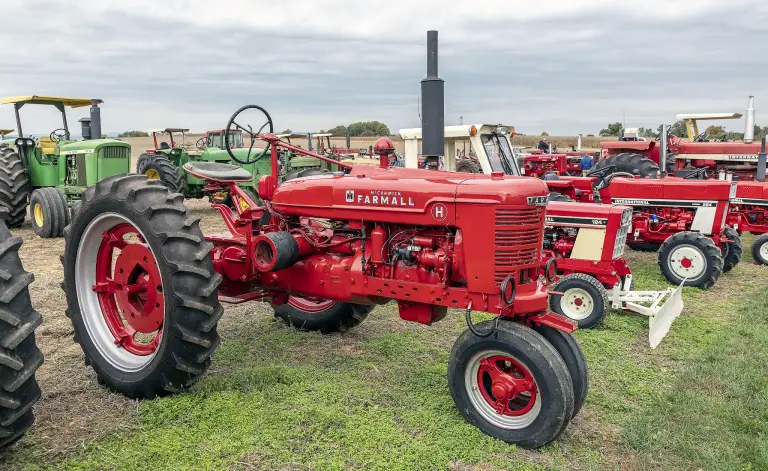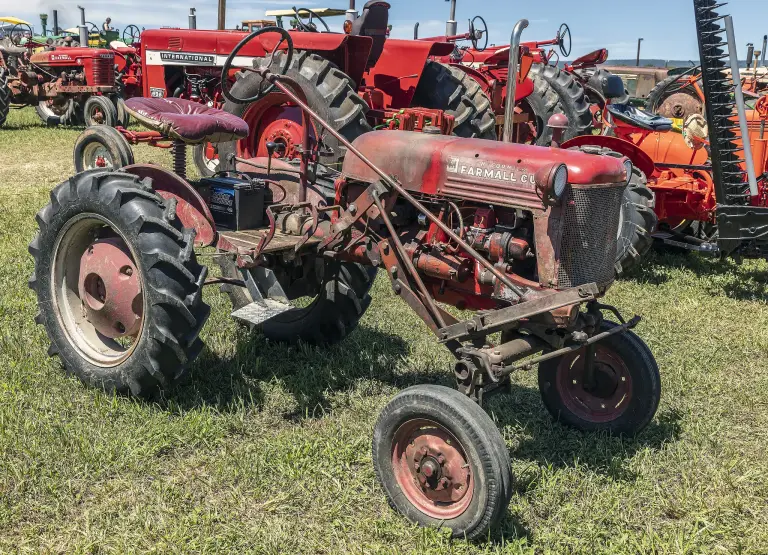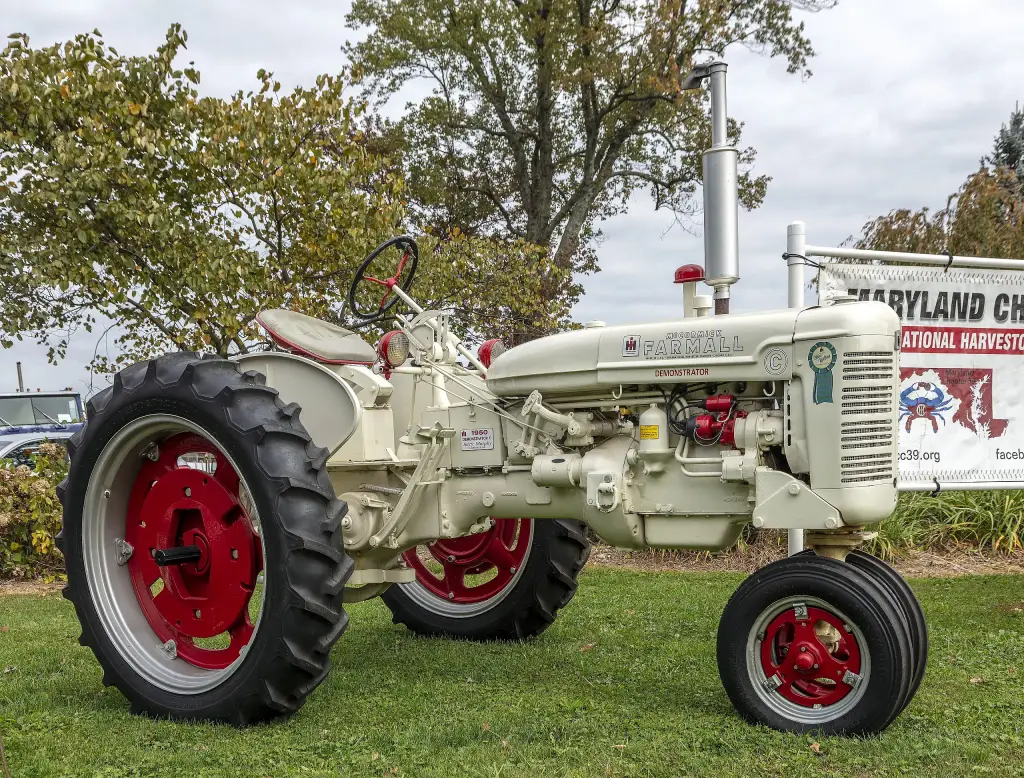
The Farmall C was a small two-plow row-crop tractor produced by International Harvester from 1948 to 1951. Developed from the Farmall B, it raised and moved the B’s offset operator seat to the centreline, increased the wheel size and used a straight, widely adjustable rear axle. It was the first of the small Farmalls to offer hydraulic capability from the beginning.
Farmall C at a glance
| Maker | International Harvester, USA |
|---|---|
| Production | 1948–1951 |
| Predecessor | Farmall B |
| Engine | IH C123, 123 cu in (2,020 cc) four-cylinder |
| Transmission | four forward and one reverse gear |
| Plow rating | two 14-inch plows |
| Rear axle | straight, splined, widely adjustable |
| Front end | tricycle, closely spaced front wheels |
| Styling | Raymond Loewy |
| Built | 103,800 |
| Successors | Super C, 200, 230, 240 |
Based on one source, the English Wikipedia article on the Farmall C, which also covers the Super C, 200, 230 and 240.
History of the Farmall C
The Farmall C was introduced in 1948 as the two-plow successor to the Farmall B, and it was one of International Harvester’s “letter series” styled by Raymond Loewy. Work had begun in September 1939 under the development designation Farmall E, but the introduction was delayed by the Second World War until 1948. The C was rated for two 14-inch plows, and International Harvester built 103,800 of them over four years.
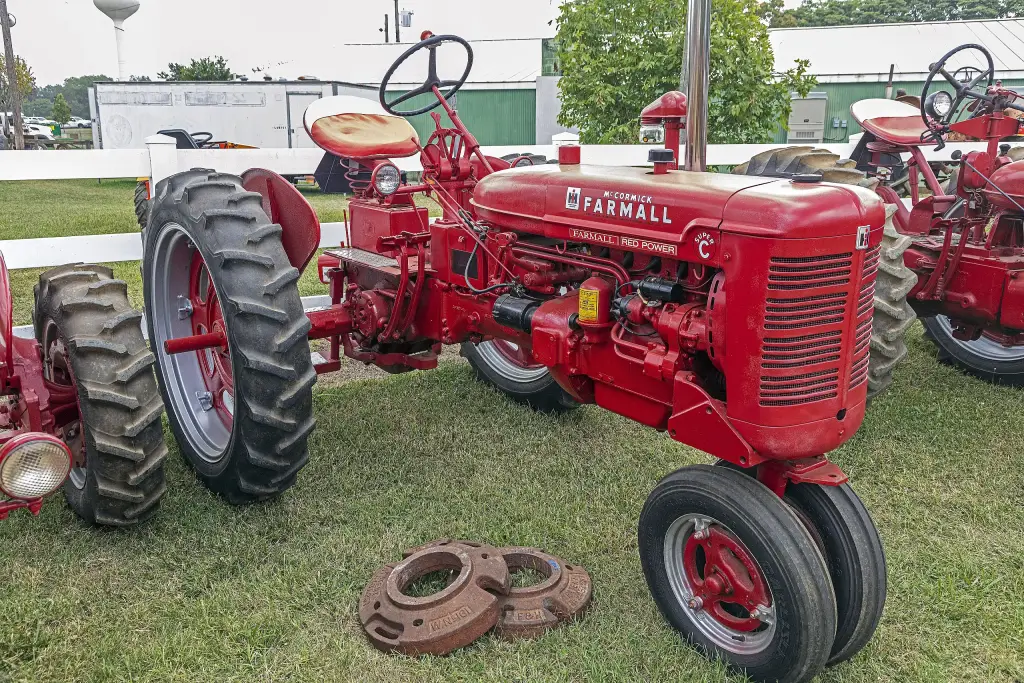
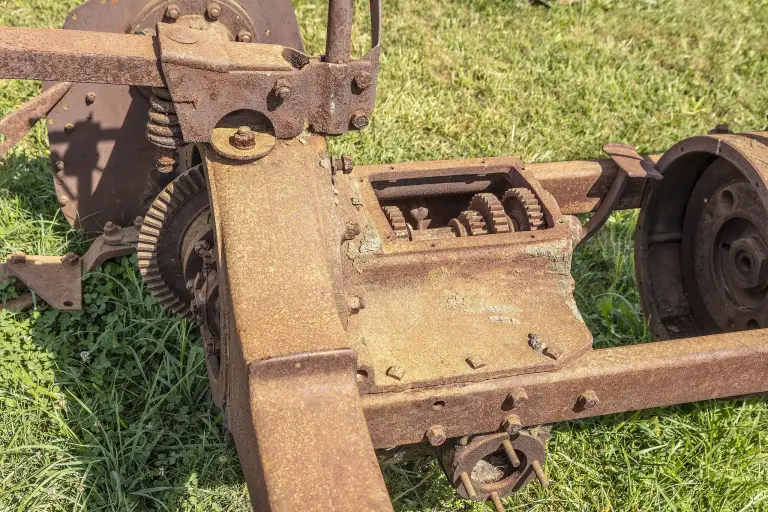
The C kept the 123-cubic-inch International Harvester four-cylinder overhead-valve engine that had been used in the Super A. It did away with the B’s offset operator’s position and its geared portal axle, replacing them with a straight, splined rear axle with a much greater range of adjustment, while larger wheels provided the necessary clearance underneath. The tractor stayed with a tricycle configuration, with closely spaced front wheels under the engine housing. It was heavier and more robust than the B, and unlike the earlier small Farmalls it had hydraulic capability from the start.
From 1951 to 1954 International Harvester produced the Farmall Super C, using a 26-horsepower version of the 123-cubic-inch IH C123 engine. About 112,000 Super C tractors were built, with either narrow or wide front wheels, and they were replaced by the Farmall 200. The 200 was a rebadged Super C with minor improvements, sold from 1954 into 1956 and marketed at farms of 80 to 120 acres; it introduced an optional “Hydra-Creeper” hydrostatic drive that allowed a creep speed of about 0.25 mph for transplanting work. The 230 of 1956–1958 brought styling changes and a higher compression ratio, and the restyled 240 of 1958–1962 closed the line, which had remained essentially the same machine throughout.
Design and features
- Two-plow rating: a step up from the one-plow Farmall A and B.
- Centred operator: the seat moved from the B’s offset position to the centreline.
- Straight rear axle: splined and widely adjustable, replacing the portal axle.
- Hydraulics from the start: the C was designed with hydraulic capability from the beginning.
- C123 engine: the 123 cu in engine carried over from the Super A.
Farmall C versions
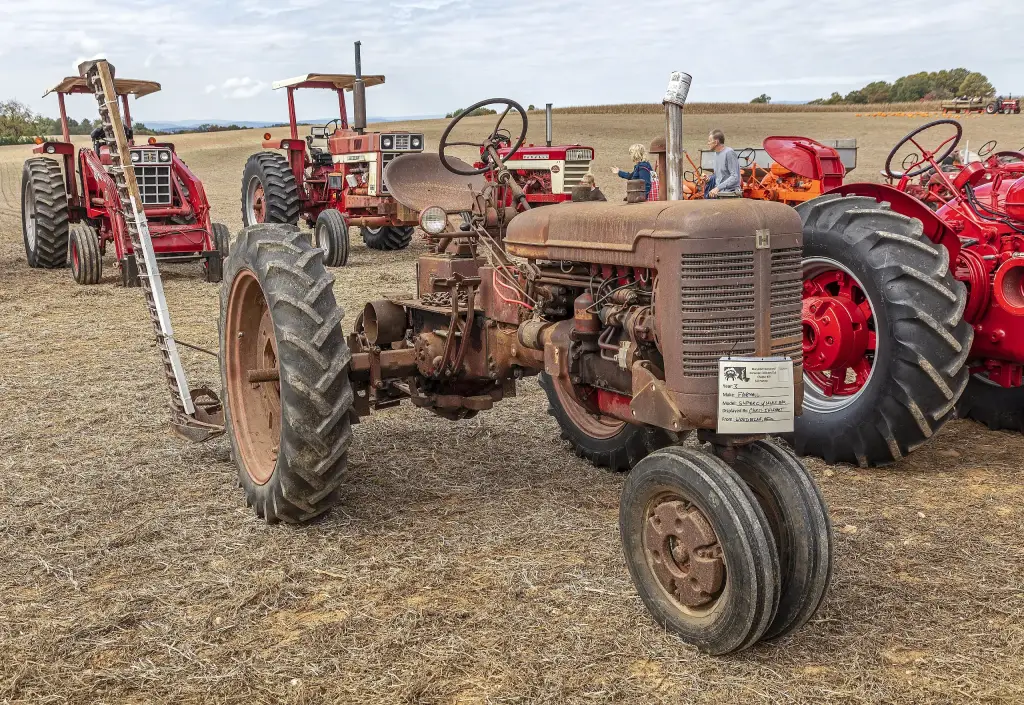
- Farmall C (1948–1951): the original two-plow model, 103,800 built.
- Farmall Super C (1951–1954): 26 hp, about 112,000 built, narrow or wide front wheels.
- Farmall 200 (1954–1956): rebadged Super C with the optional Hydra-Creeper drive.
- Farmall 230 (1956–1958): restyled with a higher compression ratio.
- Farmall 240 (1958–1962): squared-off styling and an adjusted operator position.
The C replaced the Farmall B and shared its engine with the Super A. More Farmall tractors are in the Farmall collection.
Sources
- Farmall C, English Wikipedia: development, engine, Super C and later models