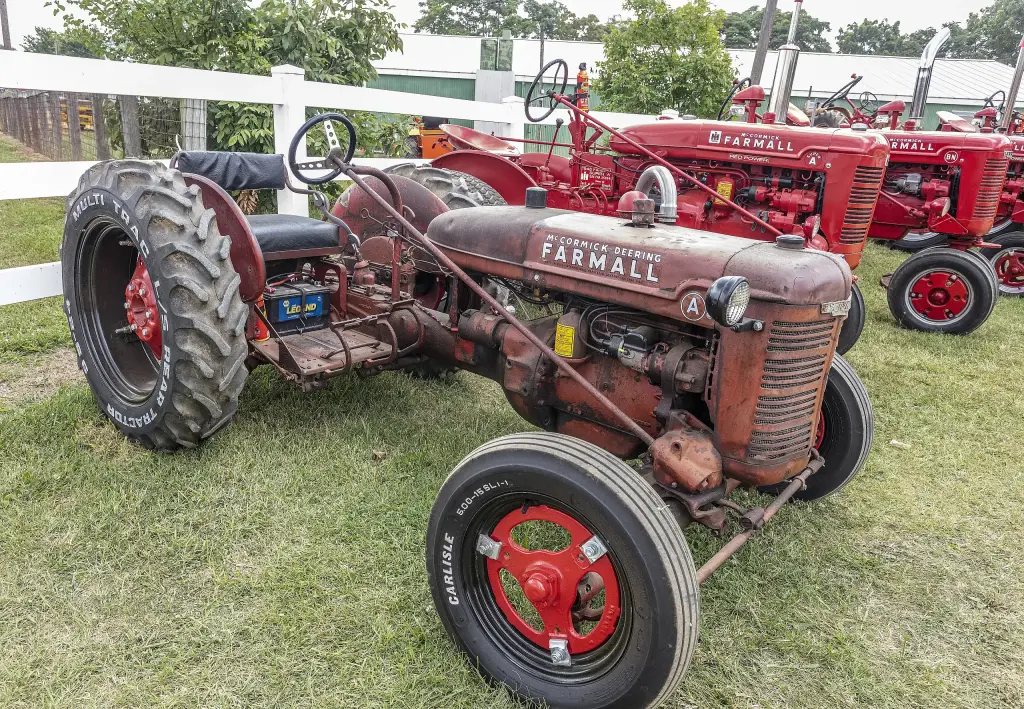
The Farmall A was a small one-plow row-crop tractor built by International Harvester from 1939 to 1947. It succeeded the Farmall F-14 and, like the smaller Farmall Cub, used an offset engine to give the driver a clear view of the row ahead. Incremental updates kept the same basic machine in production, under new model numbers, until 1973.
Farmall A at a glance
| Maker | International Harvester, USA |
|---|---|
| Production | 1939–1947 |
| Predecessor | Farmall F-14 |
| Engine | IH C113, 113 cu in (1,850 cc) four-cylinder |
| Engine from A-1 | IH C123, 123 cu in |
| Transmission | four forward and one reverse gear |
| Plow rating | one 14-inch plow |
| Rear axle | portal axle, track adjustable from 40 to 68 inches |
| Styling | Raymond Loewy |
| Built | 117,522 |
| Price | $575–$1,000 for the A and B together |
| Successors | Super A, A-1, 100, 130, 140 |
Based on one source, the English Wikipedia article on the Farmall A, which also covers the AV, Super A and the later 100, 130 and 140.
History of the Farmall A
The Farmall A was introduced in 1939 as a replacement for the Farmall F-14 and was one of International Harvester’s celebrated “letter series”, styled by Raymond Loewy. It used the F-14’s International Harvester C113 four-cylinder overhead-valve engine of 113 cubic inches, and was rated for a single 14-inch plow. The sliding-gear transmission had four forward gears and one reverse, driving through a geared portal axle. The A carried a 20-pound stamped-steel disc on the left rear wheel and a 170-pound cast-iron disc on the right, with a bolted-on weight at the right front. Production reached 117,522 over eight years.
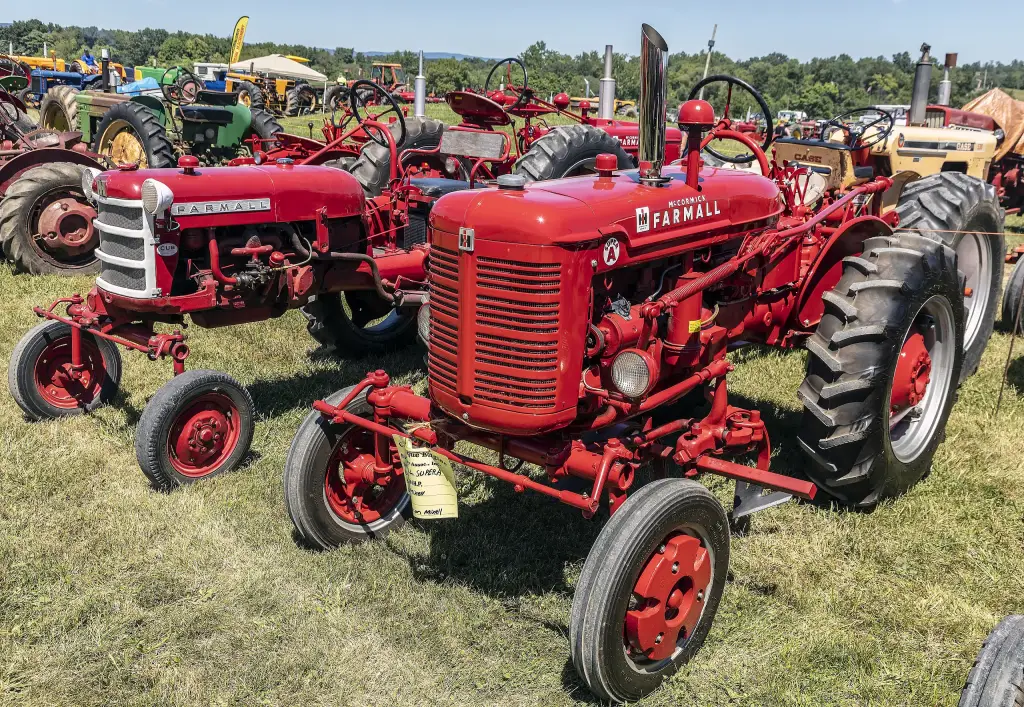
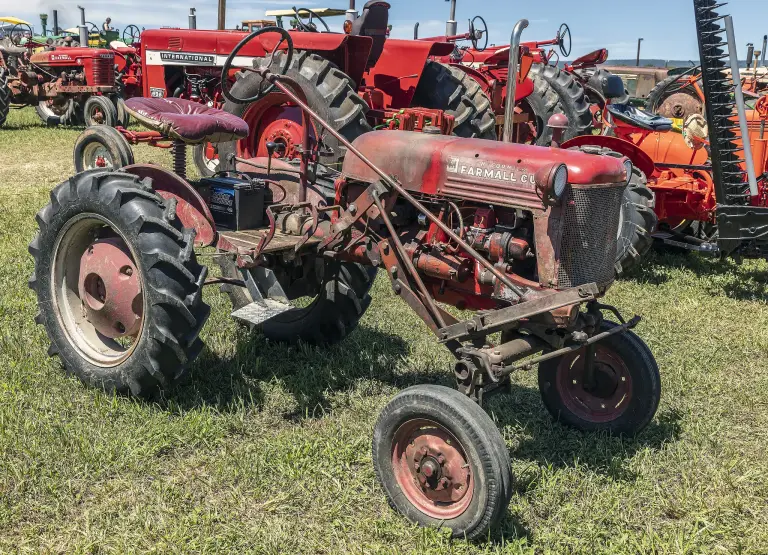
The A’s best-known feature was its offset engine, moved to the left over wide-set front wheels so that the driver could see the row directly ahead; International called the idea CultiVision. The wide front track and the offset engine also suited front-mounted cultivators, unlike the towed equipment used with competing Ford-Ferguson tractors. Like the other letter-series Farmalls, the A had an integral frame and unitary construction, so complete assemblies could be removed and replaced. The rear portal axle gave ground clearance and allowed the track to be adjusted from 40 to 68 inches.
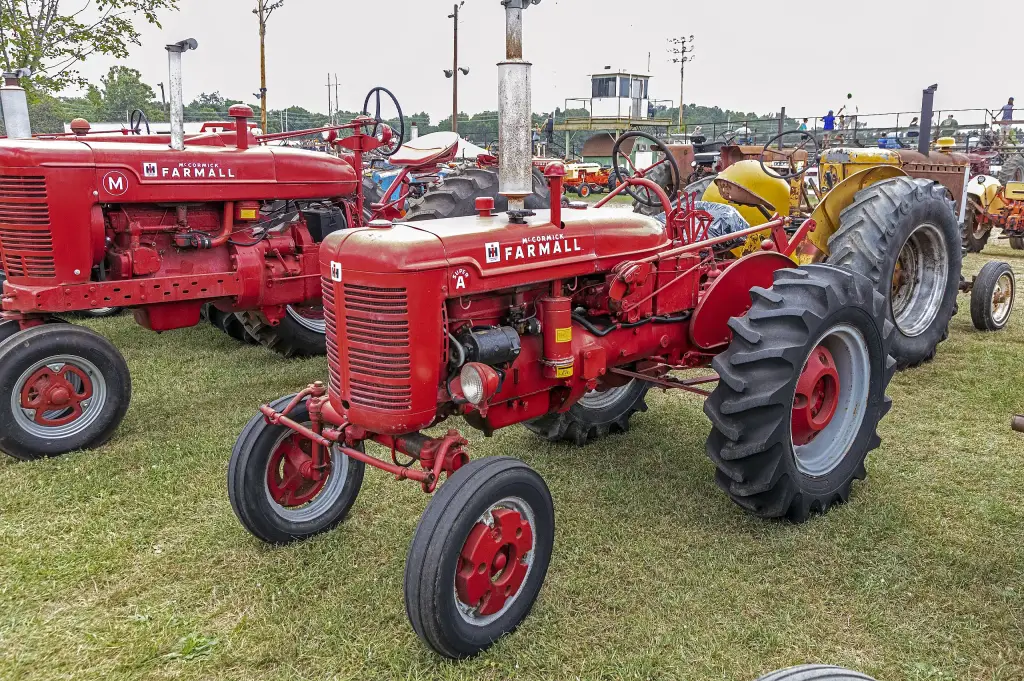
From 1947 to 1954 International Harvester built the Farmall Super A, which kept the same engine displacement but added a hydraulic lift system. About 94,000 Super A tractors were made, including the high-clearance Super AV variants. In 1954 came the Super A-1, with a higher-revving IH C123 engine and otherwise identical to the Super A. The line then continued as the Farmall 100 of 1955, the 130 of 1956–1958 and the 140 of 1958–1973, all essentially the same machine with new grilles, trim and electrical systems; the last of them was restyled with the squared-off look of the larger Farmalls in 1963.
Design and features
- Offset engine: the engine sat to the left, giving the CultiVision view of the row.
- Portal axle: geared rear axle with track adjustable from 40 to 68 inches.
- Modular construction: integral frame and unitary assemblies that could be replaced as units.
- Hydraulic lift: introduced with the Super A in 1947.
- Loewy styling: the A was one of the Raymond Loewy-styled letter-series tractors.
Farmall A versions
- Farmall A (1939–1947): the original one-plow tractor.
- Farmall AV: high-clearance version with 5 inches more ground clearance for vegetable crops.
- International A (AI): industrial version with a foot throttle and heavier front axle, used mainly as a mower.
- Farmall Super A (1947–1954): hydraulic lift, about 94,000 built including Super AV.
- Farmall Super A-1 (1954): higher-rpm C123 engine.
- Farmall 100, 130 and 140: later updates of the same design, built until 1973.
The narrow-front Farmall B was the same tractor with a centred engine, and the two-plow Farmall C was its larger stablemate. More Farmall tractors are in the Farmall collection.
Sources
- Farmall A, English Wikipedia: production, engine, CultiVision, Super A and later models