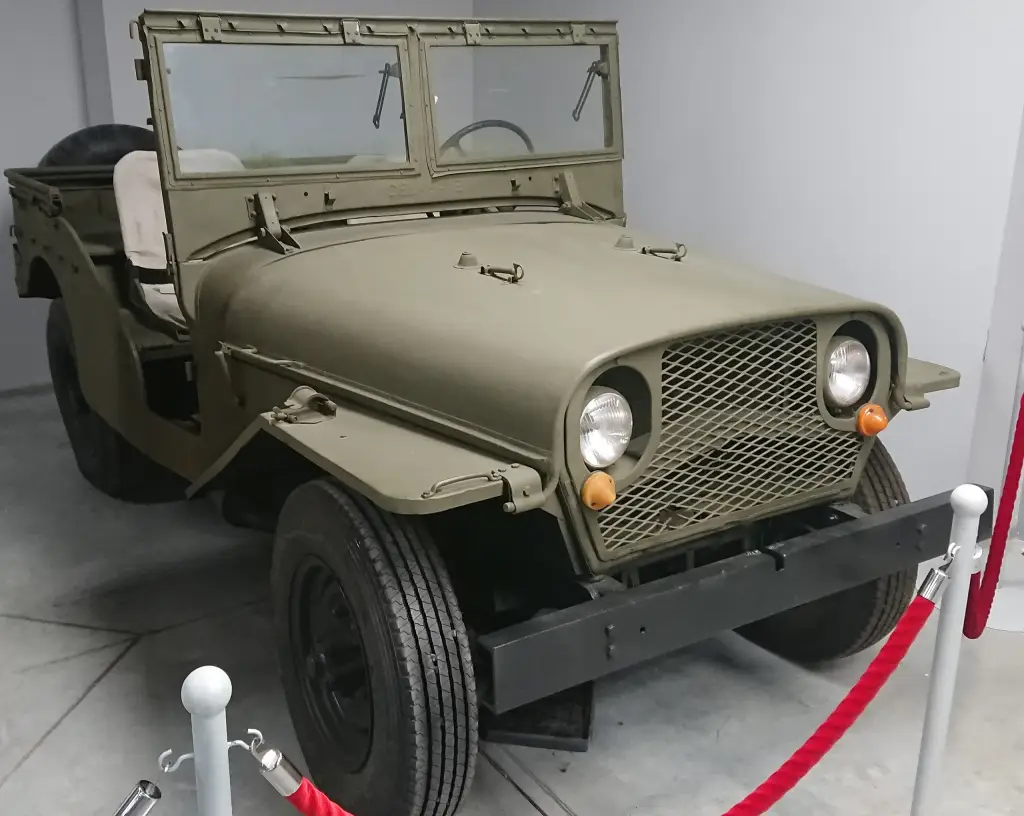
The Delahaye VLR was a four-wheel-drive passenger vehicle inspired by the American Jeep and presented by Delahaye in the summer of 1950. Built for the French army, it was the model that kept the luxury car maker alive during the early 1950s.
Delahaye VLR at a glance
| Maker | Delahaye, Paris |
|---|---|
| Also known as | VLRD (Véhicule léger de reconnaissance Delahaye) |
| Factory code | Type 182 |
| Production | 1951–1954; deliveries into 1955 |
| Engine | 1,992 cc water-cooled four-cylinder, aluminium block |
| Power | 63 hp |
| Gearbox | four-speed, fully synchronised, with reduction box |
| Drive | four-wheel drive, differential locks on both axles |
| Top speed | 110 km/h |
| Weight | 1,460 kg |
| Payload | 400 kg or four people |
| Built | about 9,600, almost all for the army |
History of the Delahaye VLR
A French replacement for the Jeep
After the Second World War the French army was equipped largely with surplus American Jeeps, but politicians wanted vehicles built in France. A programme was launched for a small 1.2-tonne 4×4 to replace the Willys MB, and, apparently because of the state of the economy, the VLR project was given to Delahaye without a competition. Delahaye was a luxury car maker that had turned to commercial vehicles during the war, and a military contract was a chance to survive: the luxury market had collapsed under post-war taxation. A first prototype was ready in 1948 under the name Delta, originally with a Renault engine, before it received an aluminium overhead-valve four-cylinder. Delahaye hoped the small 4×4 could serve farmers as well as the army, much as the Land Rover and the Unimog did.
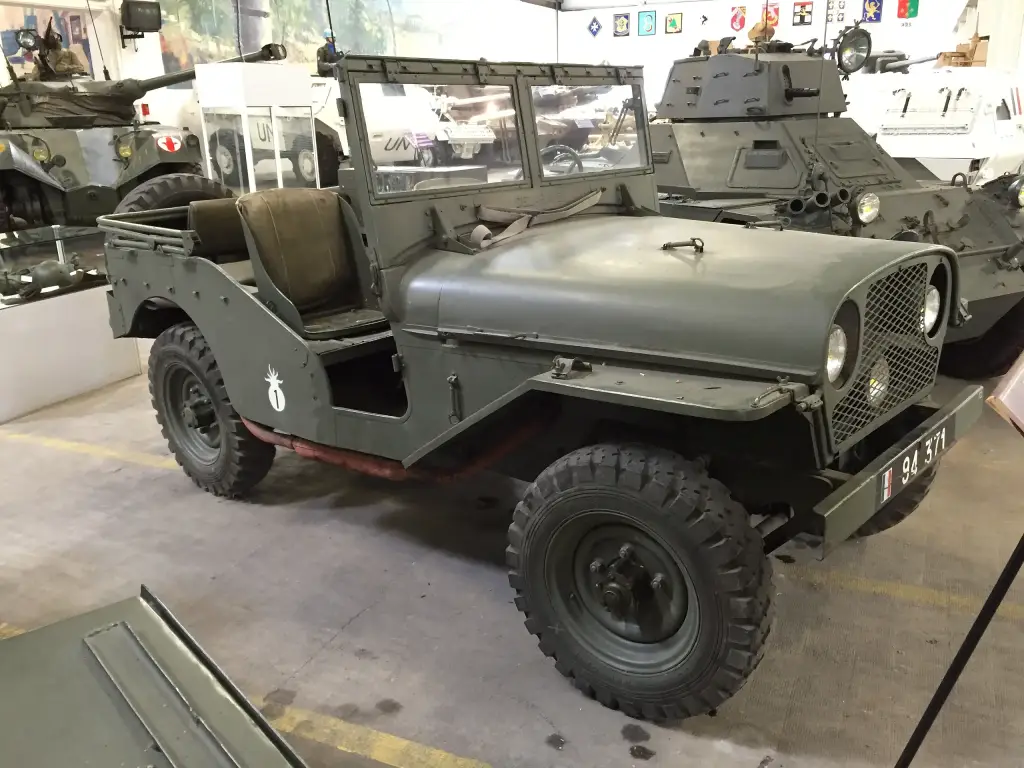
Engineering
The VLR was technically ambitious for its class. Its 1,992 cc water-cooled four had an aluminium block and developed 63 hp, and the four-speed gearbox was fully synchronised with a reduction box giving eight ratios in all. Each wheel had adjustable torsion-bar suspension, both axles had differential locks, and the electrical system was 24-volt as the army required. The open body had no doors, a folding windscreen and five seats, one more than the Jeep, and the car could reach 110 km/h, climb slopes of 60 to 70 per cent, ford 60 cm of water and carry 400 kg or four people at a kerb weight of 1,460 kg. Its military name was VLRD, and the works code was Type 182.
Service and decline
The army tested the VLR extensively in the second half of 1950, homologated it with only minor changes and ordered slightly more than 4,000. The order was welcome because Delahaye’s main post-war car, the 175, had done badly, with 521 built between 1947 and 1950. A civilian version was offered with a 12-volt system, but at over one and a half million francs it was expensive against the many cheap ex-military Jeeps, and almost all of the 9,621 VLRs sold between 1951 and 1955 went to the army. In service the sophisticated mechanics proved unreliable in the hands of soldiers: differential failures were common, the locks were often removed because they were blamed for crashes, and the 1953 model had a redesigned differential linkage. It was not enough. The army lost confidence, chose the simpler Hotchkiss-built M201, and in March 1954 Delahaye stopped VLR production, though deliveries continued into 1955. Hotchkiss took over Delahaye in 1954.
Design and features
- Air-cooled simplicity, water-cooled power: an aluminium 1,992 cc four with dry-sump lubrication.
- Eight ratios: a fully synchronised four-speed gearbox with a reduction box.
- Serious off-road kit: torsion-bar suspension at each wheel and differential locks on both axles.
- Military electrics: a 24-volt system for the army, 12 volts for the few civilian cars.
Delahaye VLR versions
- VLRD (1951–1954): the military vehicle, 24-volt electrics and differential locks.
- VLRC-12: civilian version with a 12-volt electrical system.
- 1953 model: redesigned differential linkage and controls.
The VLR was built alongside the Delahaye 175, whose poor sales made the army order vital, and its failure helped bring about the Delahaye 235 and the end of the marque. More cars are in the Delahaye collection.
Video: Delahaye VLR test drive
Video on YouTube.
Sources
- Delahaye VLR, English Wikipedia: development, army order, sales, reliability
- Delahaye VLR, French Wikipedia: prototype, technical data, production numbers
- Delahaye VLR, German Wikipedia: equipment, seats, military use, Type 182