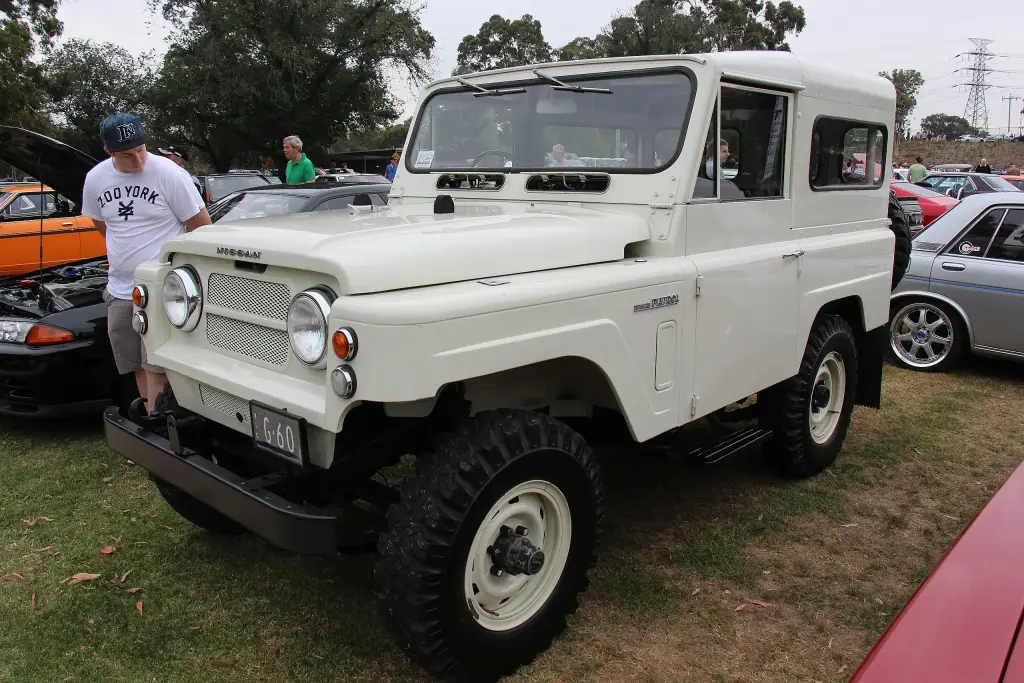
The Datsun Patrol was Nissan’s first four-wheel-drive vehicle, launched in September 1951 with styling close to the Willys Jeep. It has been in production ever since, making it Nissan’s longest-running model line, and it has spent most of that time competing with the Toyota Land Cruiser in almost every market where both were sold.
Datsun Patrol at a glance
| Maker | Nissan (Datsun), Japan |
|---|---|
| Production | from September 1951 |
| First model | 4W60, with part-time four-wheel drive |
| First engine | 3.7 L NAK six, 75 PS (55 kW) |
| 1955 update | 4W61 with the 3.7 L NB, 92 PS |
| Later engines | 4.0 L NC with 105 PS; 4.0 L P with 125 PS |
| Bodies | short-wheelbase three-door and long-wheelbase five-door, van and pickup |
| 1958 model | 4W65 with an all-chrome grille and an eight-seat hardtop wagon |
| 60 series | from October 1960, with 2,200 mm and 2,500 mm wheelbases |
| Japanese twin | Nissan Safari, from 1980 |
| Rival | Toyota Land Cruiser |
History of the Datsun Patrol
The 4W60 Patrol was introduced in September 1951 and sold only through Japanese Nissan dealerships. Its overall styling followed the Willys Jeep, but it used the 75 PS 3.7-litre Nissan NAK engine from the Nissan 290 bus, with part-time four-wheel drive and a four-speed manual gearbox. The grille carried a pressed-steel Nissan badge, and a wagon based on the 4W70 Carrier was available.
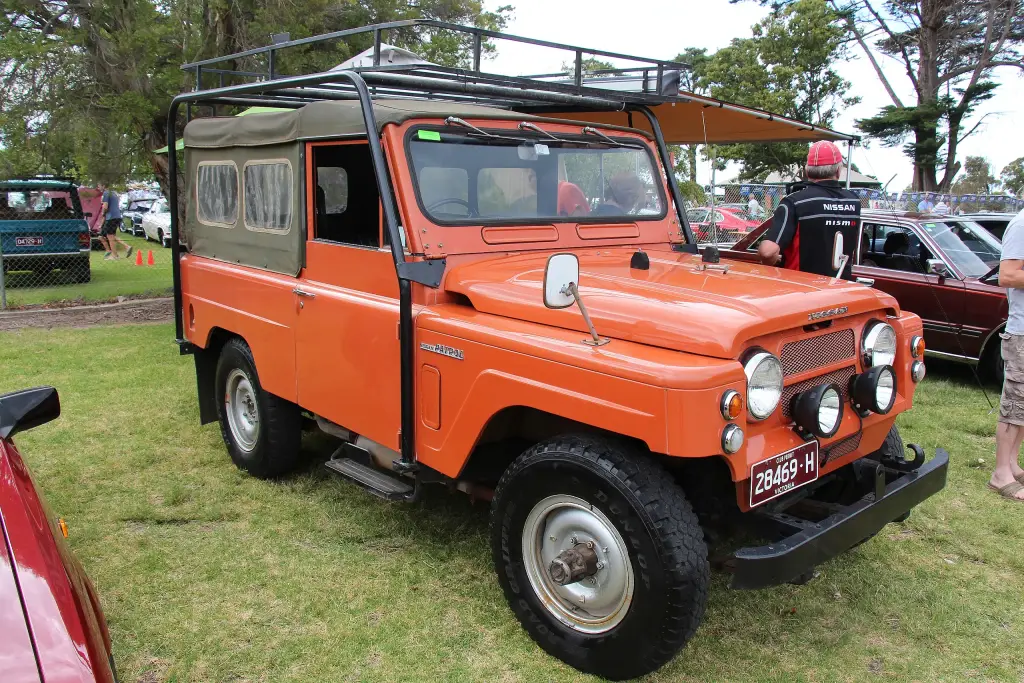
The 4W61 of August 1955 changed the grille, added some chrome bars, moved to a one-piece windscreen that sat further back when folded, and gave the passenger a wider seat than the driver. More importantly, it introduced the new 3.7-litre NB engine with 92 PS, later replaced by the 105 PS 4.0-litre NC. The 4W65 of October 1958 brought an all-chrome grille, redesigned front wings and bonnet, “Patrol” badges on the sides of the bonnet and an eight-seat hardtop wagon. A short-lived 4W66 with the 125 PS 4.0-litre P engine was built between December 1956 and June 1960.
The second generation arrived in October 1960 with the soft-top Patrol 60 on a 2,200 mm wheelbase and the G60 on a 2,500 mm wheelbase, plus left-hand-drive L60 and GL60 versions for export markets. The range also included a fire truck, sold as the Patrol Fire Truck, which used the large-displacement engine to drive an A2-class pump and was used throughout Japan rather than only in mountain and snow country. A two-wheel-drive version of the fire truck omitted the front axle and transfer lever altogether.
The Patrol was sold all over the world and has been built or rebadged in several countries: Ford Australia marketed it as the Ford Maverick between 1988 and 1994, and in Spain it was sold by Ebro as the Ebro Patrol. In Japan, from 1980, it was also rebadged as the Nissan Safari and sold through Nissan Prince Store dealerships, which is why the name Datsun Safari appears in some markets and records. The modern Patrol is a full-size SUV, and a Patrol-based vehicle returned to North America as the Infiniti QX56 for 2011.
Design and features
- Jeep-inspired start: the 1951 4W60 copied the Willys layout, with a bus engine.
- Six-cylinder power: from the 3.7-litre NAK to the 4.0-litre P.
- Two wheelbases: a short three-door and a long five-door, plus van and pickup bodies.
- Fire Patrol: a pump-equipped version used all over Japan.
- Many badges: Nissan Safari in Japan, Ebro Patrol in Spain, Ford Maverick in Australia.
Datsun Patrol versions
- 4W60 (1951–1955): the original with the 3.7-litre NAK.
- 4W61 and 4W65 (1955–1960): new engines and the all-chrome grille.
- 60 series (1960–): the Patrol 60 and G60 soft-tops and hardtops.
- Patrol Fire Truck: a pump version with an A2-class pump.
The Patrol was the largest vehicle in the Datsun collection and was never related to the Datsun truck line, despite sharing the badge.
Video: datsun patrol kivimäki
Video by Petja on YouTube.
Sources
- Nissan Patrol, English Wikipedia: first and second generations, engines, markets
- Nissan Patrol, German Wikipedia: model history