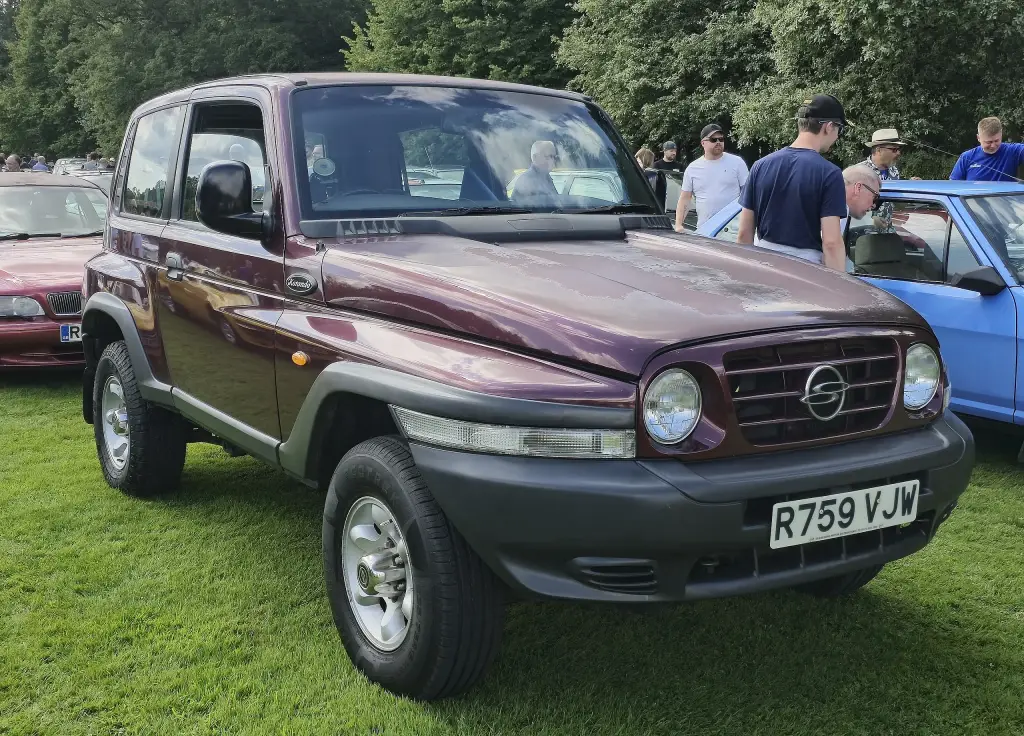
The Daewoo Korando was the Daewoo-badged version of the second-generation SsangYong Korando, a three-door mini SUV introduced in 1996 on a shortened version of the Musso chassis. Daewoo sold the car from 1999 to 2001, while it held a majority stake in SsangYong.
Daewoo Korando at a glance
| Original model | SsangYong Korando, second generation |
|---|---|
| Daewoo sales | 1999–2001 |
| Class | three-door mini SUV, about 1.8 tonnes |
| Chassis | shortened SsangYong Musso |
| Designer | Ken Greenley |
| Petrol engines | 2.3 and 3.2 litres |
| Diesel engines | 2.3 and 2.9 litres |
| Engine source | built under licence from Mercedes-Benz |
| Gearbox | five-speed manual by Borg-Warner |
| Launched in Asia | 1996; Europe 1997, Australia 1998 |
| Production ended | 2006, with stock sold into 2007 |
History of the Daewoo Korando
From Jeep to Korando
The Korando name goes back to a Jeep-derived vehicle. Ha Dong-hwan Motor began assembling Jeeps for the US armed forces in 1964, and production passed through several owners until the range was renamed Korando in March 1983. That first Korando was a CJ-7-based vehicle with an extended nine-seat version called the Korando K9, and it stayed in production until 1996. A separate model on the Isuzu Trooper chassis, the Korando Family, used the name from 1988 but had nothing else in common with the Jeep.
The second generation
The “New” Korando arrived in Asia in 1996 to complement the SsangYong Musso of 1993, reaching Europe in 1997 and Australia in 1998. It was a 1.8-tonne three-door mini SUV built on a shortened Musso chassis and styled by Professor Ken Greenley. Power came from 2.3 and 3.2-litre petrol engines or 2.3 and 2.9-litre diesels, all built under licence from Mercedes-Benz, with a five-speed Borg-Warner manual gearbox. The cabin had a steering wheel arch on either side so that converting to right-hand drive was cheaper, with a grab handle fitted in the passenger-side arch.
The Daewoo years
Daewoo sold this generation as the Daewoo Korando from 1999 to 2001, after buying a majority stake in SsangYong, but it was later forced to sell those shares. Production of the second-generation Korando ended in 2006, and sales continued into 2007 on remaining stock. From 2008 the Russian firm TagAZ assembled the car under licence as the TagAZ Tager, in both the three-door form and a longer five-door version. SsangYong revived the name in 2010 for the completely new C200 crossover.
Design and features
- Shortened Musso chassis: a compact three-door shell on the running gear of the larger SUV.
- Mercedes-derived engines: four petrol and diesel units built under Mercedes-Benz licence.
- Symmetric cabin: steering wheel arches on both sides made right-hand-drive conversion cheap.
- Ken Greenley design: the body was styled by the British designer of the Musso.
Daewoo Korando versions
- 2.3 petrol and 2.3 diesel: the smaller-engined cars.
- 3.2 petrol and 2.9 diesel: the larger engines, the 2.9 being a five-cylinder Mercedes unit.
- Daewoo Korando (1999–2001): the same car with Daewoo badges.
- TagAZ Tager: the Russian licence-built version from 2008, also as a five-door.
The Korando shared its chassis and engines with the Musso and sat below the Rexton. More cars are in the Daewoo collection.
Sources
- SsangYong Korando, English Wikipedia: nameplate history, second generation, Daewoo years