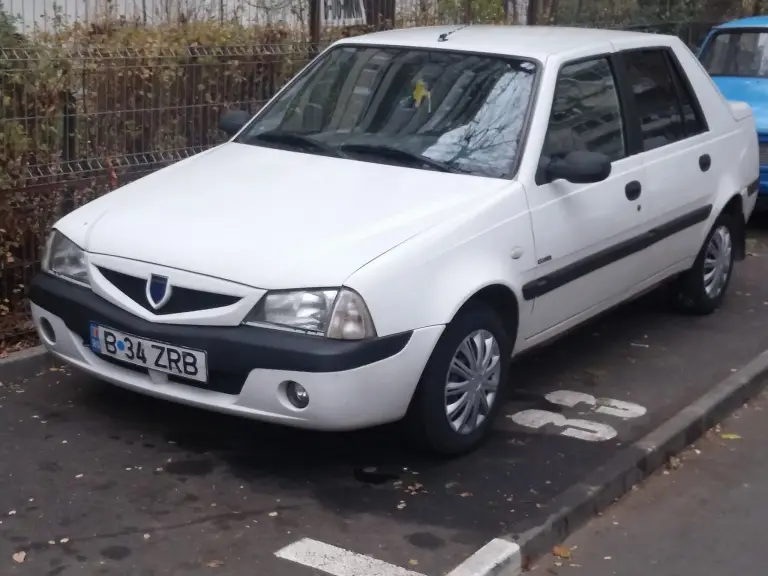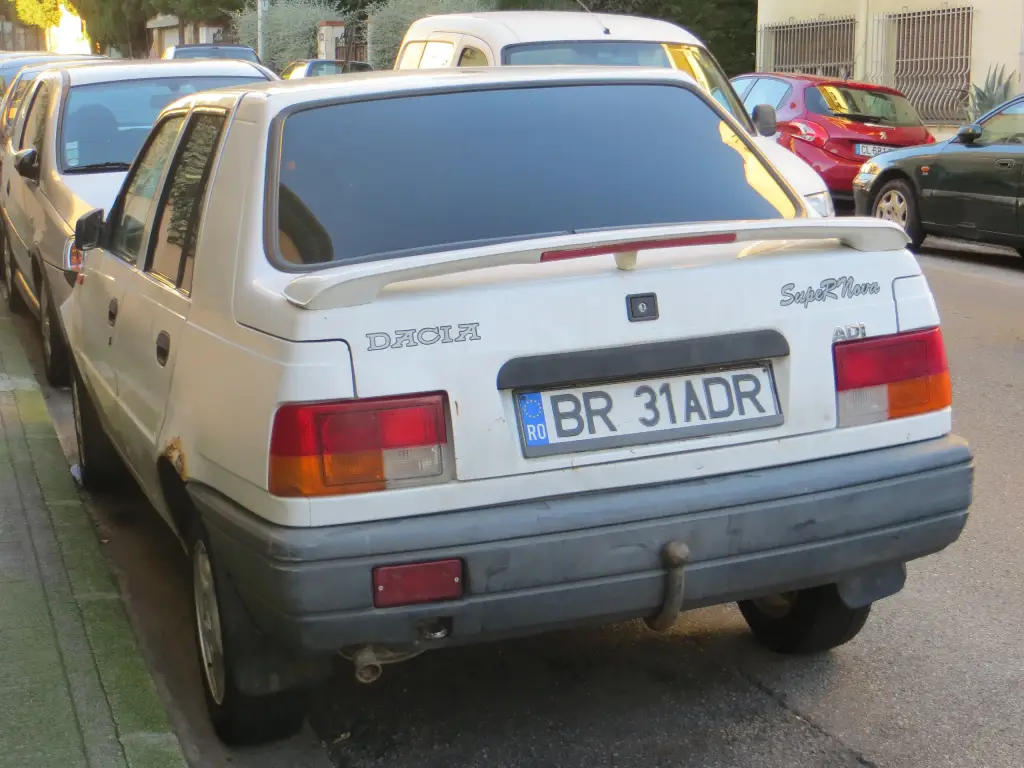
The Dacia SupeRNova was a supermini built by Dacia from 2000 to 2003. It was a facelifted Nova with a Renault engine and gearbox, and the first model the company released after Renault took it over in 1999.
Dacia SupeRNova at a glance
| Production | 2000–2003 |
|---|---|
| Built | about 60,000 |
| Based on | Dacia Nova |
| Body | five-door hatchback |
| Engine | 1.4-litre Renault E7J 260, catalysed and multi-point injected |
| Gearbox | five-speed Renault JH3 |
| Trim levels | Europa, Confort, Rapsodie, Campus, Clima |
| Emissions | Euro 2, some 2003 cars Euro 3 |
| Top price | €5,800 |
| Colours | 16, non-metallic and metallic |
| Replaced by | Dacia Solenza, 2003 |
History of the Dacia SupeRNova
The SupeRNova was, like its predecessor the Nova, a compact car with a transversely mounted front engine, a liftback body and front-wheel drive. As a facelift of the Nova it was the first model Automobile Dacia released after Renault’s takeover, and the improvements over the Nova were a new 1.4-litre Renault “Energy” engine and a new gearbox, replacing the old Cléon-Fonte-based unit and the Romanian-designed gearbox. The new engine was the catalysed, multi-point injected version of the E7J inline-four, joined to a five-speed JH3 manual gearbox.
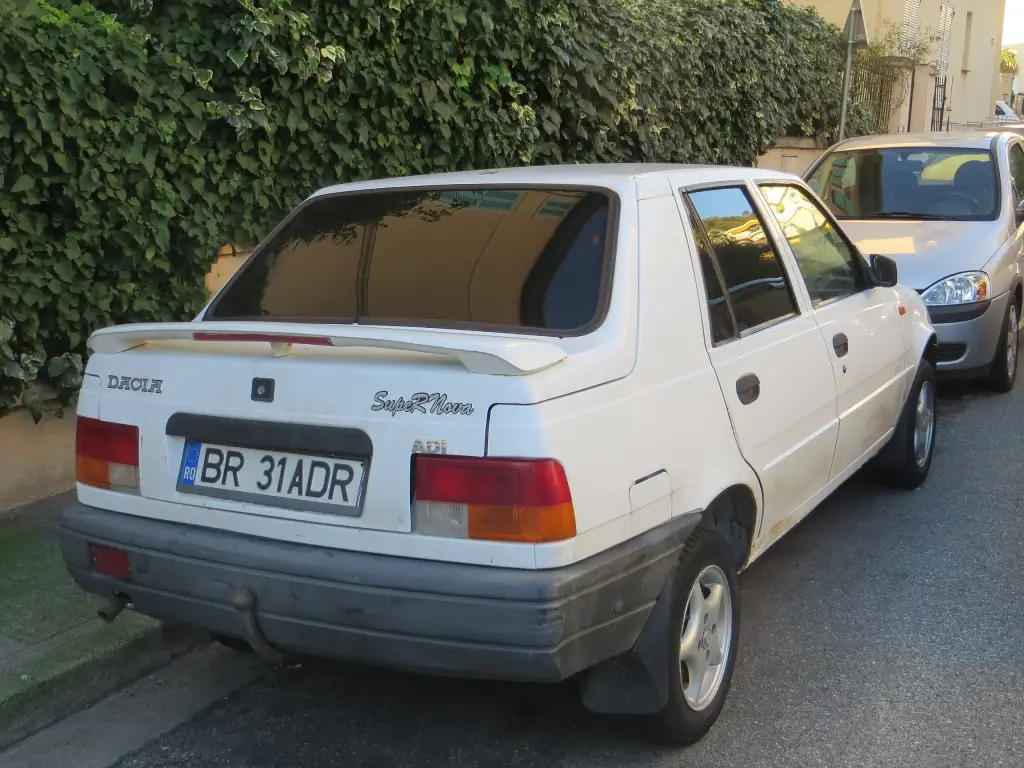
Equipment was better than in the Nova, with air conditioning, alloy wheels and electric front windows available on the more expensive versions. The car was sold in five trim levels: Europa, the base model, which lacked such things as a rev counter; Confort, with cloth upholstery and a rev counter; Rapsodie, with fog lights, body-coloured bars and grille, side mouldings and velour trim; Campus, introduced in mid-2002 as a sportier model with a spoiler, a four-speaker 15 W audio system and 13-inch wheels; and Clima, the top version, with air conditioning, two-tone velour and an anti-theft system. The car complied with Euro 2, and cars built in 2003 and at the end of 2002 with Euro 3. The top version cost €5,800.
The SupeRNova was produced in about 60,000 units and quickly became a sales success in Romania. The basic Europa version cost around $3,200 when an old car was traded in, which took sales away from the 1310 saloon and estate. It was a transitional model between the old Dacia range and the Logan: materials, finishes and colours inside and out were improved, and although it was based on the Nova it was well received and kept a high value on the used market. The model was exported in small numbers to Hungary, Bulgaria, the Czech Republic, Slovakia and Poland; in 2002 Renault authorised international exports, and the car reached Moldova, Serbia and the other former Yugoslav republics, Russia, Ukraine, Syria and Lebanon, where it served as a taxi, and even Colombia, where a small batch was exported for taxi use.
Standard equipment included electronic ignition, central locking, manually adjustable mirrors and a rev counter. Options were a spoiler at €80, metallic paint at €110 and an RDS radio cassette player at €150. Sixteen colours were offered during production, from the non-metallic Alb Boreal, Roșu Imperial, Galben Sport, Bleu de France and Verde Primăvară to the metallic Argintiu Diamant, Gri Granit, Verde Jad, Verde Montan, Verde Infinit, Roșu Toreador, Bej Mahon, Bleu Sprint, Albastru Catifea and Negru Abanos. One non-metallic colour, Galben Columbia, was reserved for the export batches sent to Colombia as taxis.
Design and features
- Renault engine: the 1.4-litre E7J 260, catalysed and multi-point injected, with a five-speed JH3 gearbox.
- Firsts for Dacia: factory air conditioning on the Clima and alloy wheels on the upper trims.
- Improved quality: better materials and finishes than the Nova, inside and out.
- Five trims: from the basic Europa to the Clima, with the sporty Campus added in 2002.
Dacia SupeRNova versions
- Europa: the base model, without a rev counter or a temperature gauge.
- Confort: cloth upholstery and a rev counter.
- Rapsodie: fog lights, body-coloured details, velour trim.
- Campus (2002): the sportier version with a spoiler and a four-speaker audio system.
- Clima: the top version with air conditioning and two-tone velour.
The SupeRNova was based on the Dacia Nova and replaced by the Dacia Solenza, itself followed by the Dacia Logan. More in the Dacia collection.
Sources
- Dacia SupeRNova, English Wikipedia: engine, gearbox, trim levels, emissions
- Dacia SupeRNova, Romanian Wikipedia: production, prices, equipment, exports, colours