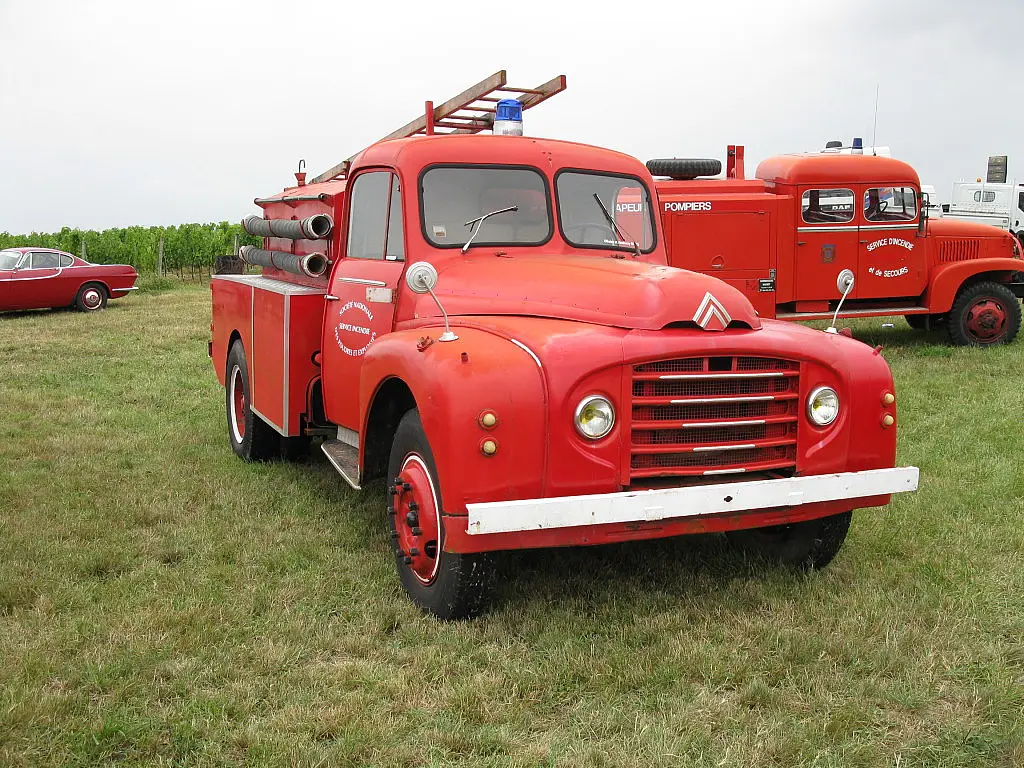
The Citroën 55, known as the U55, appeared in 1953 as the successor to the Type 45. It was less a new lorry than a thorough modernisation of the 1934 design, and it stayed in production until the second half of the 1960s, when the lorry nicknamed Belphégor took its place.
Citroën 55 at a glance
| Maker | Citroën, France |
|---|---|
| Production | from 1953 to the second half of the 1960s |
| Also called | U55 |
| Predecessor | Citroën Type 45 (1934) |
| Petrol engine | 4.58-litre six, 73 hp |
| Diesel engine | 5.18-litre six, 86 hp |
| From 1955 | type 60 range: 5.183-litre petrol, 90 hp; diesel, 93 hp |
| Cabin | rounded, two-piece windscreen, on three rubber blocks (Tri-Flex) |
| Diesel in 47Di | 100 x 110 mm six, 86 hp at 2,500 rpm, 9,300 kg gross weight |
| Built by | Citroën, with bodies from independent coachbuilders |
Based on one source (French Wikipedia). The French article gives 1965 in its introduction and 1967 at the end for the end of production, so this page avoids a single year.
History of the Citroën 55
1953: a modernised Type 45
The 55 was above all a modernisation of the Type 45 that had appeared in 1934. The main change was the cabin, entirely in curves and almost elegant, with a two-piece windscreen. It was mounted on three rubber blocks — the Tri-Flex system — which isolated the cabin from the chassis to reduce the vibration and noise felt by the occupants. Its comfort and modern line allowed the 55 to stand out from its competitors.
Engines and the type 60 range
At launch the lorry was offered with a 4.58-litre petrol six of 73 hp or a 5.18-litre diesel six of 86 hp. From 1955 further engines joined the range, forming the type 60 series: a 5.183-litre petrol six of 90 hp and a 5.183-litre diesel of 93 hp. A separate model, the 47Di, used only the Citroën diesel six of 100 mm bore and 110 mm stroke, with a gross vehicle weight of 9,300 kg and 86 hp at 2,500 rpm.
Bodies and a life on screen
The 55 served as the base for many versions adapted to different uses by independent coachbuilders, and it appeared in the film Des gens sans importance, fitted with a cattle body. Production of the Type 55 finally ran until the second half of the 1960s, when the Belphégor succeeded it.
Design and features
- Tri-Flex cabin: the cab sat on three rubber blocks so that vibration and noise stayed out of it.
- Curved cab: a rounded, almost elegant shape with a two-piece windscreen, a big step from the 1934 Type 45.
- Six-cylinder power: petrol and diesel sixes of 4.58 and 5.18 litres, and the type 60 units from 1955.
- Coachbuilder base: many specialist bodies were built on the 55 chassis.
Citroën 55 versions
- 55 (from 1953): 4.58-litre petrol or 5.18-litre diesel six.
- Type 60 (from 1955): the more powerful 5.183-litre engines.
- 47Di: diesel-only model with a 9,300 kg gross weight.
- Coachbuilt bodies: including the cattle transport seen in the film.
The 55 belongs to Citroën’s line of light lorries, which also includes the U23. Earlier cars are described under the Type A, the company’s first model. More vehicles are in the Citroën collection.
Sources
- Citroën 55, French Wikipedia: dates, engines, cabin, coachbuilt bodies, film appearance