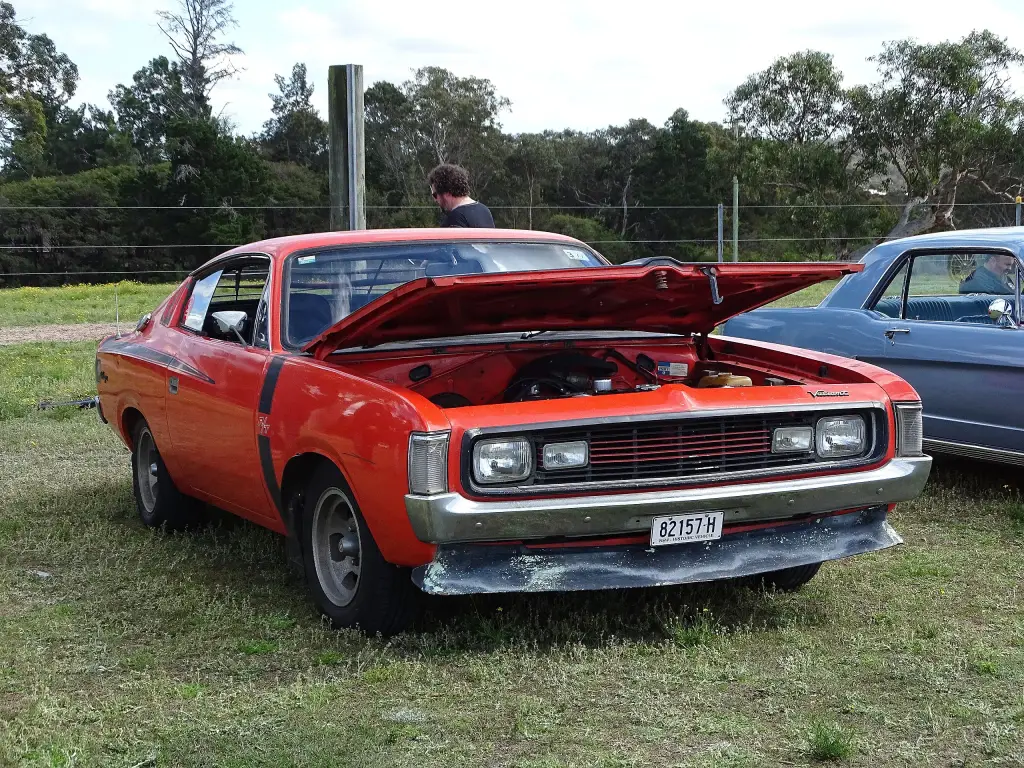
The Chrysler Valiant Charger was a two-door hardtop introduced by Chrysler Australia in 1971 as a short-wheelbase version of the Valiant sedan. Built through the VH, VJ, VK and CL series until 1978, it was at one point 80 per cent of all Australian Valiant production, and its Hemi-6 R/T versions were among the strongest six-cylinder cars in the world.
Chrysler Valiant Charger at a glance
| Production | 1971–1978 |
|---|---|
| Maker | Chrysler Australia |
| Series | VH, VJ, VK and CL |
| Base | short-wheelbase Australian Valiant, A-body platform |
| Engines | Hemi-6 of 3.5, 4.0 and 4.3 litres; LA V8s of 5.2 and 5.6 litres |
| Top Hemi-6 | E49 R/T, 302 bhp |
| V8 option | 340 cu in E55, 275 bhp, in the 770 SE |
| Wheels | 5-on-4.5 in bolt circle, wider track than US A-bodies |
| Award | Wheels Car of the Year 1971 |
| Production share | up to 80% of Australian Valiant output |
History of the Chrysler Valiant Charger
The VH Charger
The Charger was introduced in 1971 within the VH Valiant series as a two-door hardtop on a shortened sedan wheelbase. Although still based on the American Chrysler A-body with virtually identical front suspension, it had widened wings and a wider rear axle so that both tracks were considerably wider than any American A-body, allowing much wider wheels, and it used a 5-on-4.5-inch wheel bolt circle while American cars kept the smaller pattern until 1973. It was extraordinarily popular: at one point Charger production accounted for 80 per cent of all Australian Valiant output, it won the 1971 Wheels Car of the Year award and it was assembled in New Zealand from imported kits.
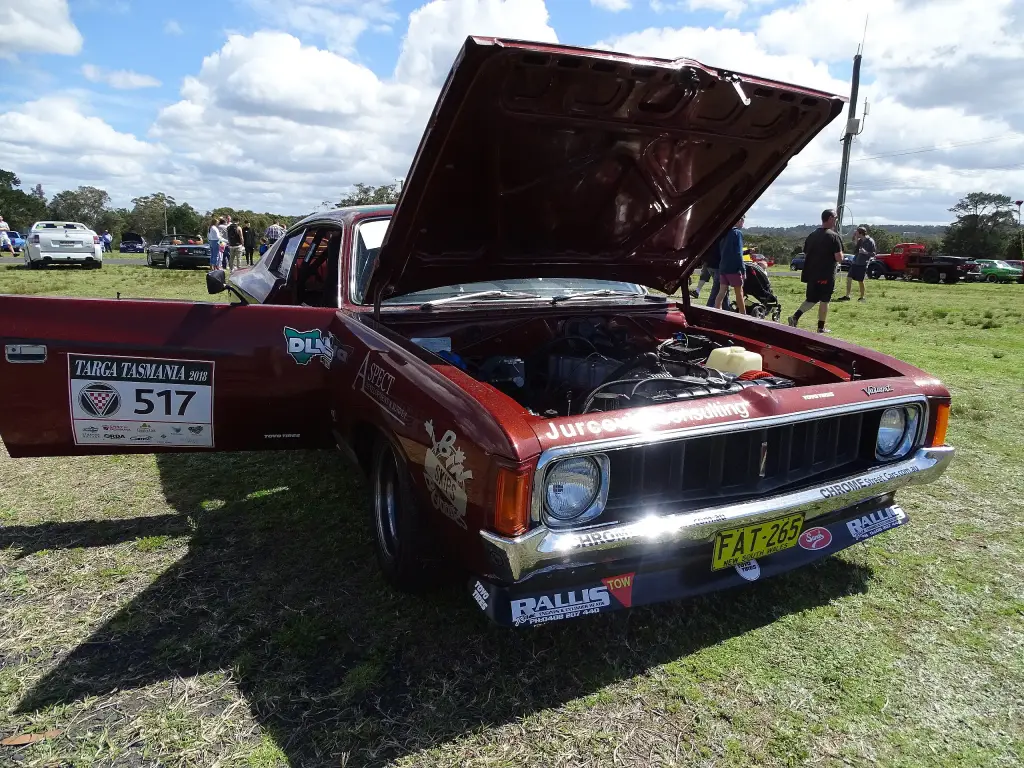
The VH range
The VH line ran from the base Charger with a 215 cu in Hemi-6 of 140 bhp at A$2,795, through the Charger XL with the 245 cu in engine of 160 bhp at A$3,195, to the R/T with the 265 cu in High Performance unit of 218 bhp at A$3,395, the R/T E38 with 280 bhp and the R/T E49 with 302 bhp at A$3,975. The 770 came with the 265 HP engine and a three-speed automatic at A$3,625, or a 318 cu in V8 of 230 bhp at A$4,105, and the 770 SE E55 used the 340 cu in four-barrel V8 of 275 bhp at A$4,850. The R/T E37 option brought a “Six Pack” engine with triple side-draught Weber carburettors and formed the basis of Chrysler’s touring car racer for 1971. The E49’s seven-bearing engine produced torque that was not surpassed by a six-cylinder until the Porsche 911 Turbo of 1975.
The 340 V8 story and the end
The 770 SE’s 340 cu in V8 came from an aborted racing programme: 336 engines and four-speed gearboxes were imported under instructions from chief engineer Walt McPherson for a planned R/T touring car, but a ute fitted with the V8 was found two to three seconds slower around Mallala than the E49 because the heavier front caused understeer, and bad press led Chrysler to abandon the programme and sell the engines in the upmarket 770 SE with a single-pipe exhaust and Torqueflite 727 transmission. Only 125 VH Charger 770 SE cars were built, in Vintage Red, Limelight and Sunfire, with black-and-white or maroon vinyl trim. The VJ of March 1973 brought a new cowl, grille, lighting and rear quarter panel with 7-inch round headlights replacing the rectangular units, and apart from four cars built as E49s it marked the end of the Charger R/T as Chrysler withdrew from racing. The sporty image faded through the VJ and was gone by the VK of 1975; production ended in 1978, and cars of the later series were badged Chrysler Charger rather than Valiant Charger.
Design and features
- Wide-track A-body: widened wings and axle gave a track no American A-body had.
- Hemi-6 engines: 3.5, 4.0 and 4.3 litres, from 140 to 302 bhp in the E49 R/T.
- R/T racing programme: the Six Pack E37 engine powered Chrysler’s touring car racer.
- 340 V8 770 SE: 125 cars with an imported V8 meant for a cancelled racing programme.
- Australian success: at its peak the Charger was 80% of Valiant production.
Chrysler Valiant Charger versions
- Charger (1971): the 215 cu in base model.
- Charger XL: the 245 cu in version.
- Charger R/T, E38 and E49: the 265 cu in performance models, up to 302 bhp.
- Charger 770 and 770 SE: the luxury models, the SE with the 340 cu in V8.
- Chrysler Charger (VK and CL): the later, softer cars to 1978.
The Charger was the two-door version of the Chrysler Valiant and shared its Hemi-6 engines with the Chrysler Centura. More cars are in the Chrysler collection.
Video: Chrysler Charger at Midstate Mopars 2013
Video by ValigruntPerformance on YouTube.
Sources
- Chrysler Valiant Charger, English Wikipedia: series, engines, prices, racing programme
- Chrysler Valiant Charger, Wikimedia Commons: photographs