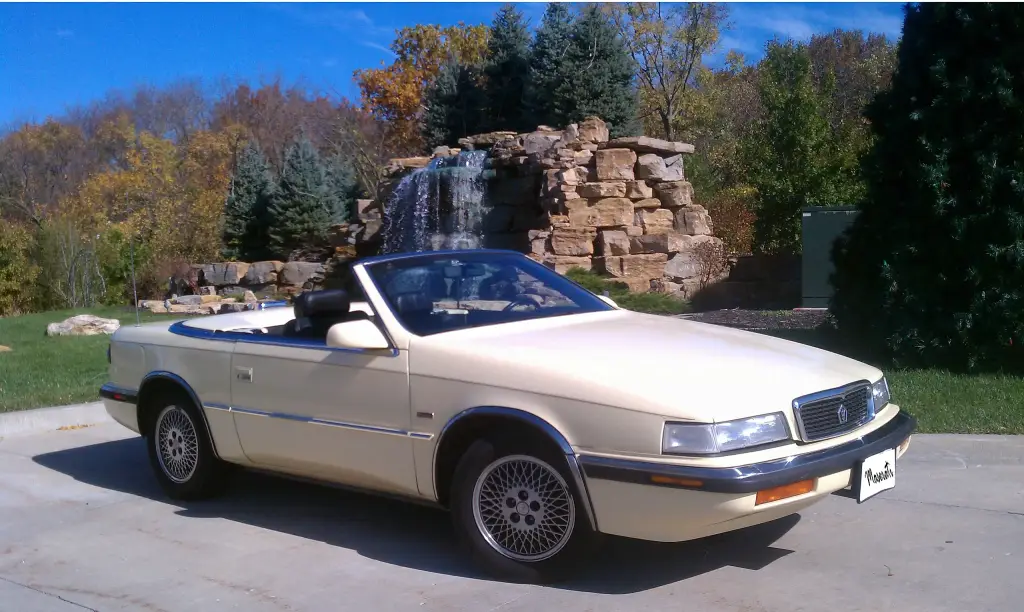
The Chrysler TC by Maserati was a two-seat convertible developed jointly by Chrysler and Maserati and built in Milan from late 1988 until 1990. Positioned as a grand tourer on a “Q” body over a modified second-generation K platform, it sold the 7,300 cars required by contract and is remembered as one of the costliest failures in Chrysler’s history.
Chrysler TC by Maserati at a glance
| Production | 1988–1990, sold as 1989–1991 models |
|---|---|
| Built at | Milan, Italy |
| Bodywork | Innocenti, a De Tomaso subsidiary |
| Bodies | two-seat convertible with detachable hardtop |
| 1989 engine | 2.2 L Turbo II, 160 bhp |
| 1990–1991 engine | 3.0 L Mitsubishi V6, 141 bhp |
| Optional engine | 2.2 L 16-valve “Maserati”, 200 bhp, 500 cars |
| Transmissions | three-speed A413, four-speed A604, Getrag five-speed |
| Total built | 7,300, the contractual minimum |
| Reported cost | close to US$600 million, about US$80,000 a car |
History of the Chrysler TC by Maserati
An Italian friendship
Lee Iacocca’s friendship with Alejandro de Tomaso, begun at Ford and leading to the De Tomaso Pantera, mattered again in the 1980s when Iacocca ran Chrysler and de Tomaso owned Maserati. In 1983 Iacocca had considered building a copy of a Mercedes roadster on Plymouth Reliant underpinnings before being talked out of it. In 1984 the two companies signed a memorandum of understanding for a sports coupé that became the TC — for “turbocharged coupe” — an image builder intended to lift Chrysler above its blue-collar reputation and revive the luxury standing it had enjoyed with the 300 letter series. Chrysler also became an investor in Maserati. In 1985 Iacocca said the planned “Q-coupe” would be the prettiest Italian to arrive in the United States since his mother emigrated. The car, which resembled a Chrysler LeBaron and shared many of its components, took five years because of mismanagement and disagreements between Chrysler and Maserati engineers; the plan had been to launch the TC before the LeBaron.
Engines and chassis
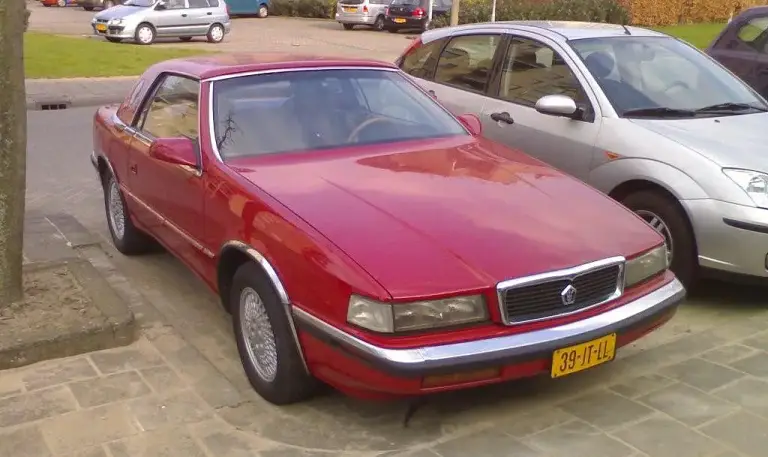
The 1989 TC used a slightly detuned 160 bhp Daytona-specification turbocharged 2.2-litre four, the intercooled Turbo II, with an A413 three-speed automatic transaxle. For 1990 and 1991 a Mitsubishi-sourced 3.0-litre V6 of 141 bhp replaced it and the transaxle was upgraded to a four-speed A604. Five hundred cars were built with an optional drivetrain of a Getrag manual gearbox and a 16-valve head version of the 2.2, often called the “Maserati” engine because Maserati assembled it and fitted a Maserati-branded valve cover: the head was cast by Cosworth in England and finished in Italy, the pistons came from Mahle in Germany, the camshafts were designed by Crane Cams in Florida and made by Maserati in Modena, the turbocharger came from IHI in Japan and the rest of the engine used American Turbo II parts. The platform was a shortened Dodge Daytona chassis with the original model’s suspension and axles, the struts and shock absorbers were designed for the car by Fichtel and Sachs, anti-lock brakes by Teves were standard and the wheels were made in Italy by the Formula One supplier Fondmetal.
Equipment and cost
The TC had a detachable hardtop with circular bevelled-glass opera windows and a six-point latch, plus a manually operated cloth-lined soft top in tan or black. Its dashboard, door panels, seats, armrest and rear trim were covered in hand-stitched Italian leather, the door jambs were finished in stainless steel and the convertible boot was a body-coloured metal panel, with a special compartment holding an umbrella, tool kit and small spare wheel so the boot stayed usable with the top down. Standard equipment included a ten-speaker Infinity stereo, power windows, six-way power seats, power locks, map lights, puddle lamps, cruise control and a tilt wheel; the only extra-cost option was a plug-in CD player, and all drivetrain choices were no-cost options. After every other Chrysler executive insisted the car was hopeless, Iacocca refused to accept responsibility, saying it might have worked had his marketers positioned it properly. Bob Lutz said the partnership with de Tomaso produced only the TC and cost Chrysler close to US$600 million — about US$80,000 for each of the 7,300 cars in 1990 dollars.
Design and features
- Italian assembly: built in Milan with bodywork by Innocenti and wheels by Fondmetal.
- Hand-stitched leather: the dashboard, door panels and seats were trimmed in Italy.
- Two roofs: a detachable hardtop with opera windows and a manual cloth soft top.
- Maserati 16-valve engine: a Cosworth-cast head assembled by Maserati, 200 bhp, 500 cars.
- Engineering by Fichtel and Sachs: bespoke struts and shock absorbers, with Teves anti-lock brakes.
Chrysler TC by Maserati versions
- 1989 TC: the 2.2 Turbo II with a three-speed automatic.
- 1990–1991 TC: the 3.0 V6 with a four-speed automatic.
- Getrag 16-valve cars: 500 examples with the “Maserati” engine and a five-speed manual.
- Executive special order: a single white 1991 car with bordeaux interior and the 16-valve engine.
The TC was built on a shortened Chrysler Laser and Daytona chassis and shared much with the LeBaron; its failure was soon overshadowed by the Viper. More cars are in the Chrysler collection.
Video: 1990 Chrysler TC by Maserati V6 start up and quick tour
Video by Intechdude300 on YouTube.
Sources
- Chrysler TC by Maserati, English Wikipedia: development, engines, chassis, equipment, cost
- Chrysler TC by Maserati, Wikimedia Commons: photographs