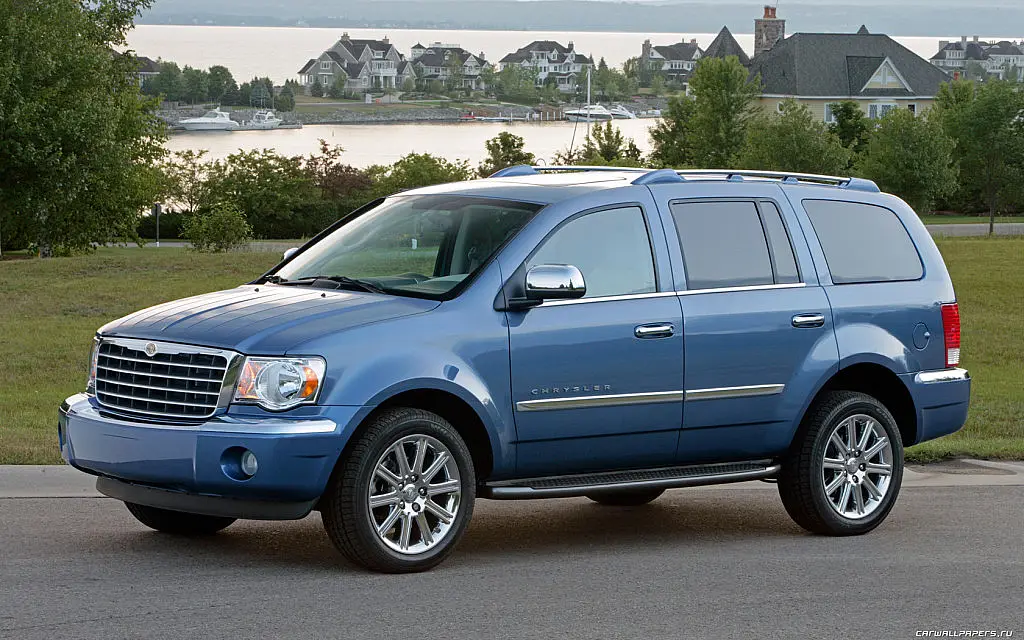
The Chrysler Aspen was the Chrysler version of the Dodge Durango, offered from 2007 to 2009. It gave Chrysler its first full-size sport-utility vehicle, built body-on-frame on the second-generation Durango and offered with V8 engines and, from 2009, a two-mode hybrid system.
Chrysler Aspen at a glance
| Production | 2007–2009 |
|---|---|
| Based on | Dodge Durango, second generation |
| Construction | body-on-frame |
| Assembly | Newark Assembly, Newark, Delaware |
| Layout | front engine, rear- or four-wheel drive |
| Seating | up to seven or eight passengers |
| Towing | up to 7,500 lb (3,400 kg) when properly equipped |
| Engines | V8 petrol units shared with the Durango |
| Hybrid | two-mode hybrid offered for 2009 |
| Market role | Chrysler’s first full-size SUV |
The Aspen has no Wikipedia article of its own and is described within the article on the Dodge Durango, which is the only source used here. No free photographs of the Chrysler Aspen were found, so the page keeps the existing lead image.
History of the Chrysler Aspen
A Durango for Chrysler dealers
The Aspen was created so that Chrysler dealers had a full-size SUV to sell: it was the Dodge Durango of the second generation with Chrysler front-end styling and a higher level of trim. The Durango on which it was based shared its front end, instrument panel and front seats with the Dodge Dakota pickup and its tail lamps and tailgate handle with Chrysler’s minivans, and was built at Newark Assembly in Delaware, where the first two Durango generations were produced through the 2009 model year.
Engineering
Like the Durango, the Aspen was a body-on-frame design aimed at buyers who towed: Dodge marketed the platform as able to carry up to seven passengers and tow up to 7,500 lb when properly equipped. The engine range came from the Durango, which had moved to the 4.7-litre PowerTech V8 for 2000 and offered the 5.9-litre Magnum V8 in the high-performance R/T version.
Hybrid and the end
A hybrid version was introduced in 2009, but it lasted barely a year and ended with the second-generation Durango. The Durango itself changed completely for 2011, moving to a unitary body on the same platform as the Jeep Grand Cherokee and to a new assembly plant in Detroit. The Aspen was not replaced, and more than two million Durangos have been sold since the name appeared in 1998.
Design and features
- Body-on-frame construction: the truck-based layout of the second-generation Durango.
- Full-size package: three rows of seats and a tow rating of up to 7,500 lb.
- V8 power: engines shared with the Durango, including the 4.7-litre PowerTech and 5.9-litre Magnum.
- Hybrid option: a two-mode hybrid system offered for the 2009 model year only.
- Chrysler identity: Chrysler front-end styling and trim on Durango mechanicals.
Chrysler Aspen versions
- Aspen (2007–2009): the standard V8 model in rear- or four-wheel drive.
- Aspen Hybrid (2009): the short-lived two-mode hybrid.
The Aspen was Chrysler’s counterpart to the Dodge Durango and sat above the Chrysler Pacifica crossover in the range, next to the minivans such as the Town & Country. More cars are in the Chrysler collection.
Video: 2008 Chrysler Aspen start up, engine and in-depth tour
Video by Saabkyle04 on YouTube.
Sources
- Dodge Durango, English Wikipedia: platform, production, engines, Aspen version
- Dodge Durango, Wikimedia Commons: photographs