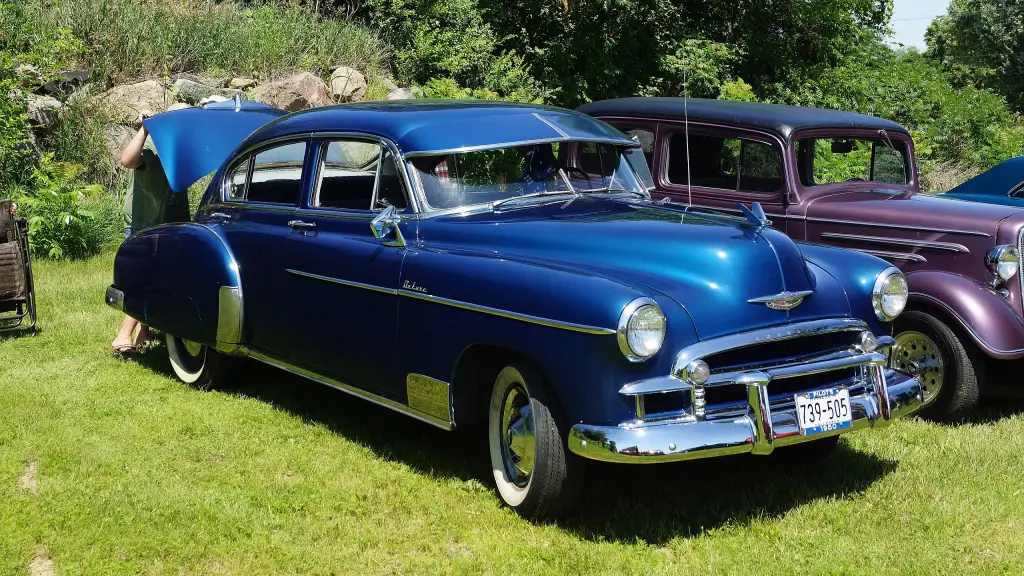
The Chevrolet Deluxe was the trim line that carried most of Chevrolet’s sales from 1941 until 1952. It began as the Master Deluxe and Special Deluxe, was restyled after the war into the 1949 Deluxe, and offered the widest choice of bodies in the range, including the Bel Air hardtop.
Chevrolet Deluxe at a glance
| Production | 1941–1952 |
|---|---|
| Pre-war versions | Master Deluxe and Special Deluxe |
| Engine 1941–1948 | 216 cu in Victory Six, 85 hp, 90 hp from 1947 |
| Transmission | Three-speed manual with vacuum-assisted shift |
| Driveline | Enclosed torque tube |
| Suspension | Lever-type shock absorbers to 1948, telescopic from 1949 |
| Windscreen | Split flat glass to 1948, curved split glass 1949–1952 |
| Bodies 1949–1952 | Styleline notchback and Fleetline fastback |
| Cheapest 1949 Deluxe | Styleline six-passenger sedan, 1,492 dollars |
| Notable addition | Bel Air hardtop of 1950, part of the Deluxe range |
History of the Chevrolet Deluxe
The Deluxe line began in 1941 with the Master Deluxe and Special Deluxe, the first Chevrolet generation that did not share its appearance with the trucks. The 1941 cars were wider than before, with the running boards deleted to make room for three people on each bench seat, and the headlamps moved into the front wings. The Special Deluxe had better fabric than the Master and armrests in the doors. For 1942 the cars could seat six in the sedan body styles, and the Signal-Seeking radio and a shortwave option were offered; civilian production stopped on 1 February 1942 for the war.
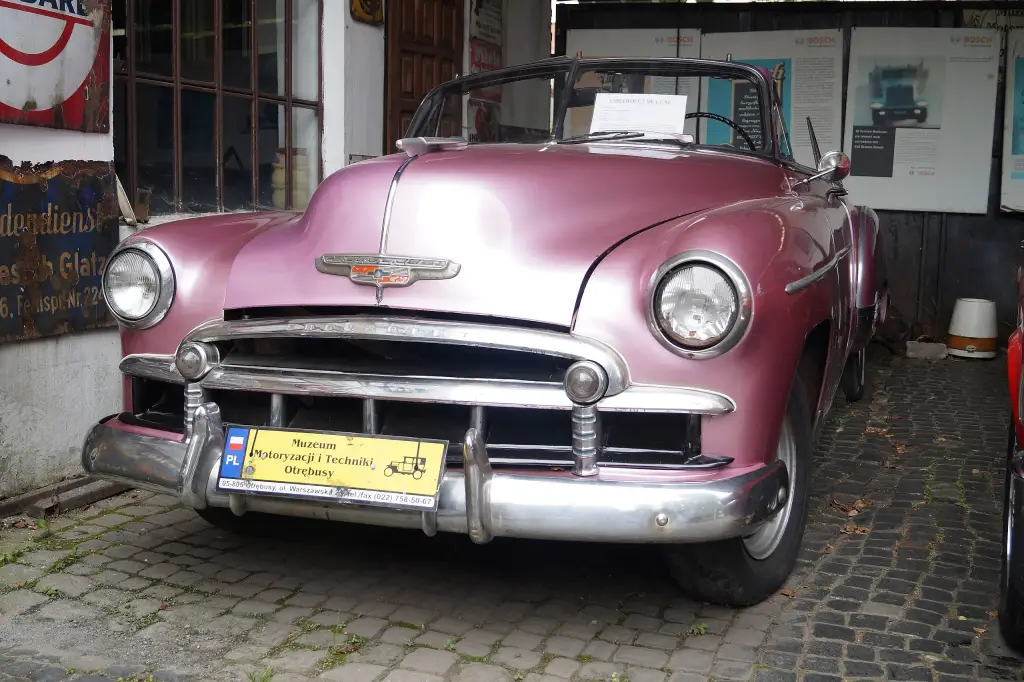
After the war the 1946 models were renamed Stylemaster and Fleetmaster, and it was not until 1949 that Chevrolet received its first complete post-war restyle. The Deluxe then became the upper end of the range, with the cheaper Special beneath it. Both were available with two families of body: the Fleetline, a fastback with pre-war streamlining available as a two- or four-door sedan, and the new Styleline, a three-box notchback also sold as a coupé, convertible and wagon. The cheapest 1949 Deluxe was the Styleline six-passenger sedan at 1,492 dollars, with 11-inch drum brakes, full instrumentation and a front anti-roll bar.
The specification was simple and rugged: a 216 cu in overhead-valve six, a three-speed manual gearbox with a vacuum-assisted shift that moved with the lightest pressure, an enclosed torque tube to the rear axle and hydraulic drum brakes all round. Lever-type shock absorbers were used until 1948 and telescopic units from 1949, and the windscreen was flat and split until the curved two-piece glass of 1949. The grille changed every year, losing its five teeth in 1950 and regaining them, with larger parking lights, in 1952. For 1950 the range gained the Bel Air hardtop, at first officially part of the Deluxe line, with cord and leather-grain vinyl trim, full carpeting and two-tone paint. Powerglide became available, and the Deluxe remained Chevrolet’s best seller into the early 1950s.
Design and features
- Master and Special: two trim levels before the war, the Special with better trim and armrests.
- Styleline and Fleetline: the notchback and fastback body families of 1949–1952.
- Victory Six: the 216 cu in engine, the only one offered in 1941 and 1942.
- Bel Air connection: the 1950 Bel Air hardtop began life inside the Deluxe range.
Chevrolet Deluxe versions
- Master Deluxe: the economy version of 1941–1942.
- Special Deluxe: the better-trimmed version, including the Fleetline sedan.
- Deluxe Styleline (1949–1952): the notchback sedans, coupés, convertibles and wagons.
- Deluxe Fleetline (1949–1952): the fastback two- and four-door sedans.
The Deluxe was the range from which the Chevrolet Bel Air and the Chevrolet 150 later emerged, and its Styleline bodies sat alongside the smaller postwar cars. More cars are in the Chevrolet collection.
Video: 1951 Chevrolet Styleline Deluxe sedan
Video by Vintage Car Fan on YouTube.
Sources
- Chevrolet Deluxe, English Wikipedia: history, specifications, bodies, annual changes