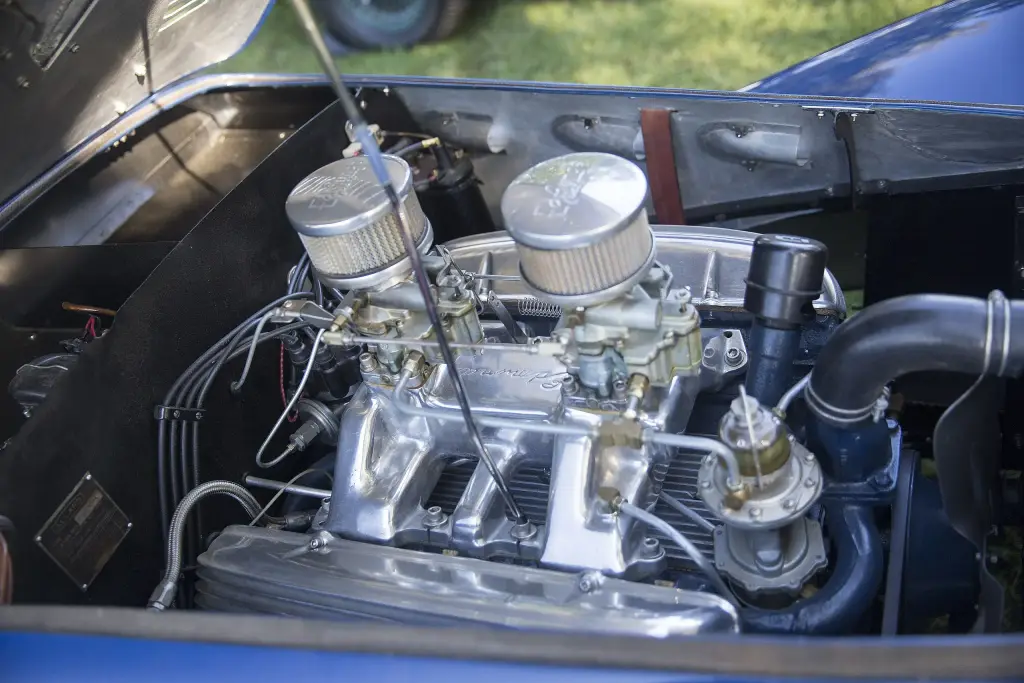
The name Cadillac V8 covers a long series of eight-cylinder engines built by the Cadillac division of General Motors, starting with the world’s first mass-produced V8 in 1914. Most often it refers to the overhead-valve engines at the heart of Cadillac’s best-known cars, from the 331 of 1949 to the Northstar of the 1990s.
Cadillac V8 at a glance
| First Cadillac V8 | Type 51, 1914, for the 1915 model year |
|---|---|
| First engine type | 90-degree L-head, 314 cu in (5.1 L), 70 hp |
| Cross-plane crankshaft | 1923, 83.5 hp |
| 341 engine | 1928, 341 cu in, 90 hp, with synchromesh gearbox |
| 353 engine | 1930-1935, 353 cu in |
| Monobloc 322 | 1936, 322 cu in, for the Series 60 |
| Monobloc 346 | 1936-1948, used across the Cadillac range |
| Overhead-valve 331 | 1949, 5.4 L, the start of the modern line |
| Later overhead-valve sizes | 365, 390, 429, 472, 500 |
| Northstar | 1992, 4.6 L, also 4.4 and 4.2 litres |
| Blackwing | 2019, twin-turbo V8 |
Based on one source: the English Wikipedia article on Cadillac V8 engines.
History of the Cadillac V8
The Type 51 of 1914 was Cadillac’s first V8 and the first such engine to be mass-produced. It was a 90-degree sidevalve design, water-cooled, with a 3.125 by 5.125 inch bore and stroke for 314 cubic inches and 70 hp. It was developed under Cadillac’s chief engineer D’Orsay McCall White, a Scot hired by Henry Leland for his V-engine expertise from Napier and Daimler, and the L-head was later named to Ward’s list of the ten best engines of the twentieth century. The engine was refined for 1923 with a cross-plane crankshaft that gave the 90-degree offset for each pair of cylinders and brought output to 83.5 hp.
L-head and Monobloc
Cadillac created a new 341 cubic inch V8 for 1928, with 90 hp, and the same year introduced a synchromesh gearbox; it served the Series 341 and 341B. From 1930 to 1935 came a larger 353 cubic inch version used in the Series 353 and 355. For 1936 a 322 cubic inch Monobloc was designed as the next-generation powerplant at lower cost than the 353 and the V12, with cylinders and crankcase cast as one unit and hydraulic valve lifters: it made the mid-priced Series 60 possible. A closely related Monobloc of 346 cubic inches, with a larger bore, served the Series 60, 61, 62, 63, 65, 67, 70, 72 and 75, and was even used in pairs in the M5 Stuart and M24 Chaffee tanks during the Second World War.
Overhead-valve engines and the Northstar
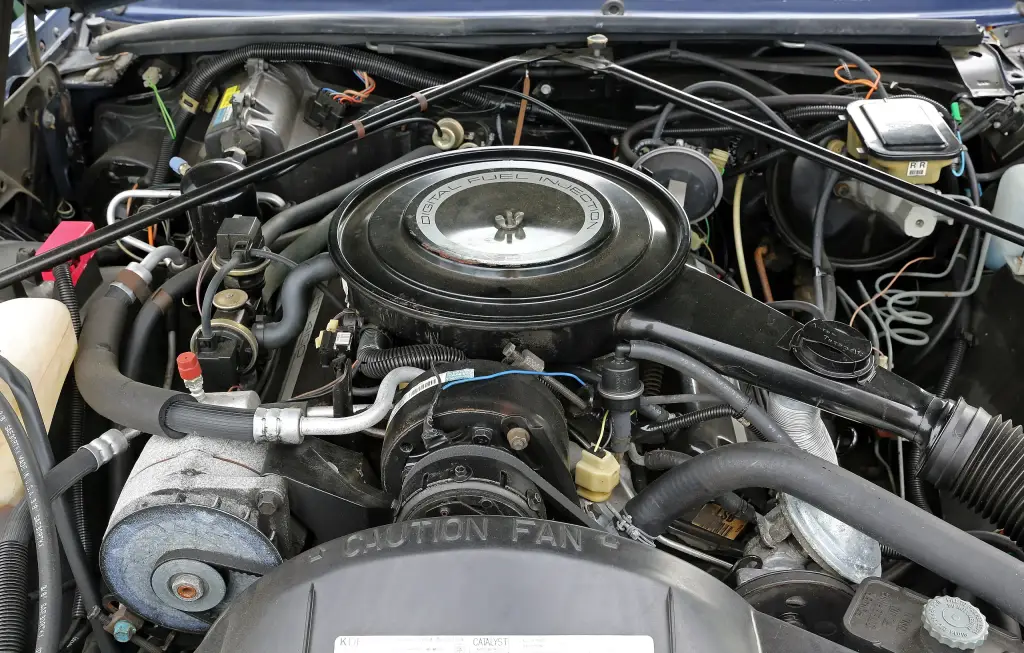
For 1949 Cadillac and Oldsmobile each produced an overhead-valve V8, a layout pioneered by Buick. The Cadillac 331 had a skirtless block, shaft-mounted rockers and a rear-mounted distributor, and it grew to 365 cubic inches in 1956, then to 390, 429, 472 and 500 in later years, reaching 8.2 litres by the end of the line. The Northstar of 1992 replaced it at the top of the range as a 4.6-litre double overhead cam unit, also built as 4.4 and 4.2 litres, and when it ended in 2010 Cadillac was the last GM division with a proprietary V8. That changed in 2019 with the twin-turbo Blackwing.
Design and features
- Pioneer: the first mass-produced V8 in the world, in 1914.
- Cross-plane crankshaft: adopted in 1923 for smoothness, now the standard layout.
- Monobloc economy: the 322 and 346 made a cheaper Cadillac possible in 1936.
- Long overhead-valve line: from 331 cubic inches in 1949 to 500 cubic inches, then the Northstar.
Cadillac V8 versions
- L-head V8 (1914-1935): 314, 341 and 353 cubic inch versions.
- Monobloc (1936-1948): 322 and 346 cubic inch flathead engines.
- Overhead-valve (1949 onwards): 331, 365, 390, 429, 472 and 500 cubic inches.
- Northstar (1992-2010): 4.6, 4.4 and 4.2-litre double overhead cam V8s.
- Blackwing (2019): the twin-turbo V8 that returned a Cadillac-only design.
The earliest V8 is described with its cars in the Type 51 and V-63 articles, and the modern one in the Northstar article. More Cadillacs are in the Cadillac collection.
Video: 1960 Cadillac engine sound
Video by M Bradley on YouTube.
Sources
- Cadillac V8 engine, English Wikipedia: all engine families, dimensions, outputs