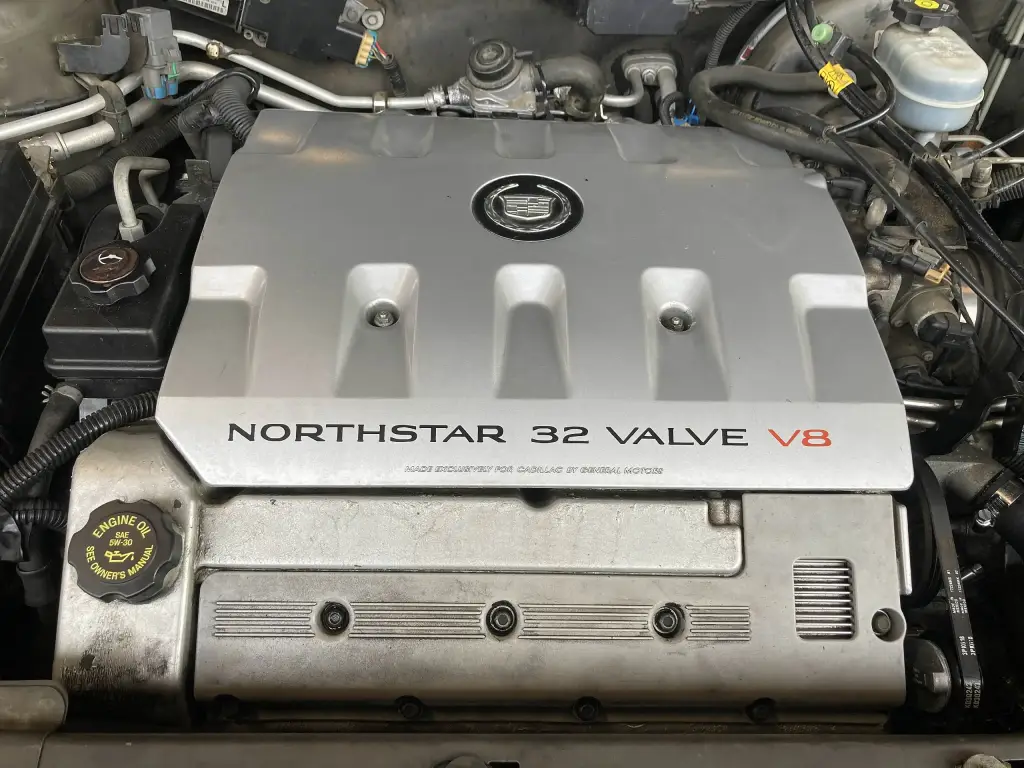
The Northstar engine is a family of high-performance 90-degree V engines built by General Motors between 1993 and 2011. Although it was developed by Oldsmobile research and engineering, the engine is most associated with Cadillac, whose cars introduced it and carried it for nearly two decades.
Cadillac Northstar at a glance
| Maker | General Motors, developed by Oldsmobile R&D |
|---|---|
| Production | 1993-2011 |
| Type | 90-degree V8, aluminium block and heads |
| Valvetrain | double overhead cam, four valves per cylinder |
| Displacement | 4.6 L (4,565 cc) |
| Other versions | 4.4 L supercharged, 4.0 L racing |
| Power | 275 hp, or 300 hp in higher-output versions |
| Bore spacing | 4 in (101.6 mm) |
| Oil capacity | 7.1-7.6 litres |
| First car | 1993 Cadillac Allante |
| Standard on Cadillacs | from 1996, except the Fleetwood |
| Replaced by | GM LS V8 |
Based on one source: the English Wikipedia article on the Northstar engine series.
History of the Cadillac Northstar
General Motors began the work that became the Northstar at Oldsmobile research and development in about 1984, in anticipation of the double overhead cam V8s that European and Japanese rivals would bring later in the decade. At the time Cadillac was using an aluminium overhead-valve V8 that GM had rushed into production for the 1982 fuel economy rules, and the division wanted a sophisticated engine of its own to fight BMW, Mercedes-Benz, Lexus, Acura and Infiniti. The result was also offered to Oldsmobile as the Aurora L47 V8 and the Shortstar LX5 V6, and to some top-end Pontiacs and Buicks.
Engineering
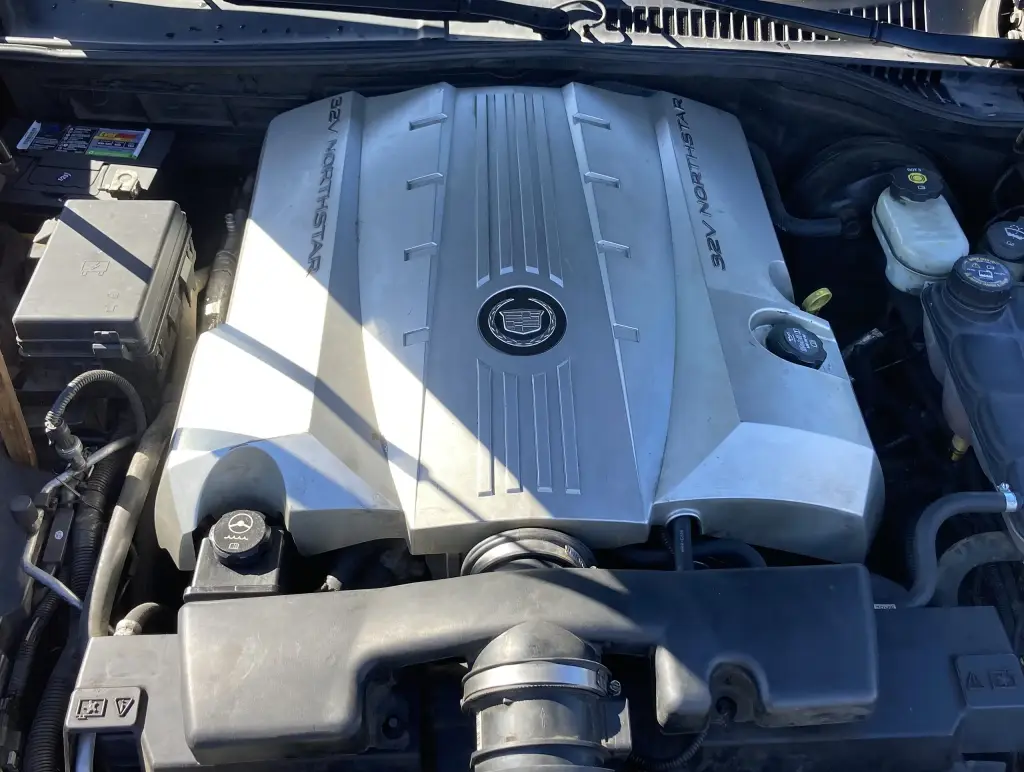
The 4.6-litre Northstar had a cast aluminium 90-degree block with 4-inch bore spacing, split into unitary upper and lower halves, with the lower crankcase carrying the crankshaft without conventional main bearing caps. It used cast-iron cylinder liners, cast aluminium four-valve heads, double overhead cams driven by a maintenance-free chain, magnesium cam covers and sequential fuel injection through eight thermoplastic tubes, with distributorless waste-spark ignition. It is an interference engine: the valves will hit the pistons if the timing is lost. Later developments included coil-on-plug ignition, roller lifters and variable valve timing on the longitudinal version.
The limp-home mode
One much-advertised feature was a fail-safe mode that let the engine keep running without coolant. By feeding fuel to one cylinder bank at a time, the engine air-cools the inactive bank, which with the all-aluminium construction and large oil capacity keeps temperatures safe: Cadillac said a Northstar car could be driven about 100 miles with no coolant without damage. Some Northstar-engined cars also had a liquid-cooled alternator, dropped for 2001 in favour of a conventional air-cooled unit.
Design and features
- Double overhead cam V8: four valves per cylinder in aluminium heads, GM’s most technically complex engine at the time.
- 300 hp: the high-output version served the Deville Concours, Eldorado ETC, Seville STS and, from 2000, the Deville DTS.
- Limp-home mode: about 100 miles of running without coolant.
- Northstar System: Cadillac’s package of the 4T80E transmission, road-sensing suspension, variable power steering, four-wheel disc brakes and a 100,000-mile service interval.
Cadillac Northstar versions
- 4.6 L transverse: 275 hp, the standard Cadillac engine from 1996.
- 4.6 L high output: 300 hp, in the Concours, ETC, STS and DTS.
- 4.4 L supercharged: the later 469 hp unit of the STS-V.
- 4.0 L racing version: twin-turbocharged for the Northstar LMP.
The Northstar powered the Allante, Seville, STS and DTS, and its racing form went to Le Mans in the Northstar LMP. More Cadillacs are in the Cadillac collection.
Sources
- Northstar engine series, English Wikipedia: development, engineering, limp-home mode, applications