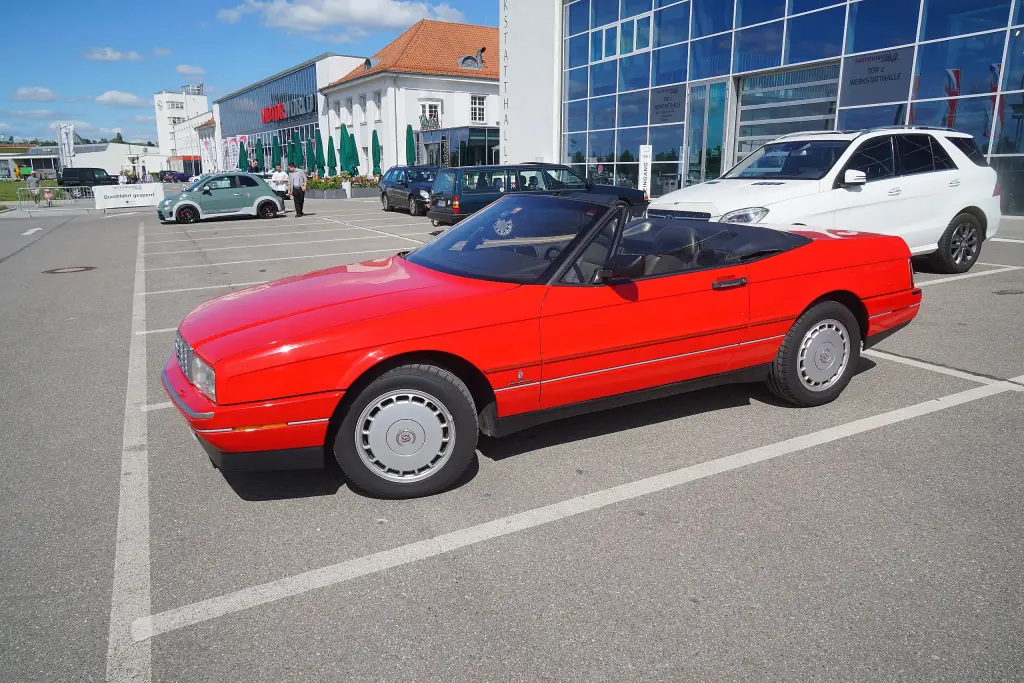
The Cadillac Allante was a two-door, two-seat luxury roadster sold from 1987 to 1993. Its bodywork was designed and built in Italy by Pininfarina, then airfreighted to Detroit where the American chassis and engine were married to it.
Cadillac Allante at a glance
| Maker | Cadillac, General Motors |
|---|---|
| Production | 1987-1993 |
| Body | two-door, two-seat convertible with removable hardtop |
| Design | Pininfarina, under Sergio Pininfarina |
| Platform | V-body, a shortened E platform |
| Assembly | San Giorgio Canavese, Italy, and Hamtramck, Detroit |
| Engines | 4.1 L V8 (1987), 4.5 L V8 (1989), 4.6 L Northstar V8 (1993) |
| Price, 1987 | $54,700 |
| Built | over 21,000 |
| Rivals | Mercedes-Benz SL, Jaguar XJS |
Based on one source: the English Wikipedia article on the Allante.
History of the Cadillac Allante
Cadillac wanted an aspirational model for the 1980s that would combine European design prestige with the name of a European coachbuilder, and so compete with Mercedes-Benz and Jaguar. Engineers were sent to Italy in 1982, and Pininfarina was chosen to design the car under Sergio Pininfarina, with Mario Vernacchia among the designers. Pininfarina opened a dedicated assembly plant outside Turin, at San Giorgio Canavese, for the Allante bodies. The name was picked by General Motors from 1,700 computer-generated possibilities.
The world’s longest assembly line
Bodies were built in Italy and flown to the United States in specially equipped Boeing 747s carrying 56 bodies at a time, from Turin to Detroit City Airport, a few miles from Cadillac’s Hamtramck plant. The arrangement was nicknamed the Allante Air Bridge and gave the car its reputation as the world’s longest assembly line. It followed the closure of Fisher Body Plant 18, which had supplied Cadillac bodies since 1921; Cadillac had worked with Pininfarina before, on the 1959 Eldorado Brougham and on several customs and show cars.
Model years
The 1987 car used a transverse, multi-point fuel injected version of the aluminium 4.1 L HT-4100 V8, with independent strut suspension front and rear, Bosch ABS III four-wheel disc brakes and a removable aluminium hardtop as standard. The only extra-cost option was a cellular telephone in a lockable centre console. For 1988 the headrests were revised, a power decklid pulldown became standard and analogue instruments replaced the digital dashboard at no extra charge. The 4.5 L V8 arrived in 1989 and the 4.6 L L37 Northstar in 1993, the final year.
Design and features
- Italian body, American chassis: Pininfarina bodywork over a shortened E platform shared with the Eldorado.
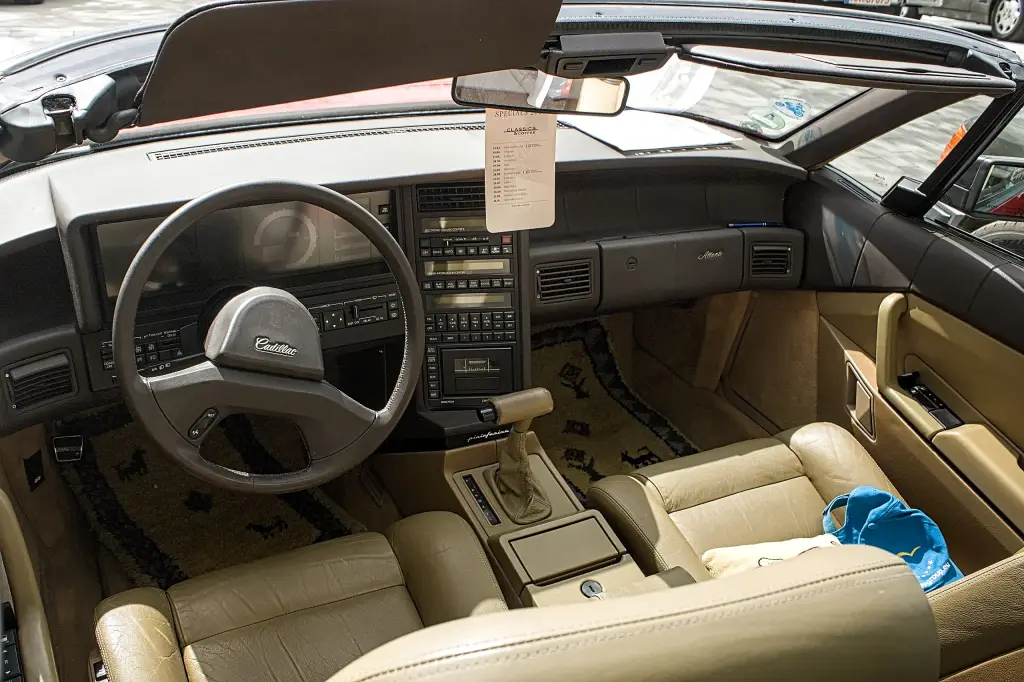
- All-digital cockpit: a fully electronic instrument and control panel angled towards the driver, without knobs or manual controls.
- Generous standard equipment: Bose sound system, the industry’s first power retractable AM/FM/cellular antenna, and a lamp-out module that substituted a neighbouring bulb for a failed one.
- Air bridge logistics: 56 bodies per Boeing 747 flight from Turin to Detroit.
Cadillac Allante versions
- 1987-1988: 4.1 L V8, digital dashboard, analogue instruments as a no-cost option from 1988.
- 1989-1992: 4.5 L V8.
- 1993: 4.6 L Northstar V8, the last and most powerful version.
- Hardtop cars: the removable aluminium hardtop was standard equipment.
The Allante was Cadillac’s roadster flagship of its day; other two-seaters and coupes are in the Eldorado and XLR articles. More Cadillacs are in the Cadillac collection.
Video: Cadillac Allante
Video by King Rose Archives on YouTube.
Sources
- Cadillac Allante, English Wikipedia: design, air bridge, model years, equipment