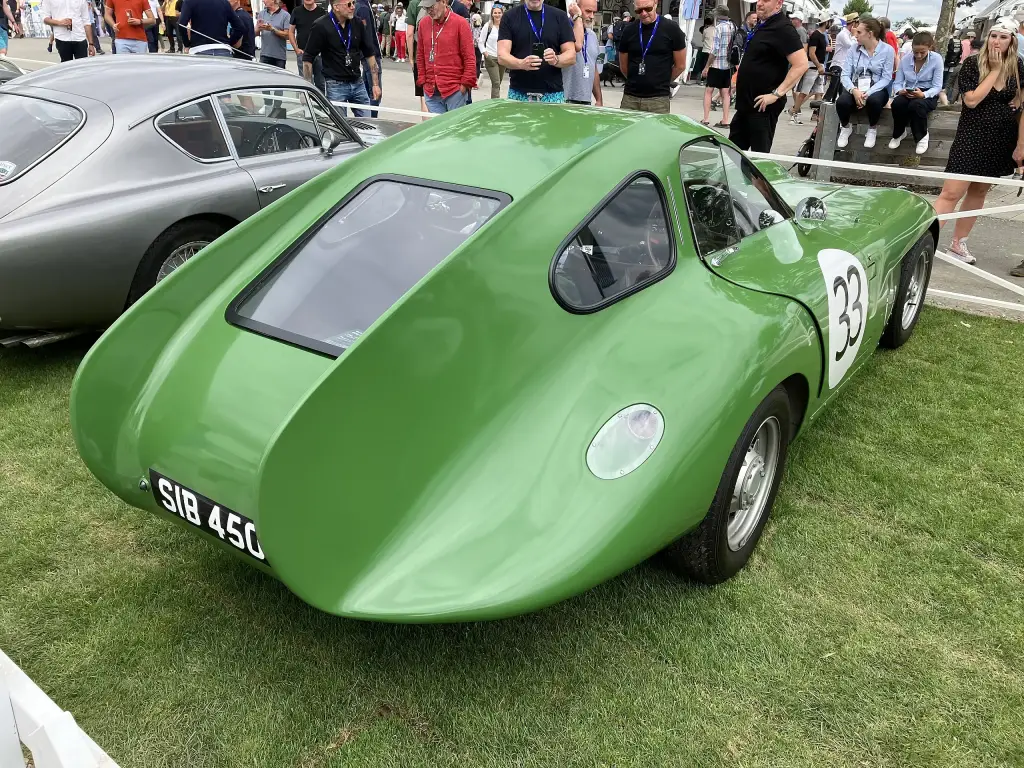
The Bristol 450 was a successful sports car racing prototype designed by Bristol Cars in 1953 and built for the 24 Hours of Le Mans. It won both its class and the team prize there in 1954 and 1955, set 2-litre speed records at Montlhéry, and was withdrawn when Bristol left motorsport after the 1955 Le Mans disaster.
Bristol 450 at a glance
| Maker | Bristol Cars |
|---|---|
| Designed | 1953, based on the ERA G-type Formula Two car |
| Purpose | 24 Hours of Le Mans and 2-litre speed records |
| Engine | Bristol straight-six, about 140 bhp, 155 bhp from early 1954 |
| Top speed | over 140 mph (230 km/h) with Le Mans gearing |
| Weight | 1,450 lb (660 kg) dry |
| Power to weight | over 235 bhp per tonne |
| Wheelbase | 8 ft 1¼ in (247.0 cm) |
| Track | 4 ft 3 in (130 cm) |
| Gearbox | four-speed, mounted behind the driver |
| Built | three, possibly four |
This page is based on the English Wikipedia article on the Bristol 450.
History of the Bristol 450
The Bristol 450 was a successful sports car racing prototype designed in 1953 by Bristol Cars and based on the abortive ERA G-type Formula Two car of 1952. Most sources state that only three were built, though photographic evidence suggests at least four existed at one point. The cars were built specifically for the 24 Hours of Le Mans, where they won both their class and the team prize in 1954 and in 1955. They also took a number of outright 2-litre speed records during trials at the Montlhéry circuit in 1953. After the 1955 Le Mans disaster, which killed Pierre Levegh and 83 spectators, Bristol withdrew from direct involvement in motorsport and all but one of the 450s were broken up.
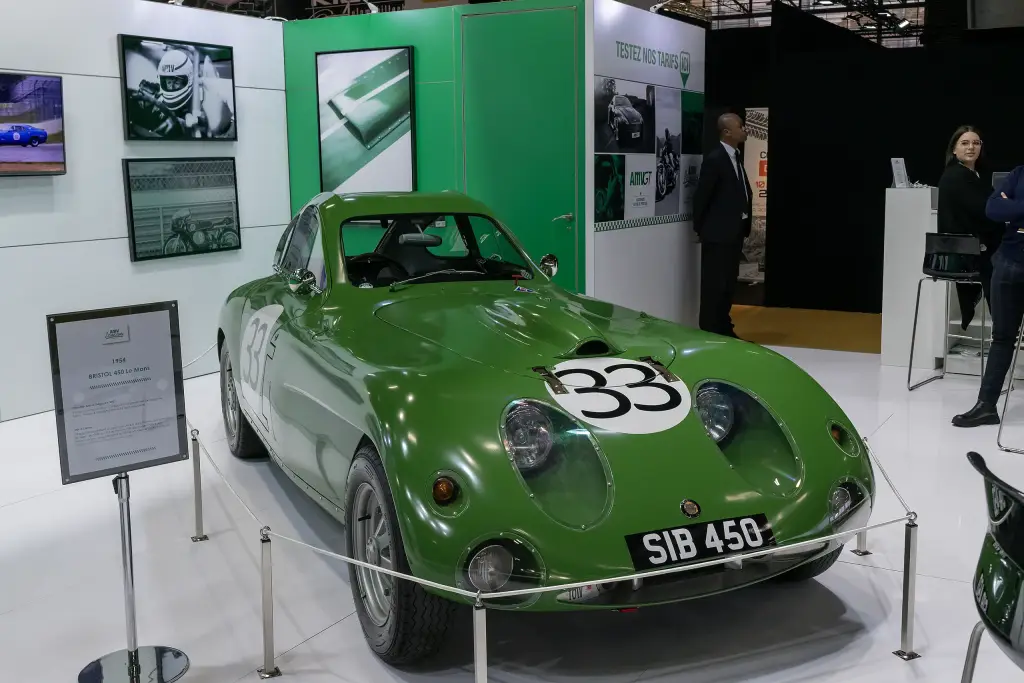
From Grand Prix failure to sports car
The fundamental design was laid down by Robert Eberan von Eberhorst and completed by his protege and successor David Hodkin as the chassis for the ERA G-type, Leslie Johnson’s attempt to revive the ERA name in 1952. The G-type was meant to run a custom ERA engine, but when funding became a problem it was adapted to take the Bristol straight-six, already used with success by Cooper, Frazer Nash and AC. Hodkin’s engine modifications led to failure in all three of the G-type’s Grand Prix outings, despite Stirling Moss driving. Out of money and in failing health, Johnson sold the project to Bristol’s car division at the end of 1952.
In late 1952 Bristol announced that the car would be redesigned as a two-seat sports car for the following year’s Le Mans. The chassis was rebuilt around twin oval-section rails, later changed to circular sections, carrying the G-type’s double wishbone front and de Dion rear suspension. The wheelbase was long at 247.0 cm given a narrow 130 cm track, and inboard rear brakes with an unusual hub and rim arrangement reduced unsprung weight. For 1955 Bristol developed a powered multi-barrelled spanner that removed all five wheel nuts at once, much like a modern Formula One wheel change.
Layout and aerodynamics
The tall Bristol engine sat well forward, with drive passing along a propshaft under the cockpit to a four-speed gearbox behind the driver, giving even weight distribution. Fuel was carried in two pannier cells behind the front wheels, in the position Bristol road cars use for the battery and spare wheel, so handling changed little between full and empty tanks. Driver Lance Macklin said the car could be driven without hands.
In early 1954 modifications raised output from about 140 bhp to 155 bhp, taking the top speed over 140 mph with Le Mans gearing. With a dry weight of only 660 kg the power-to-weight ratio was over 235 bhp per tonne. The body was advanced for the early 1950s: as part of an aircraft company Bristol had wind-tunnel access. The first cars had a smooth shape broken by headlamp, spotlight and intake bulges, and large twin stabilising fins ran down the tail behind the small enclosed cockpit. After the first race the panelwork was smoothed further, the front wings disappeared, the headlamps were set into faired conical tunnels and ducts were cut behind the front wheels to cool the brakes.
Design and features
- Le Mans class winner: first in class and team prize in both 1954 and 1955.
- 155 bhp from 2 litres: a tuned Bristol six in a car weighing only 660 kg.
- Wind-tunnel body: faired headlamps, a raised roofline and twin tail fins.
- Quick pit stops: a powered spanner that removed all five wheel nuts at once.
Bristol 450 versions
- 1953 Montlhéry cars: the original shape with exposed wings and lamps.
- 1954 Le Mans cars: smoothed body, faired headlamps and brake cooling ducts.
- 1955 cars: redesigned cockpit after further wind-tunnel work.
- Survivors: all but one of the 450s were broken up after 1955.
The 450’s six-cylinder engine came from the same BMW-derived line as the Bristol 403 and Bristol 405. Road and racing Bristols are listed in the Bristol collection.
Sources
- Bristol 450, English Wikipedia: design history, chassis, bodywork, racing record