The Bedford TM was a heavy goods vehicle manufactured by Bedford Vehicles between 1974 and 1986. Until the TM, Bedford had built mostly low-specification short-haul distribution trucks, and the TM was designed to compete with high-cab long-distance models such as the Leyland Marathon, Scania L110 and Volvo F88.
Bedford TM at a glance
| Maker | Bedford Vehicles |
|---|---|
| Production | 1974-1986 |
| Type | heavy goods vehicle |
| Civil engines | Bedford 500 turbo (8.2 Blue), Detroit Diesel V6 and V8, Cummins L10 |
| Transmissions | Fuller or Spicer |
| Cab | day or sleeper, wide or narrow |
| Military version | TM 4×4 and TM 6×6 |
| Military engine | 8.2-litre turbo diesel, 206 hp at 2,500 rpm |
| Military payload | 8 tons (4×4), 14 tons (6×6) |
| Military production | over 2,100 4×4 and over 1,000 6×6 |
| Army order | 1977, worth £40 million |
History of the Bedford TM
A competitor for the long-distance cabs
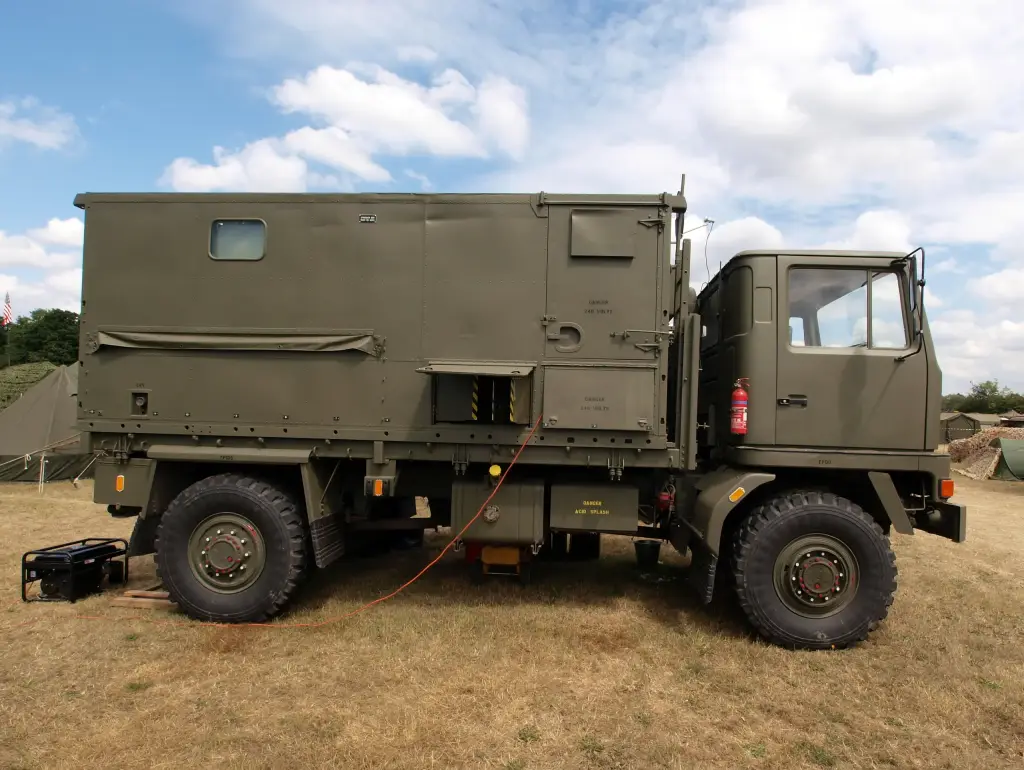
The TM was introduced in 1974. In view of the increasing popularity of high cabs in the maximum-weight long-distance category, such as the Leyland Marathon, Scania L110 and Volvo F88, Bedford designed the TM as a competitor. Through its life it was available with a Bedford 500 turbo engine, also known as the 8.2 Blue, a Detroit Diesel two-stroke V6 or V8, or a Cummins L10, coupled to either a Fuller or Spicer transmission and a SOMA rear axle, which was dropped after the 1982 facelift. The Detroit engine was not a successful choice in the UK: its high-revving characteristics proved unpopular with drivers used to slow-revving, long-stroke British diesels, and operators disliked its poor fuel economy.
A thorough update in 1982 left the appearance mostly untouched, perhaps to the detriment of sales of what was a substantially new model. Improvements included the new Detroit Diesel Series 92 engine, a new chassis, many new engine and transmission options and a variety of updated fittings. The Fuller transmissions now received a new telescopic shift mechanism, allowing the cabin floor to be sealed. The cab was counterbalanced so that it could be tilted by one person, and two front flaps allowed access to check the vitals. Production ceased in 1986 with the closure of the Bedford company.
The military TM
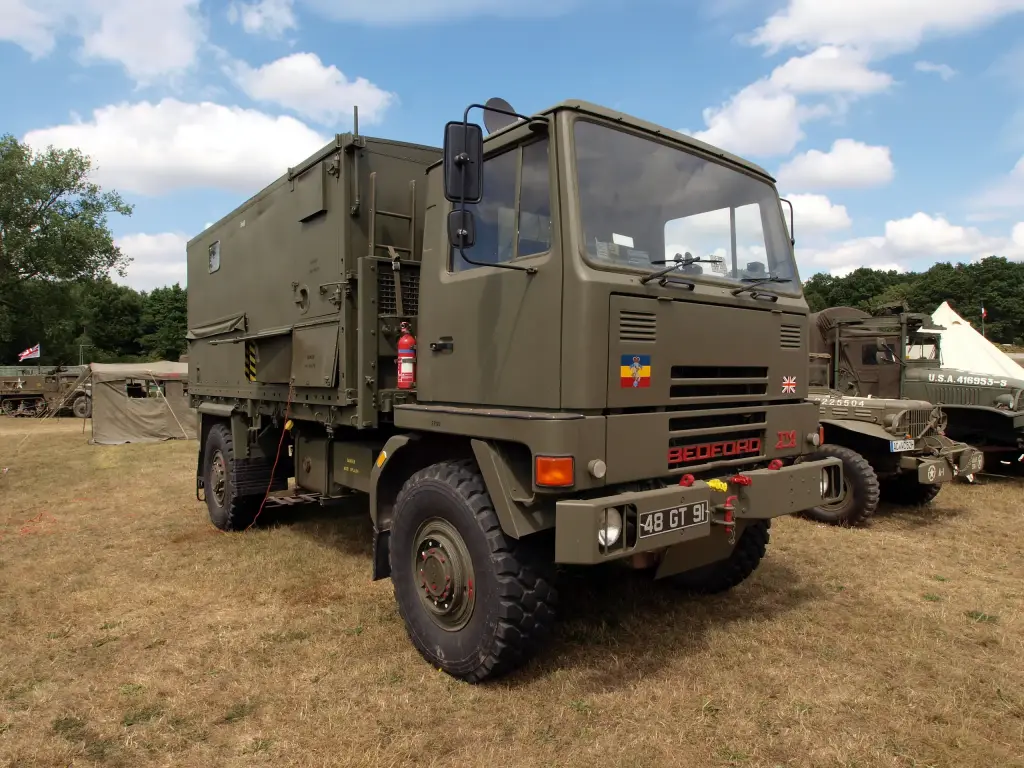
In the 1970s the British Army began looking for a successor to the Bedford MK and the AEC Militant Mark 1. It preferred a four-wheel-drive vehicle with an 8-ton payload, and three manufacturers, Bedford, Foden and Leyland, supplied prototypes. After extensive testing the Bedford TM 4-4 came out best, and in 1977 Bedford received an order worth £40 million. Production started in 1980 and the first examples were delivered to army units in April 1981.
The military Bedford was an adaptation of the civilian TM, which had rear-wheel drive only. The main differences were four-wheel drive and greater ground clearance. Payload was set at 8 tons, double the 4 tons of the Bedford MK, and a trailer with a maximum total weight of 10 tons could be towed. The vehicle had a water-cooled 8.2-litre turbo diesel engine of 206 hp at 2,500 rpm and a six-speed gearbox. Fuel tanks held 154 litres of diesel, giving a range of about 500 km. The cab held a driver and a passenger and had a roof hatch, and the flat steel load floor, covered with wooden planks, could take standard cabs, six standard NATO pallets or personnel.
The standard version could be fitted with a winch or a hydraulic crane behind the cab. The tipper version had a 3.88 m wheelbase, 44 cm shorter than the standard vehicle, with the payload unchanged at 8 tons. A longer TM 6-6 was developed as well: it was 7.5 m long, had 6×6 drive and a payload of 14 tons, and reached army units from 1986. More than 2,100 of the 4×4 version and over 1,000 of the TM 6-6 were built. The British Army planned to replace the TM with modern trucks from the German manufacturer MAN, and the type also served in Abu Dhabi, Bahrain and Oman.
Design and features
- High-cab competitor: designed to take on the Leyland Marathon, Scania L110 and Volvo F88 in long-distance work.
- Engine choice: Bedford 500 turbo, Detroit Diesel two-stroke V6 or V8, and Cummins L10.
- 1982 update: new chassis, Detroit Series 92 engine, more transmission options and a sealed cab floor.
- One-man tilt cab: a counterbalanced cab and front access flaps for routine checks.
- Military 4×4 and 6×6: 8-ton and 14-ton payloads, with more than 3,100 military TM trucks built.
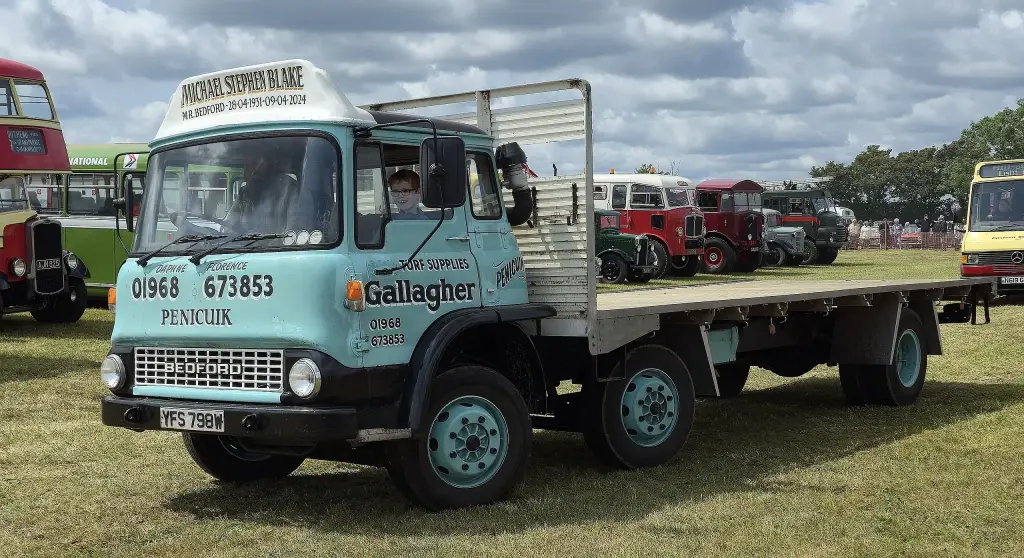
Bedford TM versions
- TM tractor unit: an articulated tractor for long-distance work.
- TM rigid: a rigid lorry in wide or narrow day and sleeper cabs.
- Bedford TM 4×4: the military 8-ton version, over 2,100 built.
- Bedford TM 6×6: the 7.5 m military version with a 14-ton payload, over 1,000 built.
- TM tipper: a short-wheelbase military tipper.
- AWD Multidrive 6×4: a later commercial version, a few of which went to the MoD and Dubai.
The TM was the heavy truck of the Bedford range, above the Bedford TK and Bedford TL. More are in the Bedford collection.
Sources
- Bedford TM, English Wikipedia: civil history, engines, military use
- Bedford TM, Italian Wikipedia: military TM 4×4 equipment and engine
- Bedford TM, Dutch Wikipedia: military development, dimensions, production