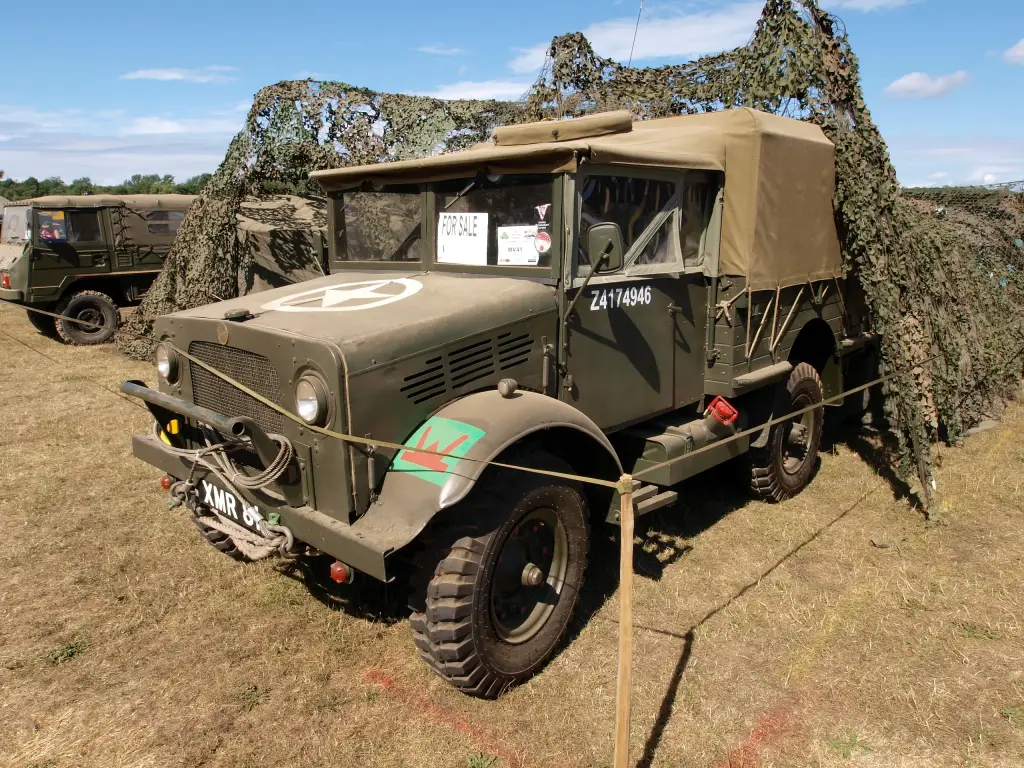
The Bedford MW was a general service truck manufactured by Bedford for the British Armed Forces during the Second World War. It was a 15 cwt (760 kg) 4×2 truck with a 72 bhp six-cylinder engine, and 65,995 were produced between 1939 and 1945.
Bedford MW at a glance
| Maker | Bedford |
|---|---|
| Type | general service truck, 15 cwt (760 kg), 4×2 |
| Used by | British Armed Forces in the Second World War |
| Engine | 3.5-litre six-cylinder petrol, 72 bhp |
| Gearbox | four-speed |
| Production | 1939-1945, 65,995 built |
| Service life | until the late 1950s |
| Cab | open with folding aeroscreens; enclosed cab with perspex side screens from 1943 |
| Main variant | MWD cargo truck |
| Other variants | MWC, MWT, MWG, MWR, MWV |
History of the Bedford MW
From War Office trials to production
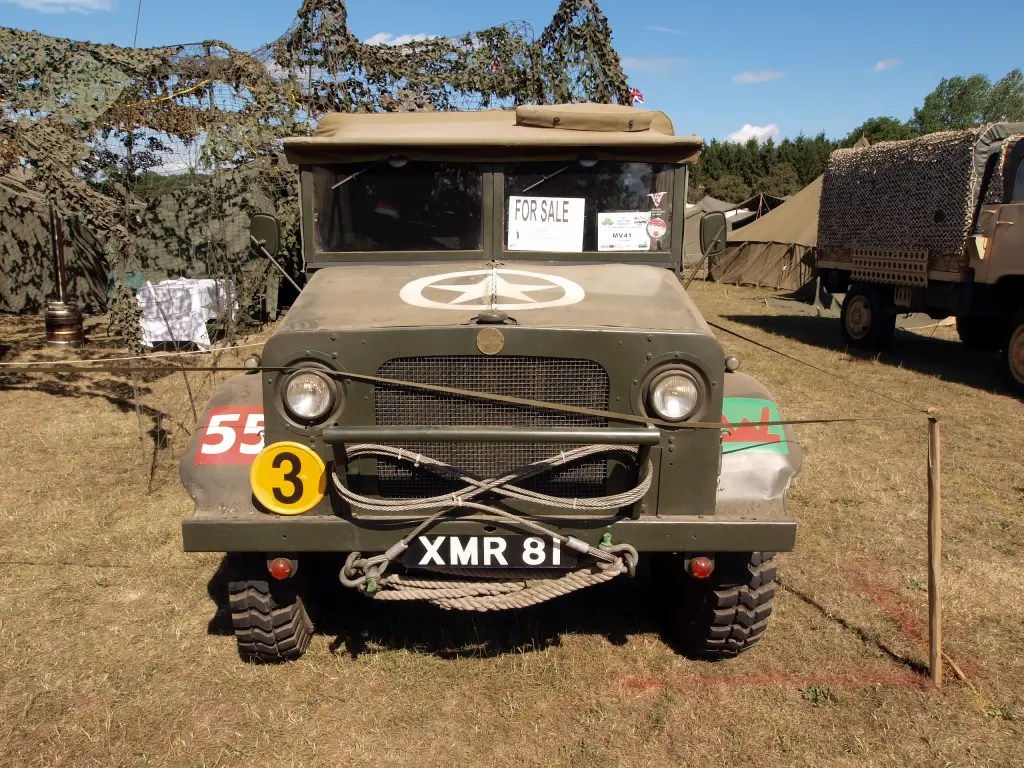
In 1935 the War Office issued specifications for a new 15 cwt 4×2 military truck for the British Army, inviting manufacturers to submit designs for annual comparative trials in North Wales. One entrant was a modification of a Bedford 2-ton rear-wheel-drive lorry. Following the trials Bedford fitted a larger radiator and larger tyres, and the trials were repeated in 1936; Bedford then modified the chassis to increase ground clearance and installed a new engine cooling system. For the 1937 trials a new special Bedford WD-1 prototype was produced with a 15 cwt payload, and it performed admirably. In 1938 the eventual 72 bhp engine was installed.
Design
The MW was a 4×2 truck powered by a Bedford 72 bhp six-cylinder inline petrol engine of 3.5 litres through a four-speed transmission. Despite lacking four-wheel drive and so being unsuited to off-road use, its powerful engine, short wheelbase, low centre of gravity and relatively light weight gave it excellent acceleration and, in the words of the source, almost sports-car-like handling. The MW could reach 65 km/h.
The early MWs had an open cab with individual folding windscreens, canvas doors and a collapsible canvas tilt. A full windscreen and steel doors were fitted on later vehicles, but the cab remained open. From 1943 an enclosed cab with doors and perspex side screens was added, retaining the canvas top. The vehicle had a distinctive wide bonnet, needed to accommodate a special extra-large War Department air filter that was never fitted to production vehicles.
Use and variants
The MW was intended mainly as a workhorse for the British Army’s infantry battalions, but throughout the war it was adapted to a number of roles and was eventually also used by the Royal Air Force, Royal Navy, other government departments and some overseas customers. Between 1939 and 1945 Bedford produced 65,995 MWs, and the vehicles remained in British service until the late 1950s.
Design and features
- 15 cwt payload: a 4×2 truck rated at 760 kg, with a 3.5-litre 72 bhp six-cylinder engine and four-speed gearbox.
- Light and quick: a short wheelbase and low centre of gravity gave it excellent acceleration despite the lack of four-wheel drive.
- Open cab: early trucks had folding aeroscreens and canvas doors; from 1943 an enclosed cab with perspex side screens was available.
- Wide bonnet: designed around a large air filter that was never used in production.
- Many roles: cargo, water tank, anti-aircraft tractor, gun portee, radio and signals.
Bedford MW versions
- MWD: cargo truck with General Service body of about 1.8 by 1.8 m, the main transport of an infantry battalion.
- MWC: water tank truck.
- MWT: anti-aircraft gun tractor.
- MWG: portee for the QF 2-pounder anti-tank gun or 20 mm Oerlikon.
- MWR: radio truck.
- MWV: Royal Air Force signals van.
Other Second World War Bedfords are the Bedford QL and the Bedford OY. More are in the Bedford collection.
Video: 1939 Bedford MW
Video by rampant rivet on YouTube.
Sources
- Bedford MW, English Wikipedia: design, development, production, variants
- Bedford MW, German Wikipedia: development and technical description
- Bedford MW, Dutch Wikipedia: production numbers and use
- Bedford MWD, Italian Wikipedia: service and production context