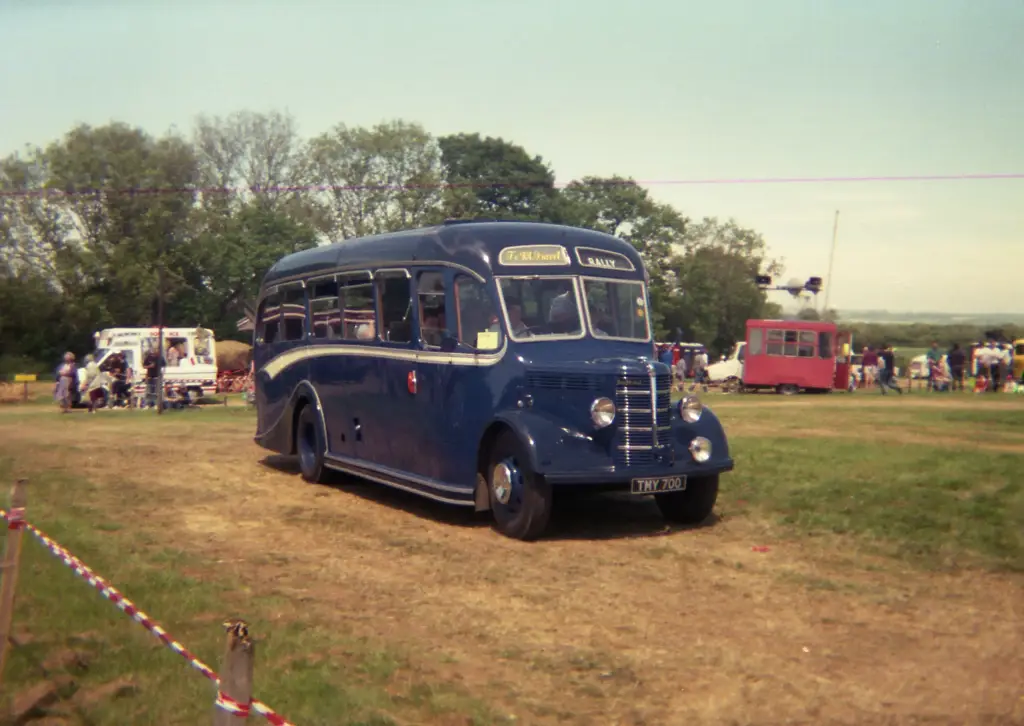
The Bedford OB was a bus chassis manufactured by Bedford from 1939. Designed as a successor to the Bedford WTB, it was a semi-forward control model for 26 to 29-passenger bodywork, and after the Second World War it became one of the most popular buses of its type.
Bedford OB at a glance
| Maker | Bedford |
|---|---|
| Production | 1939-1951 |
| Type | bus and coach chassis |
| Wheelbase | 14 ft 6 in (4.42 m) |
| Layout | semi-forward control |
| Seating | 26-29 passengers |
| Engine | 3,519 cc six-cylinder, 72 bhp at 3,000 rpm |
| Gearbox | four-speed manual |
| Rear axle | fully floating |
| Brakes | vacuum servo-assisted hydraulic |
| Pre-war production | 73 |
| Post-war production | 12,693 |
| Total production | 12,766 |
History of the Bedford OB
The pre-war OB
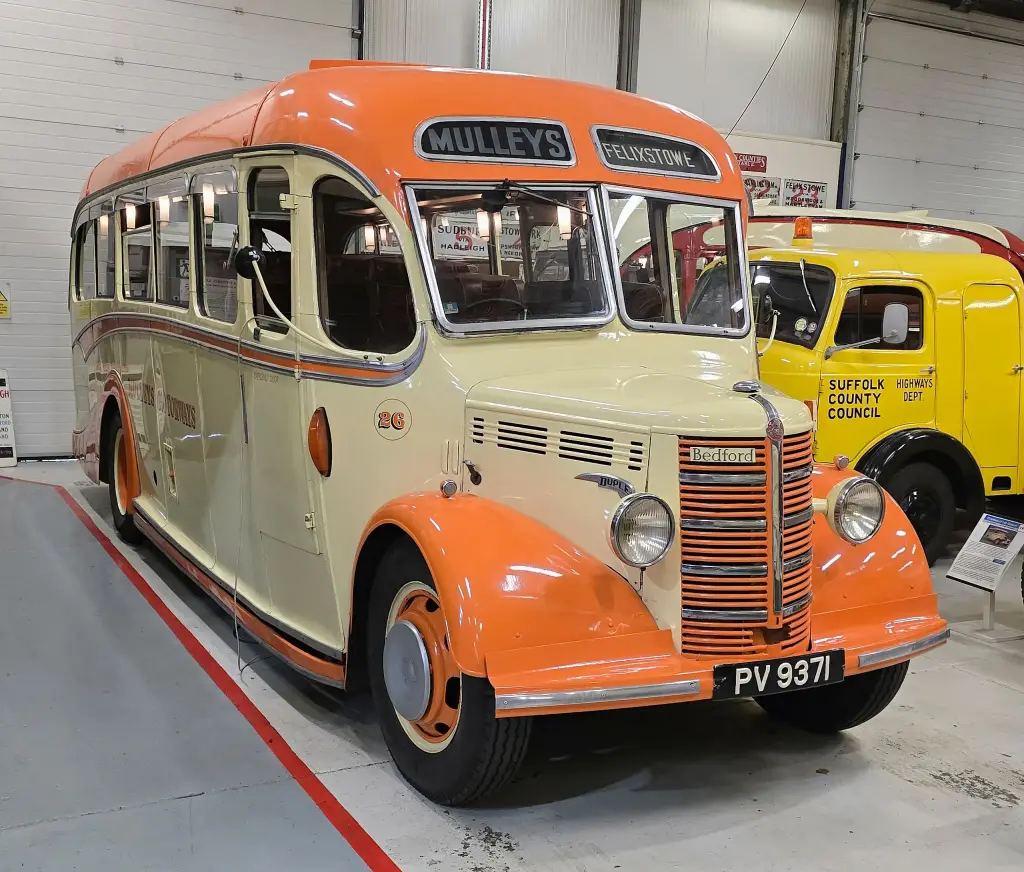
The Bedford O type lorry chassis was introduced in August 1939, with a coach-chassis version named the OB. It was designed as a successor to the Bedford WTB and had a wheelbase of 14 ft 6 in, longer than the previous model. Duple Coachbuilders modified their Hendonian body to fit the chassis. The six-cylinder overhead-valve engine of 3,519 cc, introduced in 1938, developed 72 bhp at 3,000 rpm. The OB was a semi-forward control design for 26 to 29-passenger bodywork, with a four-speed manual gearbox, a fully floating rear axle and vacuum servo-assisted hydraulic brakes.
Only 73 OB buses were built in the two months before production ceased at the outbreak of the Second World War. All of Vauxhall and Bedford’s production was turned over to the war effort, including the Churchill tank.
The wartime OWB
The Bedford OWB chassis was produced during the war to the same basic design as the OB, but replaced valuable metals such as aluminium with cast iron. It had austere bodywork and an interior with 32 seats and no upholstery, just wooden slats like a park bench. Bodies were designed and built by Duple Coachbuilders, and bodies to Duple drawings were also built by Charles H. Roe in Leeds, Mulliners in Birmingham and Scottish Motor Traction in Edinburgh. Total OWB production was 3,398, finishing in late 1945, and most utility bodies were by Duple.
The post-war OB
Bedford restarted production of the OB in October 1945 at its Dunstable plant, with only minor changes to the pre-war design. From the end of the war until 1951 a total of 12,693 OBs were built, which with the 73 pre-war buses gives 12,766 in all. The Duple Vista remained Duple’s standard OB body until production ceased in 1951. The OB was succeeded by the Bedford SB, and some wartime OWBs were rebuilt to post-war OB standard.
Coachwork and preservation
Bedford co-developed the Vista coachwork with Duple for the OB, fronted by a classic bullnose. The ash framework was reinforced with steel, and the floor was made from hardwood with softwood tongued and grooved boarding, except in the cab area, which was finished with alloy chequerplate. Seating capacity was normally 29 with overhead luggage racks, while the rear luggage boot was also used to store the spare wheel. The price of a complete coach in a two-colour livery was £1,314 10s for a 27-seater and £1,325 10s for a 29-seater. Geared to reach at least 40 mph, fast for its day, the OB is remembered for its characteristic gearbox whine.
The OB is one of the most popular coaches in preservation. There are known to be 180 still in existence, nearly 70 in roadworthy condition and 30 licensed for private hire work. They have appeared in period television programmes including Foyle’s War, Miss Marple and Endeavour. The type was also sold in other Commonwealth countries, with Commonwealth Aircraft Corporation bodying many in Australia.
Design and features
- Duple Vista coachwork: a classic bullnose front and a body developed by Bedford and Duple.
- Ash and steel body: an ash framework reinforced with steel, and a hardwood floor with softwood boarding.
- 29 seats: overhead luggage racks and a rear boot that also held the spare wheel.
- Fast for its day: geared for at least 40 mph, with a characteristic gearbox whine.
- Long-lived design: the post-war OB was almost unchanged from the 1939 original and stayed in production until 1951.
Bedford OB versions
- Bedford OB: the standard bus and coach chassis.
- Duple Vista: the best-known OB body, with a bullnose front.
- Bedford OWB: the wartime utility version with cast iron replacing aluminium and 32 bare seats.
- Australian-bodied OB: coaches bodied by Commonwealth Aircraft Corporation.
- Preserved OBs: 180 survive, with about 70 roadworthy.
The OB was succeeded by the Bedford SB, and its O-series chassis family also produced the Bedford OY lorry. More are in the Bedford collection.
Video: BEDFORD OB BUS | ON BOARD DRIVE AROUND NORFOLK’S LANES
Video by Franklin Samuel on YouTube.
Sources
- Bedford OB, English Wikipedia: history, coachwork, production, preservation
- Bedford OB, French Wikipedia: history, coachwork, preservation