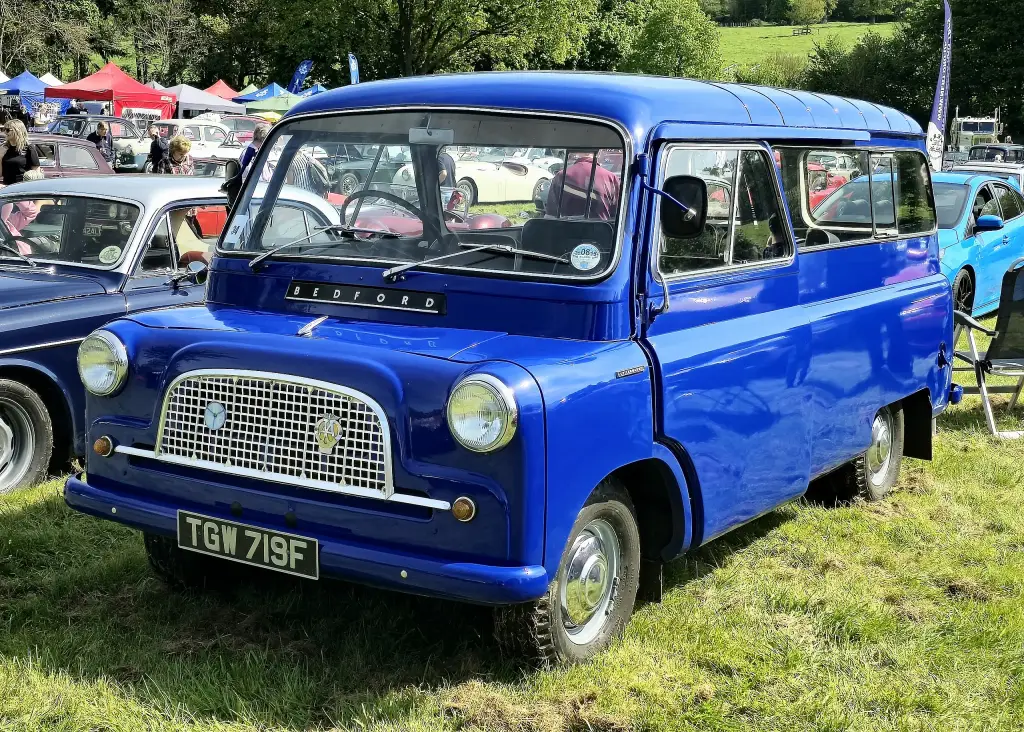
The Bedford CA was a distinctive pug-nosed, body-on-frame light commercial vehicle produced by Bedford in Luton, England, between 1952 and 1969. It was built in short- and long-wheelbase forms, each available with a 10-12 cwt or 15 cwt payload, and its engine sat beside the driver under a very short bonnet.
Bedford CA at a glance
| Maker | Bedford, Luton, England |
|---|---|
| Production | 1952-1969 (17 years) |
| Type | light commercial vehicle, body on frame |
| Bodies | van with sliding doors; chassis with cowl for specialist bodies |
| Wheelbases | short and long |
| Payload | 10-12 cwt or 15 cwt |
| Petrol engines | 1,508 cc four-cylinder; later 1,594 cc |
| Diesel engines | Perkins 1,622 cc and 1,760 cc |
| Gearbox | three-speed, later four-speed option |
| Front suspension | double wishbones, coil springs, anti-roll bar |
| Rear suspension | semi-elliptic leaf springs |
| Built | 370,000 |
History of the Bedford CA
A light van for post-war Britain
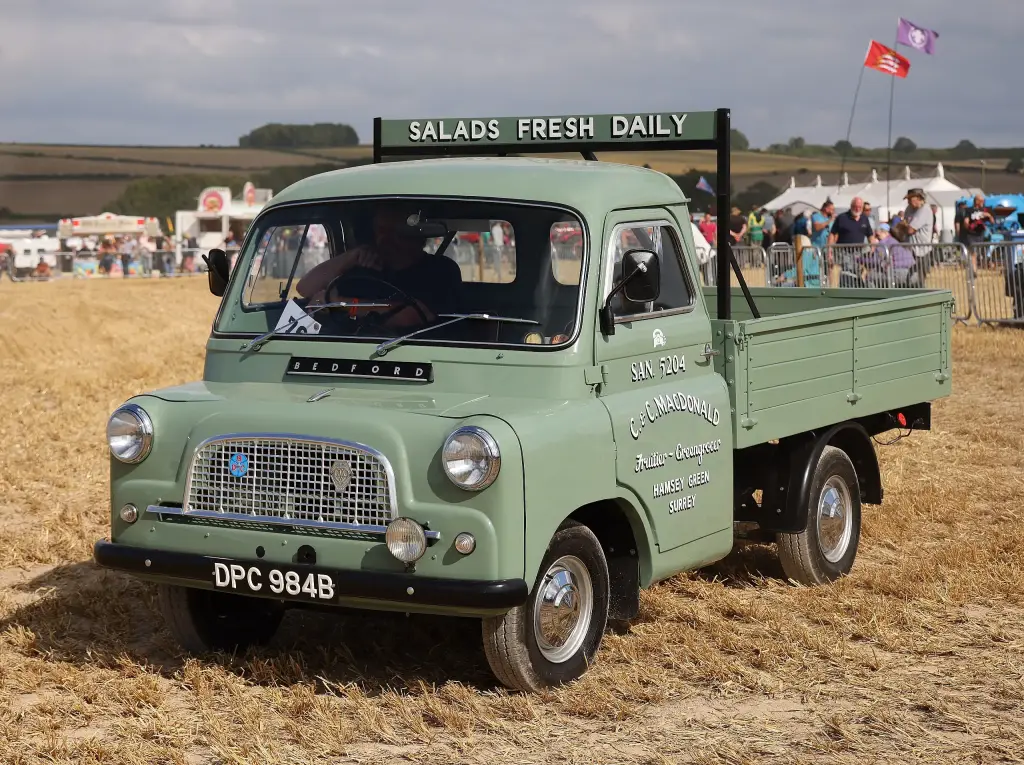
The CA was introduced in 1952 and remained in production for seventeen years. It came in short-wheelbase and long-wheelbase forms, each with a 10-12 cwt or a 15 cwt payload. The usual body was a light delivery van with sliding doors, but Bedford also supplied a chassis with a cowl so that specialist coachbuilders could add their own bodywork. The type was exported to Canada and sold there as the Envoy CA, as part of the Envoy brand line-up. In total 370,000 were manufactured.
Three body versions
The overall profile of the CA changed little during its life, but three distinct versions were sold. The first vans had a two-piece windscreen made of two flat glass panes with a vertical metal divider between them, and a painted front grille with a central split that echoed the screen. When curved screen glass became available in Britain at an acceptable price, the split screen was replaced by a single slightly curved windscreen, in about 1958, and the grille became a smaller unsplit unit, still painted in the body colour.
The third version, sold from late 1964, had a much deeper windscreen and deeper side windows, with a corresponding reduction in the height of the painted metal scuttle panel below the screen. These vans also gained a pressed aluminium alloy front grille. The longer-wheelbase model had its body lengthened by an additional short roof panel and wider doors.
Engine, chassis and suspension
Power came from an inline four-cylinder petrol engine of 1,508 cc at first, with pushrod-operated overhead valves and a three-main-bearing crankshaft; it had first been used in the 1951 Vauxhall Wyvern. A Zenith 34VN downdraught carburettor was fitted, and the engine was offered in low-compression or, less often, high-compression form. Later models received the slightly larger 1,594 cc engine fitted to the Vauxhall Victor FB after 1964. A 1,622 cc Perkins diesel was also available, as was a Perkins 1,760 cc diesel, and a popular aftermarket conversion used the Perkins 4/99 diesel.
The engine extended back into the passenger compartment and was covered by a removable cowling. That gave the CA its very short bonnet and meant that driver and passenger travelled with their feet alongside the engine, but it allowed a good proportion of the vehicle’s length to be used for payload. Routine checks were made through the tiny bonnet flap or the interior cowl; a major overhaul required removal of the front panel with the headlights and grille, and of the chassis front crossmember.
The three-speed gearbox was mounted immediately behind the engine, and torque reached the live rear axle through an open tubular propeller shaft. Engine and gearbox were also used in the Vauxhall F-series Victor, and the four-speed gearbox of the later FC-series could be retro-fitted easily to any three-speed CA before it was offered as a factory option. The front suspension used double wishbones and coil springs on a front axle crossmember, with an anti-roll bar, while the rear used semi-elliptic leaf springs: seven leaves on the 10-12 cwt version and eight on the 15-17 cwt version. Steering was by a Burman worm and nut system.
Design and features
- Cab-forward layout: the engine sat beside the driver and passenger under a removable cowling, leaving a very short bonnet and more of the length for load space.
- Independent front suspension: double wishbones, coil springs and an anti-roll bar gave the CA handling that Bedford sources describe as better than the early Ford Transit.
- Choice of engines: 1.5-litre and later 1.6-litre petrol units, plus 1,622 cc and 1,760 cc Perkins diesels.
- Three front ends: split windscreen, the 1958 curved screen with a smaller grille, and the 1964 deep screen with an aluminium grille.
- Coachbuilder ready: the chassis-with-cowl version could take specialist bodywork, including the Dormobile camper conversion.
Bedford CA versions
- Panel van: the standard light delivery body with sliding doors, in short or long wheelbase.
- Chassis with cowl: supplied for specialist bodywork.
- Bedford Dormobile: a campervan conversion based on the CA van.
- Envoy CA: the Canadian-market version sold under the Envoy brand.
- Perkins diesel models: 1,622 cc and 1,760 cc oil-burners, with the Perkins 4/99 a popular conversion.
- 15 cwt version: the heavier-payload CA with eight-leaf rear springs.
Other Bedford light commercials in our collection include the Bedford CF and the Bedford HA. More examples are in the Bedford collection.
Video: Trojan Cars Classic Bedford CA Crewbus 1960 very rare!!
Video by Mark Battye on YouTube.
Sources
- Bedford CA, English Wikipedia: production, bodies, engines, chassis
- Bedford CA, German Wikipedia: dimensions, suspension, brakes
- Bedford CA, French Wikipedia: engines, transmission, suspension