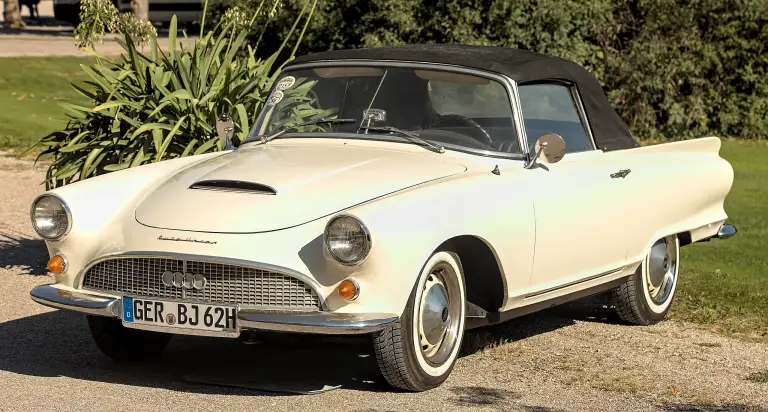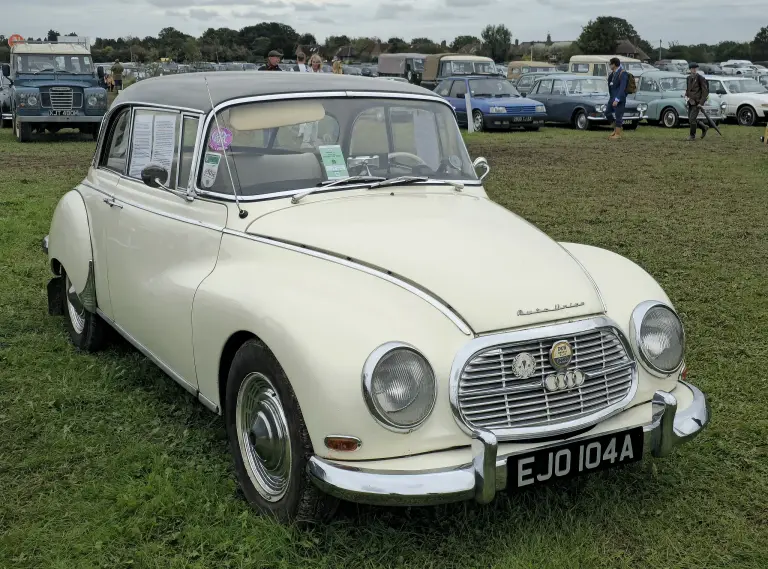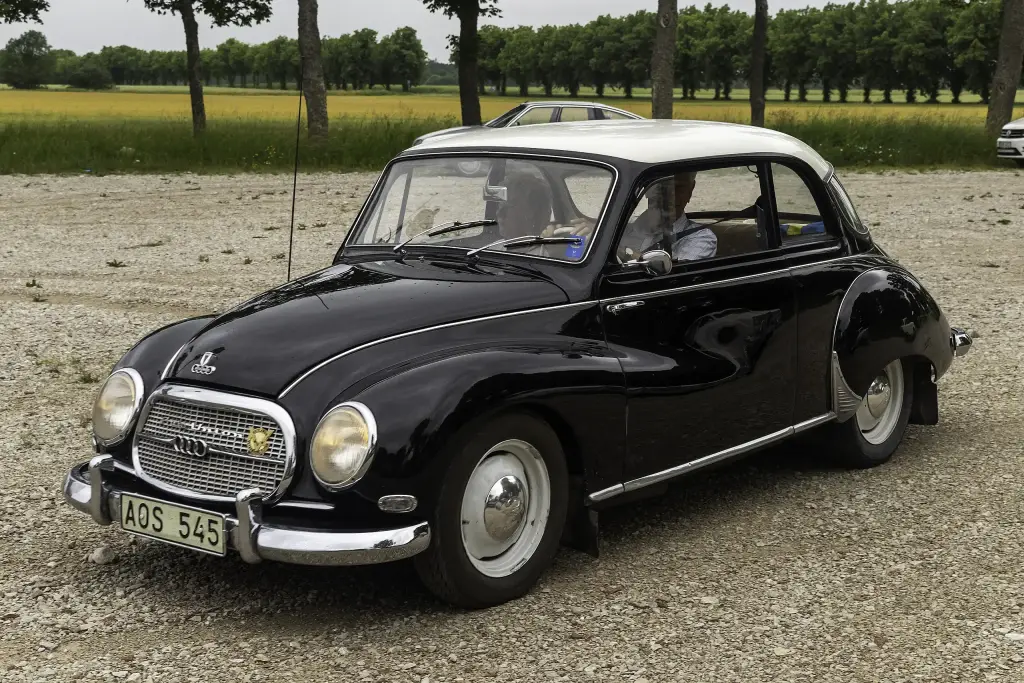
The DKW 3=6 is the compact front-wheel drive saloon that Auto Union launched at the Frankfurt Motor Show in March 1953 and sold until 1959. Under the bonnet sat an 896 cc two-stroke three-cylinder engine, and the name on the boot was a claim rather than a description: a two-stroke three worked, the advertising said, like a four-stroke six.
Auto Union DKW 3=6 at a glance
| Maker | Auto Union GmbH, Düsseldorf |
|---|---|
| Production | 1953–1959 |
| Class | compact saloon |
| Engine | 896 cc two-stroke three-cylinder |
| Layout | front engine, front-wheel drive |
| Project numbers | F91, then F93 and F94 |
| Names | Sonderklasse, Großer 3=6, DKW 900 |
| Power | 38 PS (28 kW) in the F93, 40 PS from 1957 |
| Bodies | two- and four-door saloon, pillarless coupé, Karmann cabriolet, Universal estate |
| Built | 137,800 from September 1955 to July 1959, 19,531 of them estates |
| Successor | Auto Union 1000 |
Translated from the English and German Wikipedia articles; the two agree on the production figures.
History of the Auto Union DKW 3=6
The name that became the model
The DKW 3=6 followed the DKW F89 Meisterklasse, which stayed in production until April 1954. At first the name was only an advertising slogan. A two-stroke engine fires in every cylinder on every turn of the crankshaft, a four-stroke only on every second turn, so a three-cylinder two-stroke was presented as the equal of a six-cylinder four-stroke. By the 1955 facelift the slogan had become the model name, and the car was advertised as the Großer 3=6 to separate it from the earlier version.
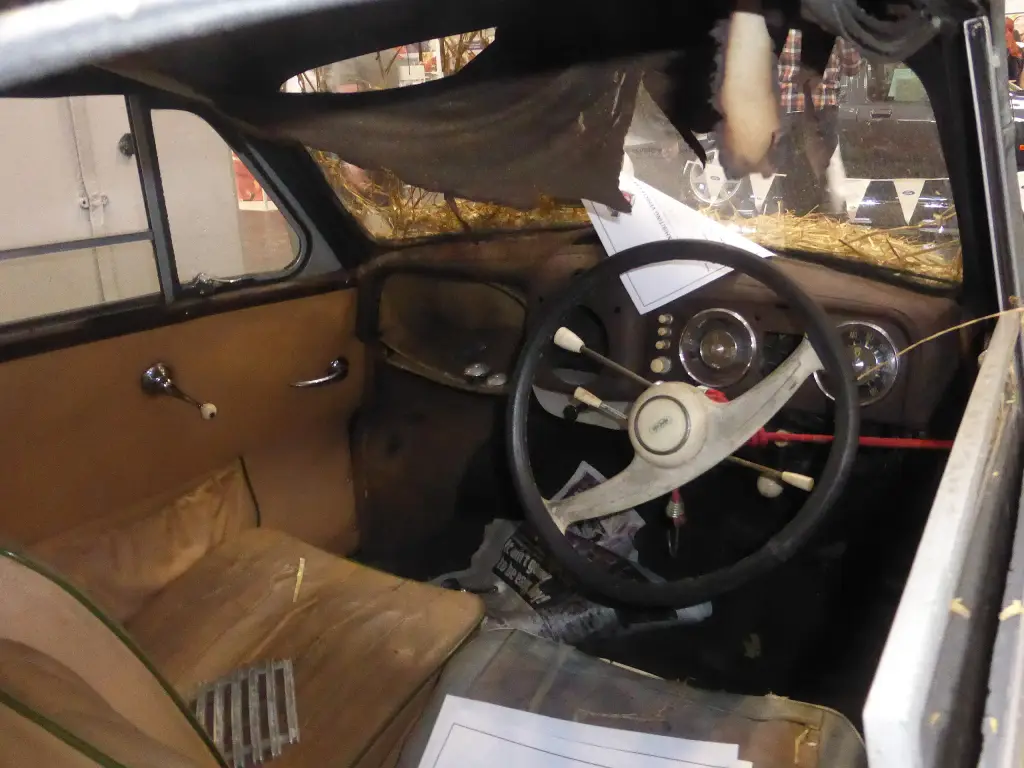
F91, F93 and F94
The first car of the range carried the factory project number F91; the F stood for Frontantrieb, front-wheel drive. The F91 was a two-door saloon with front-hinged doors, joined from 1954 by a pillarless coupé and by a cabriolet bodied by Karmann in Osnabrück, and by a three-door estate called the Universal. The F93 arrived for the 1956 model year with a stronger 38 PS engine, a body 10 cm wider, a uniformly curved windscreen and a chrome-framed oval grille; the three-piece wrap-around rear window stayed. From 1957 a four-door saloon with a longer body was offered as the F94, mostly to taxi firms and the Bundeswehr, together with the Universal estate; power rose to 40 PS and the grille gained a fine aluminium mesh. From September 1957 the two-door saloons had front-hinged doors again, while four-door cars and estates kept rear-hinged ones.
The end of the line
The takeover of Auto Union by Daimler-Benz showed in the naming: from the middle of 1958 the car was marketed as the DKW 900, and in the United States and the Netherlands it was known simply by that name. The successor, the Auto Union 1000, was already on sale from late 1957 for the 1958 model year, and the older car became a run-out model. Between September 1955 and July 1959 Auto Union built 137,800 cars of the series, 19,531 of them estates, and Karmann built 667 cabriolets. The chassis of the big 3=6 also served the DKW Monza, built by Dannenhauer & Stauss in Stuttgart.
Design and features
- Two-stroke three-cylinder: 896 cc, 38 PS in the F93 and 40 PS after 1957, driving the front wheels.
- Front-wheel drive: the layout DKW had used since the 1930s, giving sure-footed handling on poor roads.
- Saxomat: a semi-automatic clutch was available at extra cost on all versions.
- Wrap-around glazing: a three-piece panoramic rear window on the coupé and, from late 1954, on the two-door saloon.
- Many bodies: saloon, coupé, cabriolet and the Universal estate from one range.
Auto Union DKW 3=6 versions
- F91 (1953–1955): the original Sonderklasse, two-door saloon with front-hinged doors.
- F93 Großer 3=6 (1955–1959): wider body, 38 PS, oval grille; coupé and cabriolet in the same range.
- F94 (1957–1959): four-door saloon on a longer body, 40 PS, aluminium mesh grille.
- Universal: three-door estate, offered unchanged until 1956 and then in F94 form.
- DKW 900 (1958–1959): the run-out name used after the Daimler-Benz takeover.
The 3=6 was replaced by the Auto Union 1000, which used the same body and a larger engine; its two-seat derivative was the 1000 Sp. More cars are in the Auto Union collection.
Sources
- DKW 3=6, English Wikipedia: launch, names, bodies, production
- DKW F 93/94, German Wikipedia: F93 changes, F94, production totals