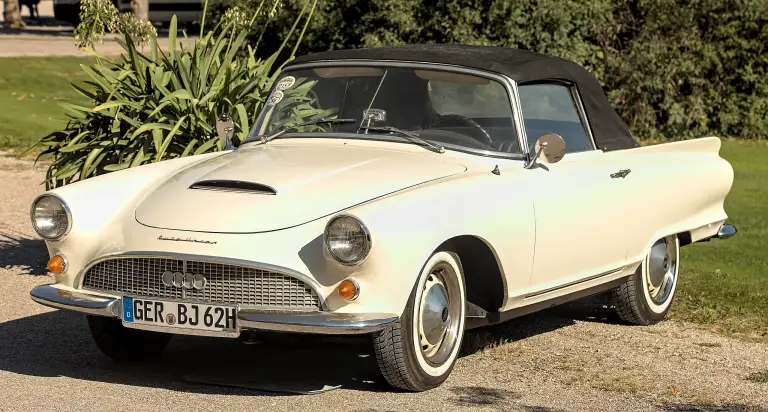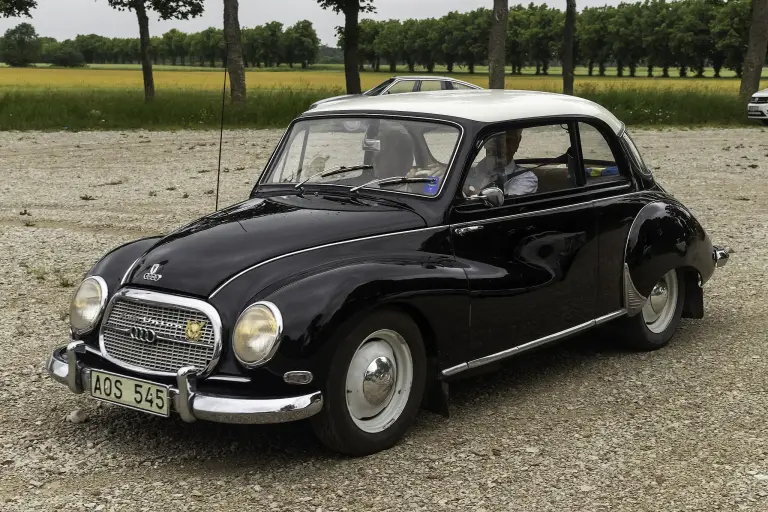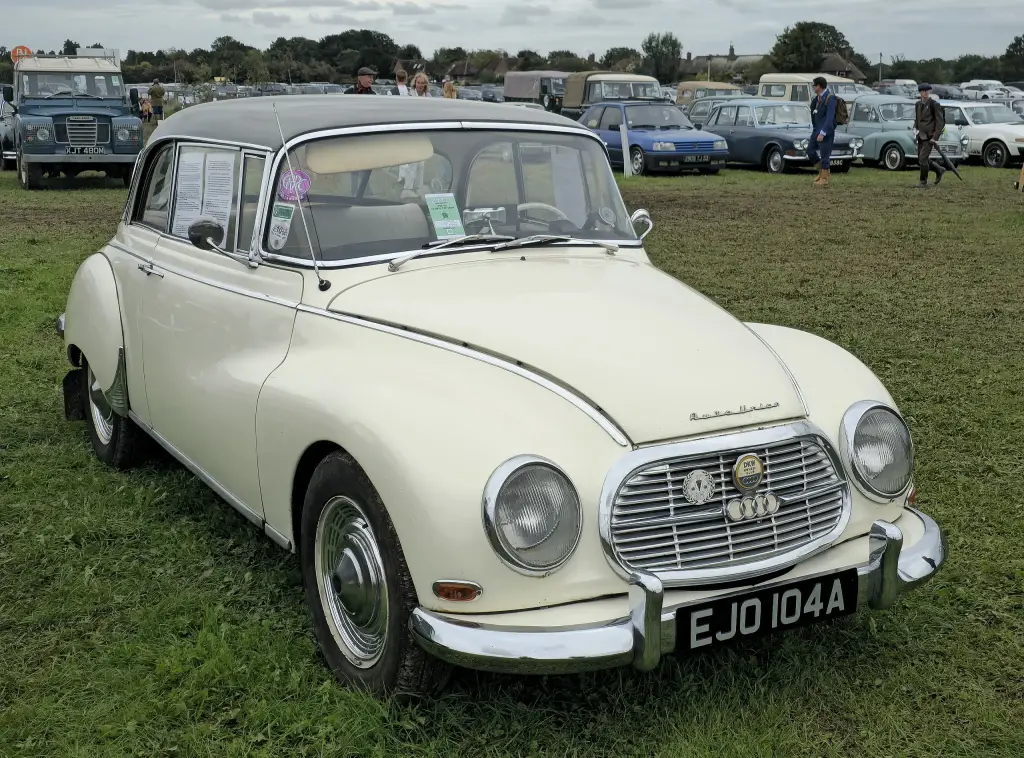
The Auto Union 1000 is the compact front-wheel drive car that Auto Union made from 1958 to 1965. It was the first model the company had sold under its own Auto Union name since the 1930s, and in many markets the last, and it replaced the DKW 3=6 while that car lingered on until the end of 1959.
Auto Union 1000 at a glance
| Maker | Auto Union GmbH, Düsseldorf |
|---|---|
| Production | 1958–1965 |
| Engine | 981 cc two-stroke three-cylinder |
| Power, base model | 44 PS (32 kW) |
| Layout | front engine, front-wheel drive |
| Series | model 58, model 60, model 62 |
| Bodies | two- and four-door saloon, pillarless coupé, Universal estate |
| Built | 171,008 saloons and coupés, 16,421 Universal estates |
| Chassis | box-section frame, all-steel body |
| Options | Saxomat clutch, from 1961 Frischöl-Automatik |
| Successor | DKW F 102, August 1963 |
The 1000 S is described here as part of the same model, since it shared the body and differed mainly in equipment.
History of the Auto Union 1000
A DKW with four rings
The 1000 was an evolution of the DKW F93, F94 and F94U of the 3=6 series. The engine grew to 981 cc and gave 44 PS in the base model, an increase of 10 to 37 per cent depending on the version. Outside, the old four-ring Auto Union badge sat across the grille with the Auto Union name above it instead of the DKW badge, and the boot lid was smooth. Under the skin the cars kept a box-section frame and an all-steel body, with independent front suspension on lower wishbones and a transverse leaf spring, and the swing axle at the rear that the earlier cars had used.
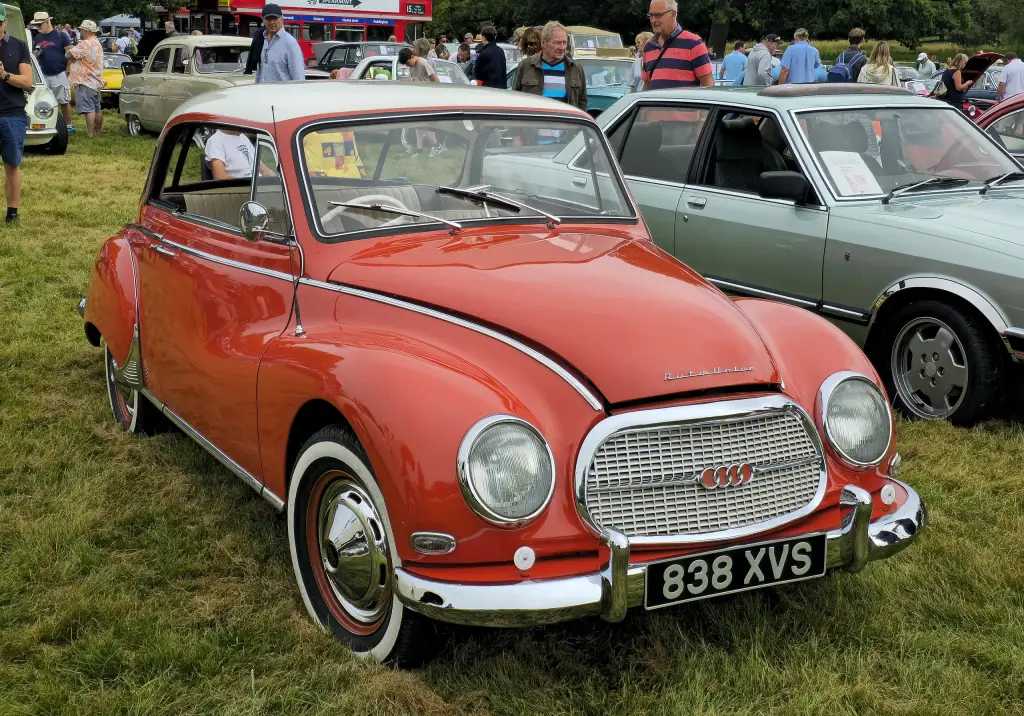
Three European series
The first series, the model 58 or AU1000/58, appeared in late 1957 for 1958 and 1959 and was sold only as the 1000 Coupé de luxe with the 44 PS engine. The model 60, or AU1000/60, brought the panoramic windscreen to the two-door cars; its first car was a 1000 S Coupé chassis 6820000001, finished at Düsseldorf on 27 July 1959 after 25 pre-production cars, with series production starting at chassis 6820000026. A four-door saloon and the Universal estate joined the range, all built at Düsseldorf. The model 62, or AU1000/62, was an improved version with front disc brakes, the Lubrimat, a wider-track rear axle and a larger boot; production of the model 60 line was switched to the model 62 on 29 September 1961. In August 1959 the two-door models gained a wrap-around windscreen with a vertical strip speedometer.
The end
Production of the third series wound down from late 1962: the last 1000 Universal was completed on 31 October 1962 and the last 1000 S four-door on 13 November, both at Ingolstadt, and the final European car built, a 1000 S Coupé de Luxe, carried chassis 6820146387. Between January 1958 and July 1963 the Düsseldorf-Derendorf works built 171,008 saloons and coupés of the 1000 and 1000 S, and the Universal, sold from August 1959 to November 1962, added 16,421. The 1000 S was the sportier version of the same body, renamed with the rest of the coupé and four-door range for the new decade. From the 1961/62 model year the cars could be had with the Frischöl-Automatik, an oil tank and pump that let owners fill up with plain petrol instead of a mixture. After German production ended in mid-1963, the 1000 S was still made in Brazil until 1967 and in Santa Fe, Argentina, where Industrias Automotriz de Santa Fe built it from 1960 to 1969, including a Fissore-designed coupé and spyder.
In competition
The 1000 was rallied widely in the late 1950s and early 1960s. It won the 1959 Acropolis Rally with Wolfgang Levy and Hans Wenscher, the South African national rally championship in 1961, 1962 and 1963 with Reinhard and Pieter Mühl, Jan Hettema joining in 1963, and took class wins at the 1960 Monte Carlo Rally. Cars were still being rallied in Sri Lanka, Brazil and South Africa in the 1970s.
Design and features
- Four-ring badge: the Auto Union name on the bonnet instead of the DKW badge.
- 981 cc two-stroke: 44 PS in the base model, up from the 896 cc of the 3=6.
- Panoramic windscreen: offered on the two-door cars from the model 60, with a vertical strip speedometer.
- Model 62 improvements: front disc brakes, Lubrimat, wider rear track and a larger boot.
- Frischöl-Automatik: separate oil tank and pump, so the tank took petrol without oil.
- Universal: the three-door estate version, built from 1959 to 1962.
Auto Union 1000 versions
- Model 58 (1958–1959): 1000 Coupé de luxe with the 44 PS engine.
- Model 60 (1959–1961): two-door saloon, four-door, coupé and Universal, panoramic windscreen.
- Model 62 (1961–1963): disc brakes, Lubrimat, wider rear axle, larger boot.
- 1000 S: the sportier version of the same body, coupé de luxe with disc brakes at the top of the range.
- 1000 Universal (1959–1962): three-door estate, 16,421 built.
- South American cars: built in Brazil until 1967 and in Argentina from 1960 to 1969.
The 1000 replaced the DKW 3=6, and its two-seat sports derivative was the Auto Union 1000 Sp. More cars are in the Auto Union collection.
Sources
- Auto Union 1000, English Wikipedia: series, bodies, motorsport, Argentina
- Auto Union 1000, German Wikipedia: chassis, production totals, Frischöl-Automatik