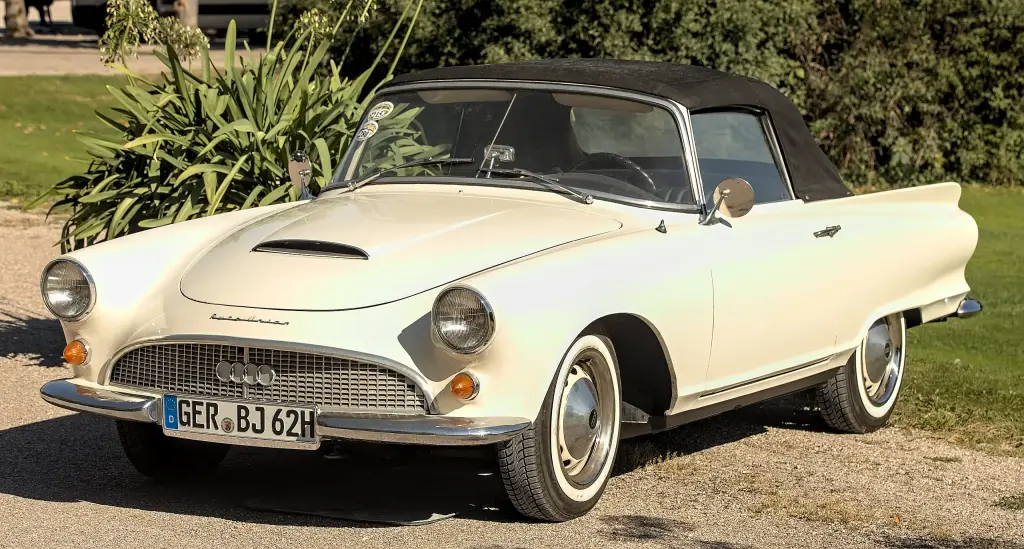
The Auto Union 1000 Sp is the two-seat sports car that Auto Union presented at the 1957 Frankfurt show and built from 1958 to 1965. Under its low, finned body it was an Auto Union 1000 turned up to 55 PS, and the press called it the Schmalspur-Thunderbird, the narrow-gauge Thunderbird.
Auto Union 1000 Sp at a glance
| Maker | Auto Union GmbH; bodied by Baur, Stuttgart |
|---|---|
| Production | 1958–1965 |
| Engine | 981 cc two-stroke three-cylinder |
| Power | 55 PS (40 kW) |
| Top speed | 140 km/h |
| Bodies | two-seat coupé, roadster from 1961 |
| Built | 5,004 coupés and 1,640 roadsters |
| Price at launch | 11,950 DM |
| Chassis | box-section frame, all-steel body |
| Name | Sp stands for Spezial, not Sport |
The English article is short; the German Wikipedia article on the Auto Union 1000 supplies the body, prices and the 1962 changes.
History of the Auto Union 1000 Sp
A sports body on a saloon floorpan
The 1000 Sp was shown at the IAA in 1957 and made from 1958 to 1965 by the Stuttgart coachbuilder Baur. Sp stood for Spezial, not, as is often assumed, for Sport. The body was a two-seat sports coupé with styling cues taken strongly from the Ford Thunderbird, and from September 1961 a roadster joined it. Underneath, the car was an Auto Union 1000, with a box-section frame and an all-steel body.
More power from the same engine
Compared with the 1000 S, power rose mainly through a higher compression ratio of 8:1 to 41 kW (55 PS), helped by small differences in the engine block and a different carburettor arrangement. That gave a top speed of 140 km/h, slightly better than the less powerful 1000 S coupé and at the top of the range. The 1000 Sp was lower than the saloon but, with two people aboard, not much lighter. In 1959 fifty cars were built with a 1,280 cc two-stroke V6.
Changes and the end
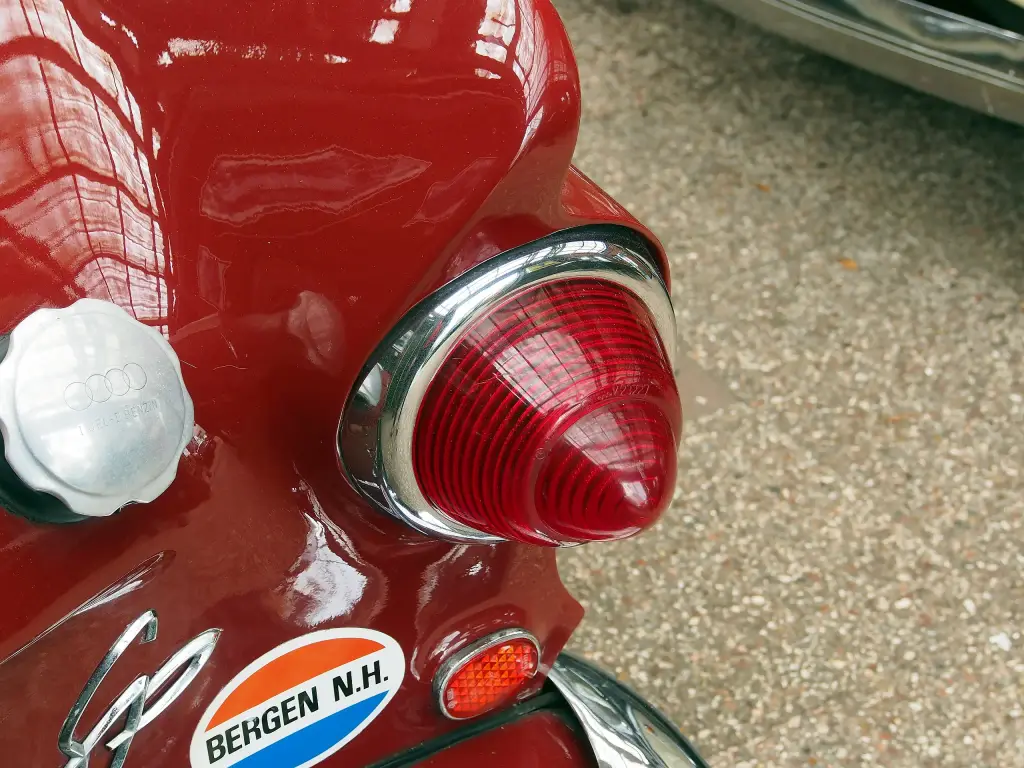
From the model 62 cars both the coupé and the roadster received rounded tail fins. From chassis 4360, in March 1962, front disc brakes and the Frischöl-Automatik arrived, the latter bringing a Solex 40 CIB carburettor in place of the 32/36 NDIX twin-choke. The cars also received reinforcement plates for fitting seat belts. The coupé and roadster cost 11,950 DM at launch, later 10,950 DM and finally, in early 1965, 9,400 DM; in Austria the 1963 price was 95,500 schillings. Auto Union built 5,004 coupés and, between September 1961 and April 1965, 1,640 roadsters. It was the company’s last open car for some three decades, until the Audi 80 cabriolet.
Design and features
- Two-seat body: a low coupé with tail fins, joined by a roadster in 1961.
- 55 PS: the 981 cc two-stroke three-cylinder with 8:1 compression, enough for 140 km/h.
- Baur of Stuttgart: the bodies were built by the coachbuilder rather than in Auto Union’s own works.
- Thunderbird looks: American styling cues on a small German two-stroke.
- 1962 update: front disc brakes and the Frischöl-Automatik oil system.
Auto Union 1000 Sp versions
- Coupé (1958–1965): the original two-seater, 5,004 built.
- Roadster (1961–1965): the open version, 1,640 built.
- Model 62: rounded tail fins on both bodies.
- From chassis 4360 (March 1962): front disc brakes, Frischöl-Automatik and the Solex 40 CIB carburettor.
- V6 cars (1959): fifty cars with a 1,280 cc two-stroke V6.
The 1000 Sp was derived from the Auto Union 1000, itself the successor of the DKW 3=6. More cars are in the Auto Union collection.
Sources
- Auto Union 1000 Sp, English Wikipedia: engine, production, Thunderbird styling
- Auto Union 1000, German Wikipedia: Baur, prices, 1962 changes