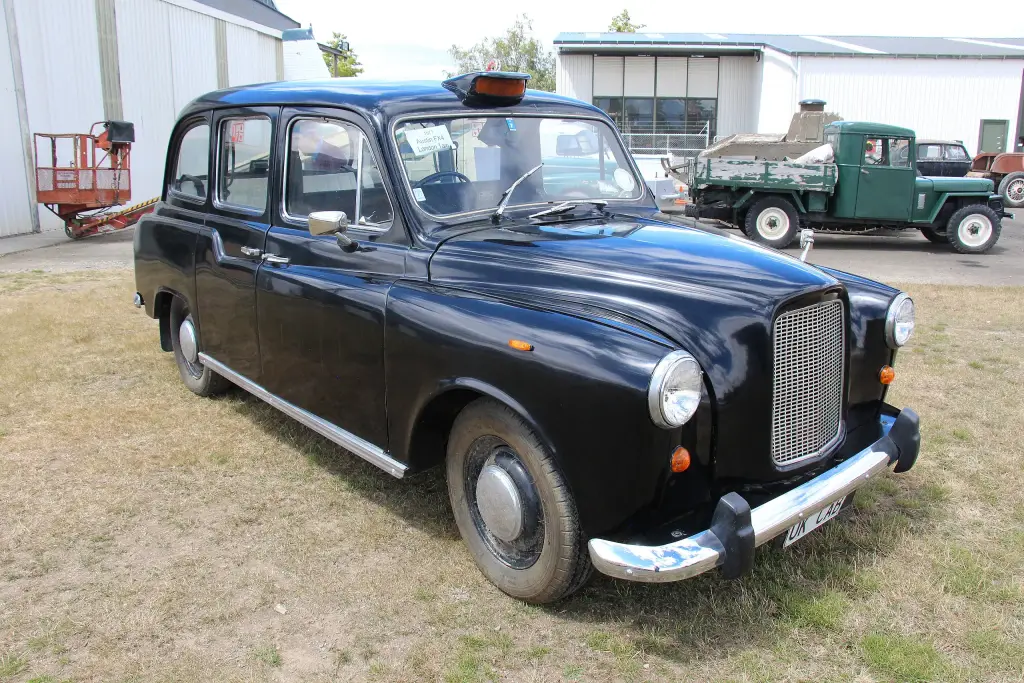
The Austin FX4 is a hackney carriage that was produced from 1958 until 1997. It was sold by Austin from 1958 until 1982, when Carbodies, who had been producing the FX4 for Austin, took over the intellectual rights. Carbodies produced it for two years, until 1984, when London Taxis International took over and continued until 1997.
Austin FX4 (London taxi) at a glance
| Produced | 1958 to 1997 |
|---|---|
| Built | more than 75,000 |
| Predecessor | Austin FX3 (1948–1958) |
| Designers | Austin’s Eric Bailey, engineered by Carbodies’ Jake Donaldson; team included Albert Moore, Jack Hellberg and David Southwell |
| Chassis | separate chassis, independent front suspension, dual-circuit hydraulic brakes |
| Turning circle | 7.6 m (25 ft), by Ackermann steering geometry |
| First engine | 2,178 cc BMC diesel with Borg-Warner automatic |
| Launch | Commercial Motor Exhibition, Earls Court, 1958; 2,000 ordered for £24 million |
This page is based on English Wikipedia only (a trusted source), so the facts were not cross-checked against a second source.
History of the Austin FX4 (London taxi)
The FX4 was the successor to the Austin FX3, produced between 1948 and 1958, and in its day the most widely used taxi in London. Like the FX3 it was designed by Austin in collaboration with Mann & Overton, the London taxi dealership that commissioned it and paid for half of its cost, and Carbodies, the coachbuilder that built the body and assembled the cab. It was the first London taxi to go into production with four doors, since earlier cabs had an open luggage platform in place of a front passenger seat.
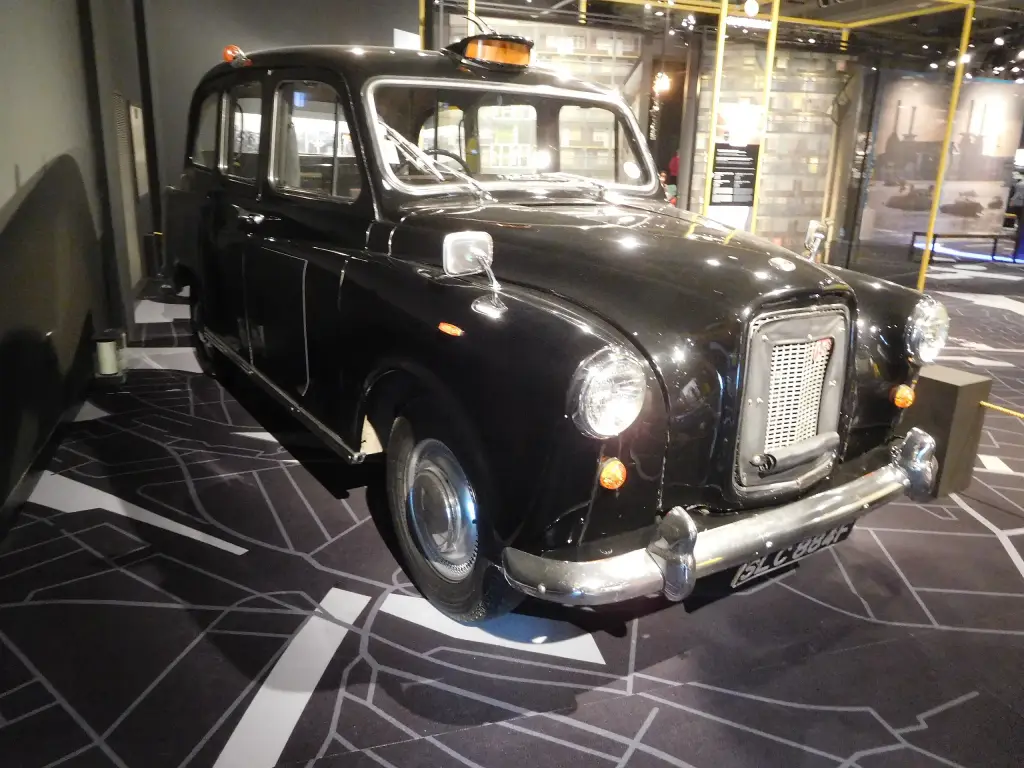
The first FX4, registered VLW 431, was delivered in July 1958 and went on test with York Way Motors. The official launch was later that year at the Commercial Motor Exhibition at Earls Court, where an order worth £24 million for 2,000 FX4s was placed. The first model was fitted with a 2,178 cc BMC diesel engine, based on the petrol Austin A70 engine, and a Borg-Warner automatic transmission.
After Austin
Over its lifetime the FX4 increasingly became regarded as a design classic and a visual icon of London recognised throughout the world, to the point where its eventual successors, the TX-series and the current LEVC TX, continue its basic styling cues.
Design and features
- Chassis: separate, with independent front suspension.
- Steering: a 7.6 m U-turn for narrow London roads.
- Doors: the first four-door London taxi.
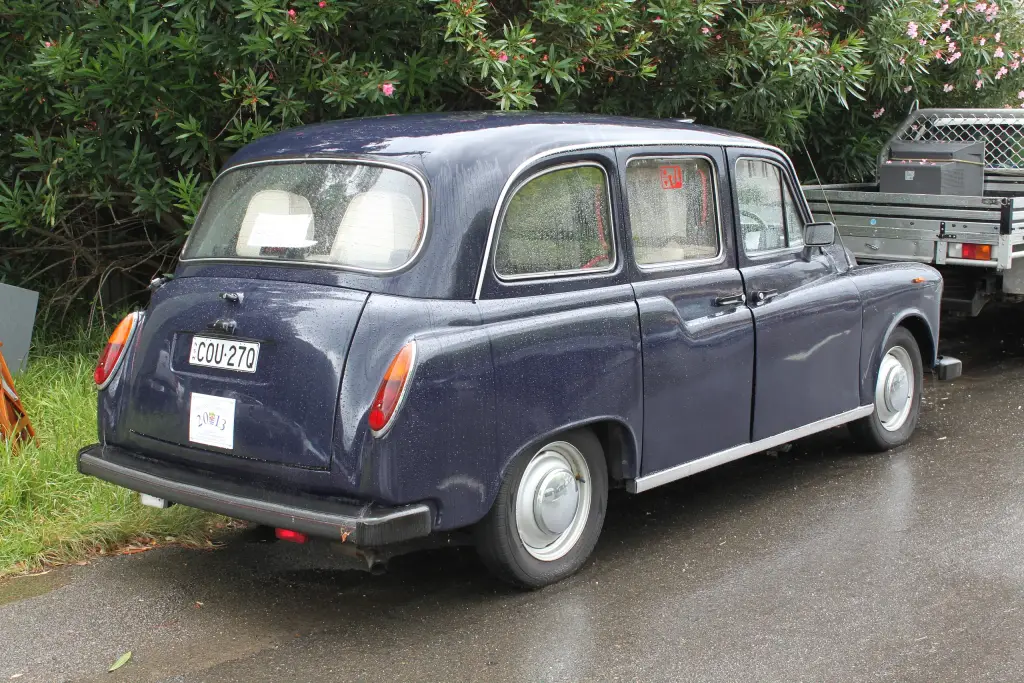
Austin FX4 (London taxi) versions
- Austin FX4 (1958–1982).
- Carbodies FX4 (1982–1984).
- London Taxis International FX4 (1984–1997).
More Austin cars are in our Austin collection, for example the A70 whose engine it first used, the A40 and the Sheerline.
Austin FX4 (London taxi) questions and answers
When was the FX4 built?
From 1958 until 1997.
How many were made?
More than 75,000.
Why can it turn so tightly?
Ackermann steering geometry allows a 7.6 m (25 ft) U-turn.
Who built the body?
Carbodies, the coachbuilder.
What took its place?
The TX-series and later the LEVC TX.
Sources
- Austin FX4, English Wikipedia: design and launch