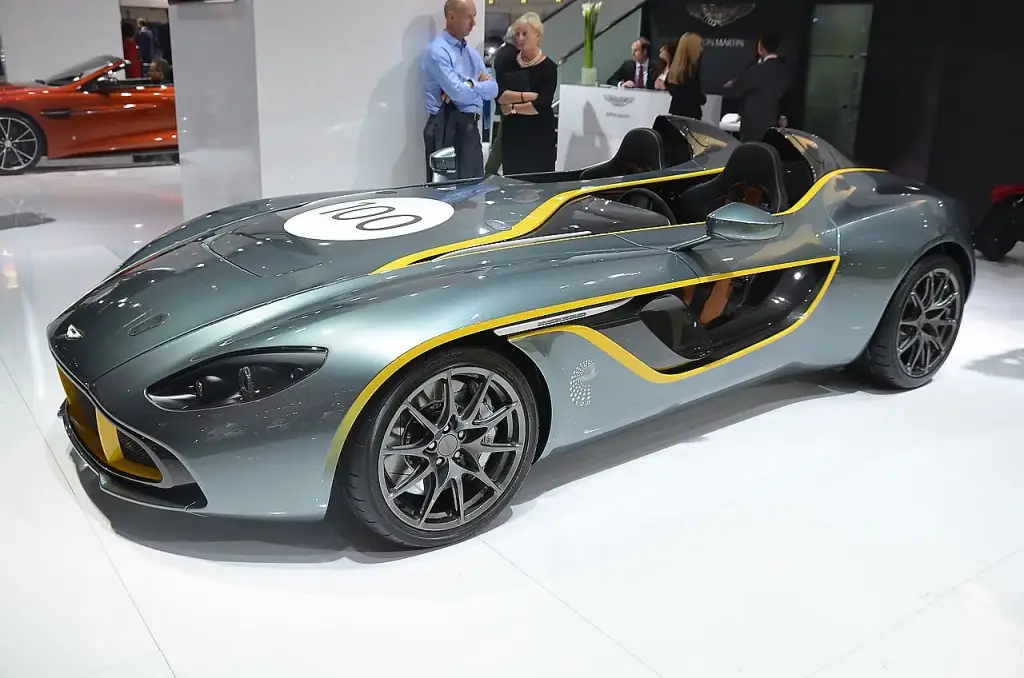
The Aston Martin CC100 Speedster, also called the CC100 Speedster Concept and internally the DBR100, is a sports car built by Aston Martin to celebrate its 100th anniversary, announced in May 2013 at the ADAC Zurich 24 Hours of Nürburgring race. Only two were produced and both were sold to loyal customers.
Aston Martin CC100 Speedster at a glance
| Announced | May 2013, ADAC Zurich 24 Hours of Nürburgring |
|---|---|
| Built | two cars, both sold |
| Engine | naturally aspirated V12 (the Italian page: AM11, 6.0 L, 558 hp) with a 6-speed automated sequential manual gearbox |
| Claimed performance | limited top speed 180 mph (290 km/h); 0–62 mph in under 4 s |
| Platform | VH platform with a carbon-fibre monocoque (Multimatic) under an aluminium or carbon-fibre body |
| Designers | Miles Nurnberger, chief exterior designer, with design director Marek Reichman |
| Colour | Alloro Green with yellow trim |
| Development time | six months at Gaydon |
History of the Aston Martin CC100 Speedster
For the brand’s 100th anniversary Aston Martin wanted a special sports car that both reflected its history and previewed its future, according to chief designer Miles Nurnberger. The CC100 was created in only six months at Gaydon and first shown to the public in May 2013 at the Nürburgring, where it was driven during the programme of the 24-hour race by the company’s then chief executive.
The car is inspired by the 1950s DBR1 and, like it, is a speedster with an open split cockpit, cutaway doors and twin rear buttresses, no roof and no windscreen. It is painted in Alloro Green with yellow stripes. Unlike the DBR1 the driver’s seat is on the left. The carbon-fibre shell seats by Sparco are covered in Alcantara with leather from the Scottish maker Bridge of Weir, whose leather was also used in the McLaren F1 and the DeLorean DMC-12.
The CC100 is built on the VH platform with a carbon-fibre body designed and built at the company’s headquarters in Gaydon; the Italian page adds a carbon-fibre monocoque by Multimatic and a 6.0 litre V12 of 558 hp with a six-speed sequential gearbox with hydraulic actuators and steering-wheel paddles. The front has a reinterpreted traditional grille with a honeycomb pattern and a yellow moulding, and the doors, with a fish-gill opening, are closed by pulling leather straps.
The two cars
Only two were produced and both were sold to loyal customers. One of the owners plans to keep it in his private collection, while the owner of the second car plans to get regulatory approval so it can be driven on public roads.
Design and features
- Engine: a naturally aspirated V12 with a 6-speed sequential gearbox.
- Body: an open speedster with cutaway doors and twin rear buttresses inspired by the DBR1.
- Construction: VH platform with a carbon-fibre body made at Gaydon.
- Interior: Sparco carbon shell seats with Alcantara and Bridge of Weir leather.
Aston Martin CC100 Speedster versions
- CC100 Speedster (2013): two cars, one kept in a private collection.
More Aston Martin cars are in our Aston Martin collection, for example the DBR1 that inspired it, the One-77 and the Vanquish.
Aston Martin CC100 Speedster questions and answers
What is the Aston Martin CC100?
A speedster built for the company’s 100th anniversary and shown in May 2013.
How many were built?
Two, and both were sold.
What inspired it?
The 1950s DBR1 racing car.
What engine does it have?
A naturally aspirated V12, claimed at a limited 180 mph top speed.
Who designed it?
Miles Nurnberger with design director Marek Reichman.
Sources
- Aston Martin CC100, English Wikipedia: overview and design
- Aston Martin CC100, German Wikipedia: background and interior
- Aston Martin CC100, Italian Wikipedia: technical details