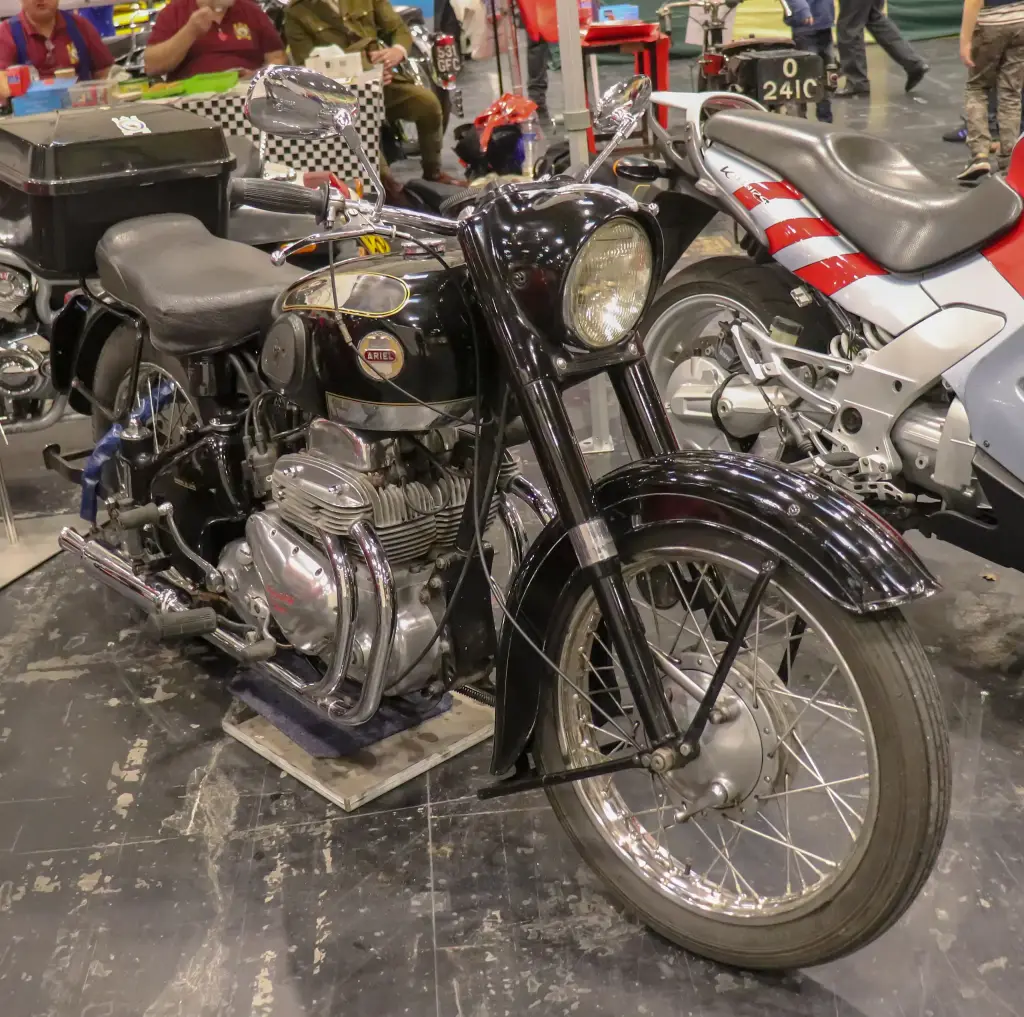
The Square Four is a motorcycle produced by Ariel between 1931 and 1959, designed by Edward Turner, who devised the Square Four engine in 1928. At the time he was looking for work and showed drawings of his engine design to motorcycle manufacturers; BSA rejected the idea, but Ariel adopted it.
Ariel Square Four at a glance
| Maker | Ariel Motorcycles, Birmingham |
|---|---|
| Production | 1931–1959 |
| Designer | Edward Turner |
| Engine layout | four cylinders, two transverse crankshafts joined by geared flywheels |
| 4F (1931–1936) | 498 cc, enlarged to 601 cc in 1932 |
| 4G (1937–1949) | 995 cc overhead-valve |
| Mark I (1949–1953) | 35 bhp at 5,500 rpm, 90 mph plus |
| Mark II (1953–1959) | 997 cc, 40 hp, 100 mph, about £336 |
| Weight, Mark II | 425 lb (193 kg) |
| Rear suspension | Anstey-link plunger, optional from 1939 |
Based on one source, the English Wikipedia article on the Square Four.
History of the Ariel Square Four
The early engine with two transverse crankshafts was essentially a pair of across-frame overhead-camshaft parallel twins joined by their geared central flywheels, with a four-cylinder block and a single head. The first Ariel Square Four 4F was shown at the Olympia Motorcycle Show in 1930 in chain-driven overhead-camshaft 500 cc form, and early Square Fours used a hand-change four-speed Burman gearbox. In 1932 the cylinder bores were enlarged by 5 mm to give 601 cc, specifically to accommodate owners who wanted a sidecar; the model was then used for the Maudes Trophy test, covering 700 miles in 700 minutes followed by a timed lap of 87.4 mph.
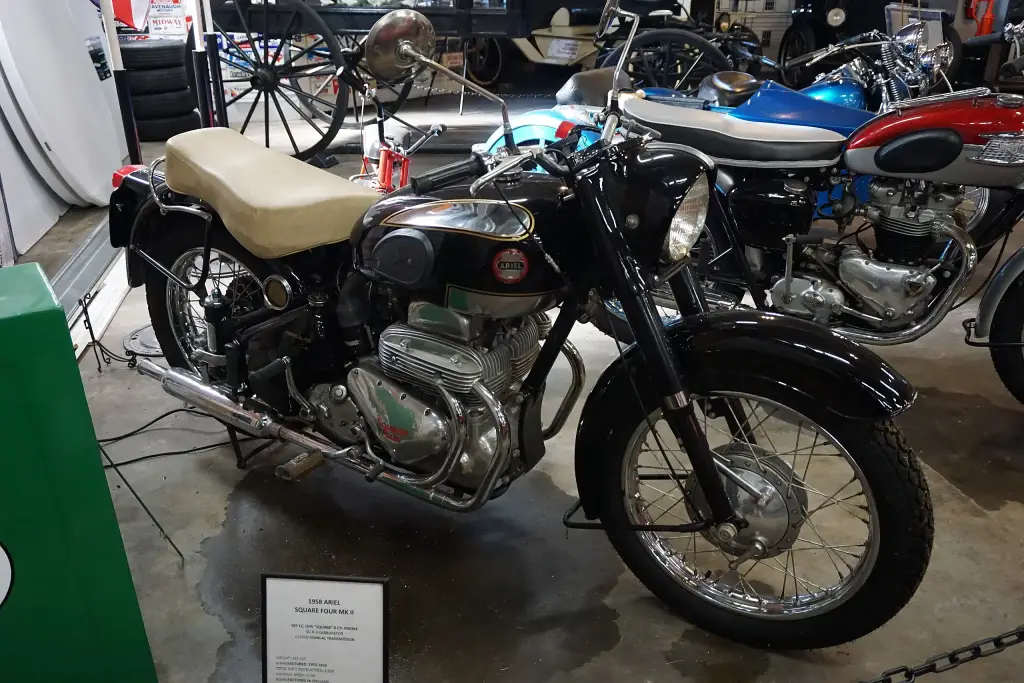
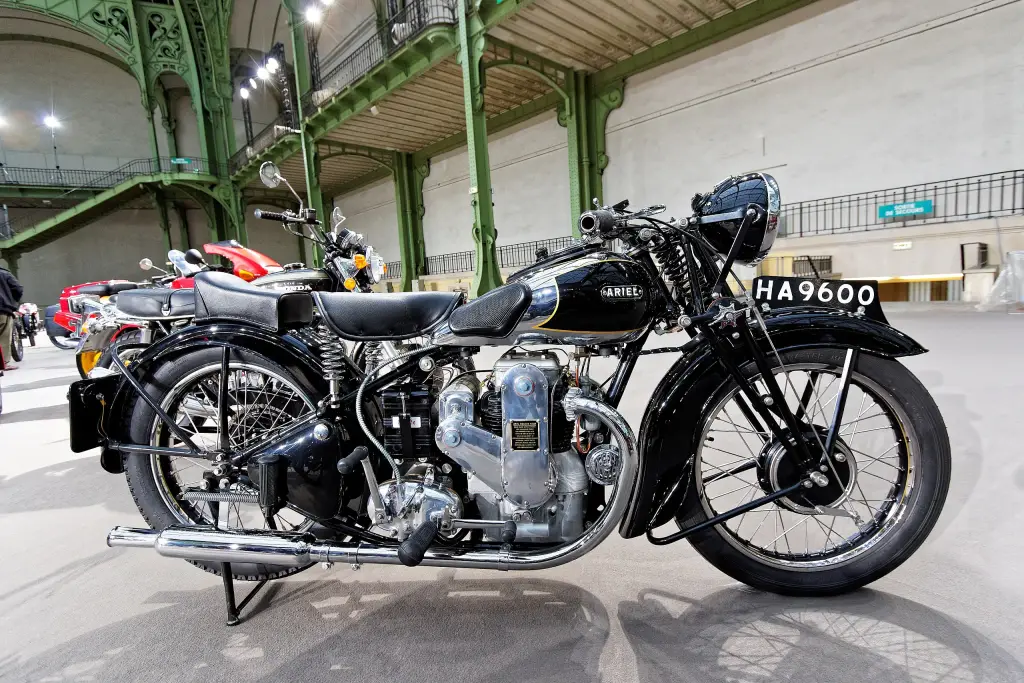
The “Cammy” engine gained a reputation for overheating its rear cylinder heads, so in 1936 it was completely redesigned and emerged as the 1937 overhead-valve 995 cc model 4G. In 1939 Ariel’s patented Anstey-link plunger rear suspension became an option; in 1946 the plunger rear was available again and oil-damped telescopic front forks replaced the previous girder type.
In 1949 the Mark I replaced the cast-iron cylinder head and barrel with alloy items, saving about 30 pounds (14 kg) in weight. The 1949 machine weighed around 435 lb (197 kg) dry and produced 35 bhp (26 kW) at 5,500 rpm, enough for more than 90 mph. In 1953 the four-pipe 997 cc Mark II was released with a redesigned cylinder head, four separate exhaust pipes from two cast-aluminium manifolds and a rocker box combined with the inlet manifold. A redesigned frame provided clearance for the high-mounted, tall, car-type SU carburettor; the 40 hp (30 kW) machine was capable of 100 mph, weighed 425 lb (193 kg) and cost about £336. In 1954 Ariel built prototypes of a Mark 3 with Earles forks, but the model was never put into production.
The end came in 1959, when Square Four production, along with that of all other Ariel four-stroke models, ceased. Phil Vincent wrote in Motor Cycle in 1966 that the model had been a victim of the trend towards small, high-revving engines, and that with falling demand the price would have had to be raised excessively high; at the time it was approaching £350. A further development, the Healey 1000/4, was based on an updated Square Four and produced between 1971 and 1977.
Design and features
- Square-four layout: two across-frame twins with geared central flywheels sharing one four-cylinder block and head.
- Anstey-link rear suspension: Ariel’s patented plunger system, optional from 1939.
- Alloy engine, Mark I: the switch from cast iron saved about 30 lb and helped the bike past 90 mph.
- Four-pipe Mark II: a new head with two aluminium manifolds and a car-type SU carburettor, for 100 mph.
- Long life: nearly thirty years in production, from 1931 to 1959.
Ariel Square Four versions
- 4F (1931–1936): 498 cc overhead-camshaft Square Four, enlarged to 601 cc in 1932.
- 4G (1937–1949): 995 cc overhead-valve redesign that cured the Cammy’s overheating.
- Mark I (1949–1953): alloy head and barrel, 35 bhp, 90 mph plus.
- Mark II (1953–1959): 997 cc, 40 hp, four exhaust pipes, 100 mph.
- Mark 3 prototype (1954): Earles forks, never produced.
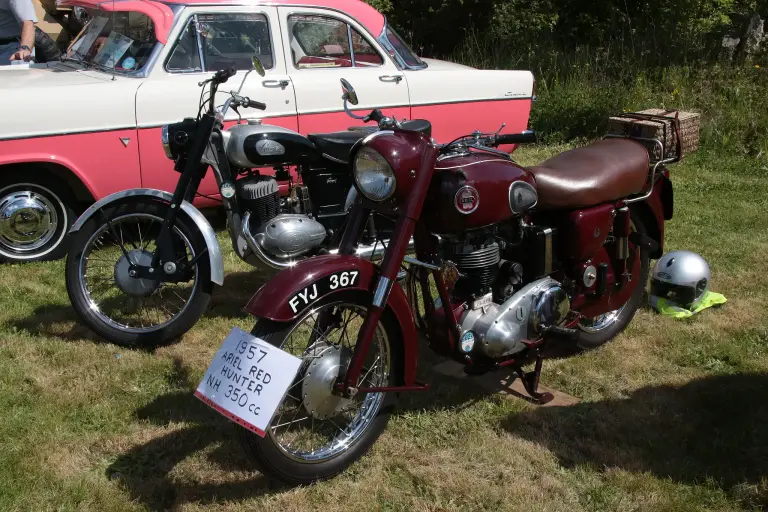
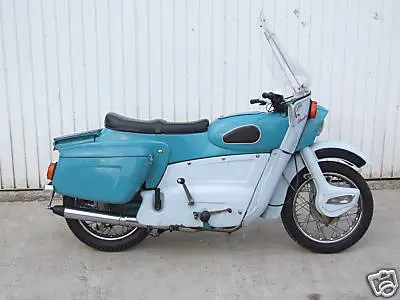
The Square Four was the largest of the four-stroke Ariels, sold alongside the Red Hunter; the company’s last motorcycle was the two-stroke Leader. More in the Ariel collection.
Video: 1957 Ariel Square Four Mk II
Video on YouTube.
Sources
- Ariel Square Four, English Wikipedia: engine design, model history, specifications, production end