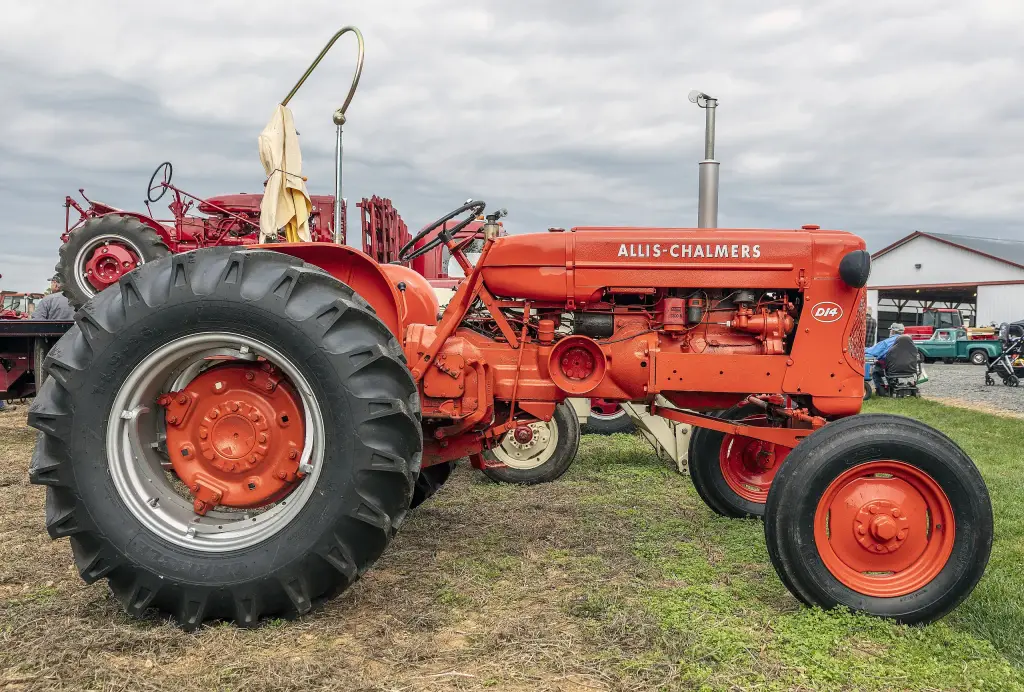
The Allis-Chalmers D series was a line of tractors made from 1957 to 1969. It replaced the company’s earlier models with a new generation that offered three-point hitches, power steering and diesel engines, and it grew from the small D14 to the D21, the first Allis-Chalmers tractor to exceed 100 horsepower.
Allis-Chalmers D series at a glance
| Maker | Allis-Chalmers Manufacturing Company |
|---|---|
| Production | 1957–1969 |
| First model | D14, introduced 1957 |
| Largest model | D21, 103 hp |
| Engines | four- and six-cylinder, petrol, LP gas and diesel |
| D14 engine | 149 cu in (2,440 cc) Power-Crater four |
| D17 engine | 226 cu in (3,700 cc), 52.6 hp at the belt |
| Transmission | four-speed with transfer case on the D14, eight forward gears |
| Clutch | hand-operated “Power Director” on most models |
| Three-point hitch | standard on the series |
| D14 built | 17,474 |
| D17 built | 62,867 |
This page is based on one source, English Wikipedia, so its figures could not be cross-checked. The article covers the whole D series, so the old D-14 and D-17 records both lead here.
History of the Allis-Chalmers D series
A new generation
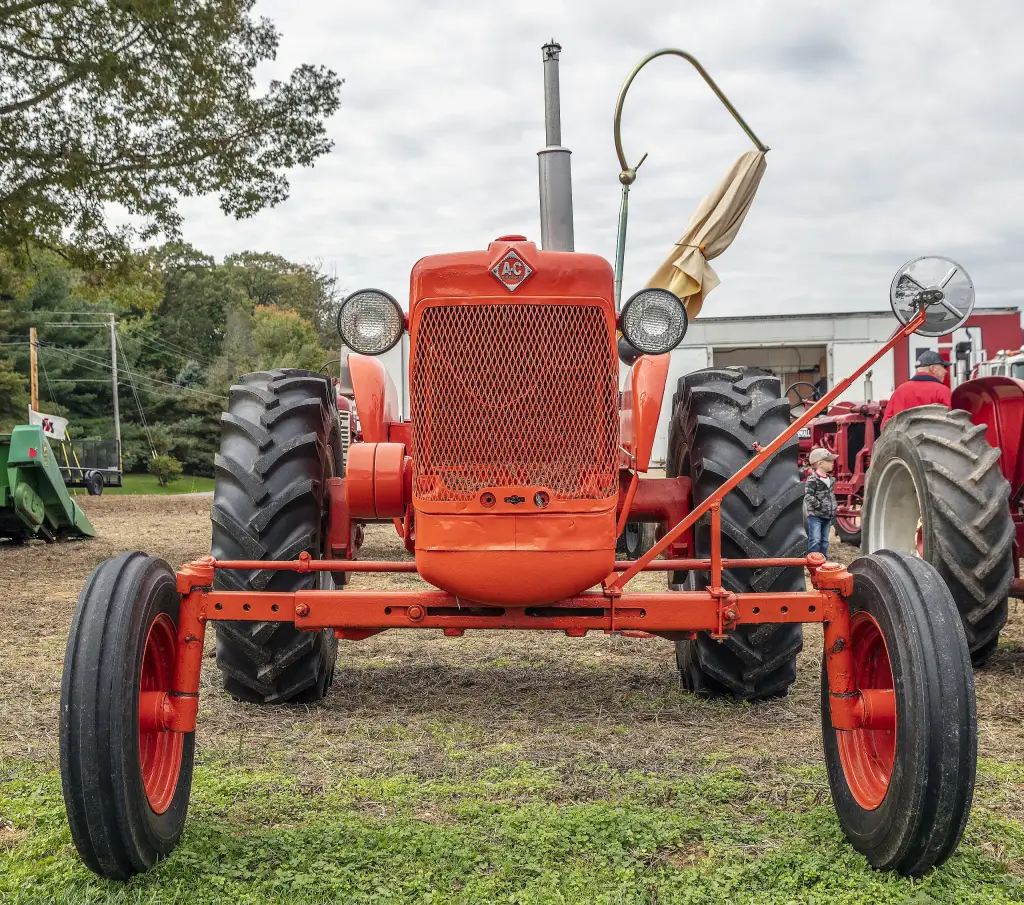
An industry trend toward higher horsepower led Allis-Chalmers to develop the all-new D series to replace its earlier tractor lines. The new tractors featured three-point hitches, power steering and diesel engine options, and the low-compression fuel options for kerosene and distillate were dropped.
Most D-series tractors except the D21 had a hand-operated, shift-on-the-go oil clutch, which Allis-Chalmers marketed as the “Power Director”. Pulled back it was in low range, in the middle it was neutral, and pushed forward it was in high range; it could also be ordered as a forward-reverser called the “Shuttle Clutch”. The D21 had the same hand clutch, but it was not intended for shifting on the move.
The four-cylinder models: D14, D15, D10 and D12
The D14 was the first D-series model, introduced in 1957. Its engine was a new 149-cubic-inch (2,440 cc) Allis-Chalmers Power-Crater four-cylinder, available in petrol and LP gas form, coupled to a four-speed transmission with a transfer case for eight forward gears and two reverse. High-clearance and rice cultivation models were produced, orchard shield kits were available, and the adjustable wide front axle was branded “Roll-Shift”; narrow front and single wheel options were also offered. The D14 was made from 1957 to 1960, when the D15 replaced it, and 17,474 were built.
The D15 was essentially the same tractor at first, with the same engine but a higher compression ratio and higher rpm, and power steering became available. From serial number 9001 a larger engine was fitted. The D15 Series II arrived in 1963 with new 165-cubic-inch (2,700 cc) engines in diesel, petrol and LPG, about 15 more horsepower for the petrol and LPG versions, and headlights moved from the grille to the fenders. 17,434 D15s were built between 1960 and 1969; the Renault-built Model 160 ended the line.
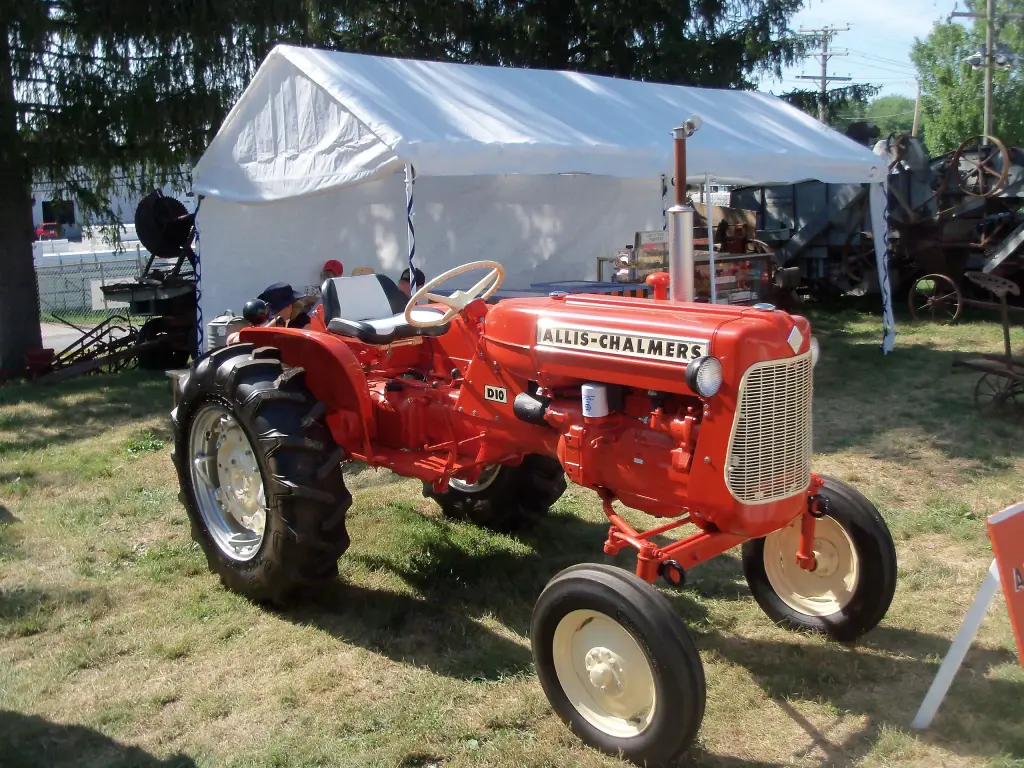
The D10 and D12 appeared in 1959; in that year Allis-Chalmers offered as many as 50 configurations of the D10, D12, D14 and D17. The D10 replaced the Model B and was not made with narrow front ends. Both it and the D12 used a 138.7-cubic-inch (2,273 cc) engine tested at 28.5 horsepower at the belt and 25.8 at the drawbar; the D12 differed by longer front-axle sleeves and a wider front axle adjustment. 5,304 D10s were built from 1959 to 1967 and 4,070 D12s from 1959 to 1968.
The six-cylinder models: D17, D19 and D21
The D-17 was introduced in October 1957 as a replacement for the WD45 and as a four-plow tractor. Its styling closely followed the smaller D14. It was made in petrol, diesel and LPG versions; the 226-cubic-inch (3,700 cc) engine turned at 2,000 rpm and was tested at 52.6 horsepower at the belt and 46 at the drawbar. Adjustable wide front, narrow dual and single front wheels were offered, along with a high-clearance model, Wheatland models with full rear fenders, orchard models and a taller high-clearance version for sugar cane. Later years brought Series II to Series IV with minimal changes. 62,867 D-17s were built in ten years; the diesel used a 262-cubic-inch (4,290 cc) six-cylinder and weighed about 4,660 pounds.
The D19 arrived in 1961 for larger farmers. It was the first D-series tractor besides the diesel D17 to have a six-cylinder engine, and its diesel version was the first in the industry to come with a turbocharger as standard. Output was 71.54 hp on petrol, 66.19 on propane and 66.92 on diesel from 262 cubic inches. 10,591 were built until 1964, weighing 6,650 to 6,840 pounds, and it could pull a five-bottom plow.
The D21 of 1963 was the largest of the series and the first Allis-Chalmers tractor to exceed 100 horsepower, as well as the largest row-crop tractor then available. Rated at 103 horsepower from a 7.0-litre (430 cu in) engine, it was styled quite differently from the other D-series tractors, with full fenders, a large platform and a rear-mounted fuel tank holding 52 US gallons, enough for about 10 hours of field work. It received a turbocharger in 1965.
Design and features
- Three-point hitch and power steering: the D series brought both to the Allis-Chalmers range.
- Power Director clutch: a hand-operated oil clutch with low, neutral and high ranges, or a Shuttle Clutch forward-reverser.
- Diesel options: offered across the line, with the D19 diesel the first in the industry to have a standard turbocharger.
- Many configurations: high-clearance, rice, orchard, Wheatland and sugar cane versions, plus several front axle choices.
- Roll-Shift front axle: an adjustable wide front axle introduced with the D14.
Allis-Chalmers D series versions
- D14 (1957–1960): the first of the line, 149 cu in, 17,474 built.
- D15 (1960–1969): more power and power steering, then the Series II with 165 cu in engines.
- D10 and D12 (1959–1967/68): small four-cylinder models replacing the Model B and Model CA.
- D17 (1957–1967): the four-plow six-cylinder model, 62,867 built.
- D19 (1961–1964): six-cylinder with a standard turbocharged diesel.
- D21 (1963–1969): the 103 hp flagship with full fenders and a rear fuel tank.
The D series replaced the Model WC line and the small Model B; its D12 took over from the Model CA. More machines are in the Allis-Chalmers collection.
Video: allis chalmers d-17 plowing
Video on YouTube.
Sources
- Allis-Chalmers D series, English Wikipedia: development, models, engines, production