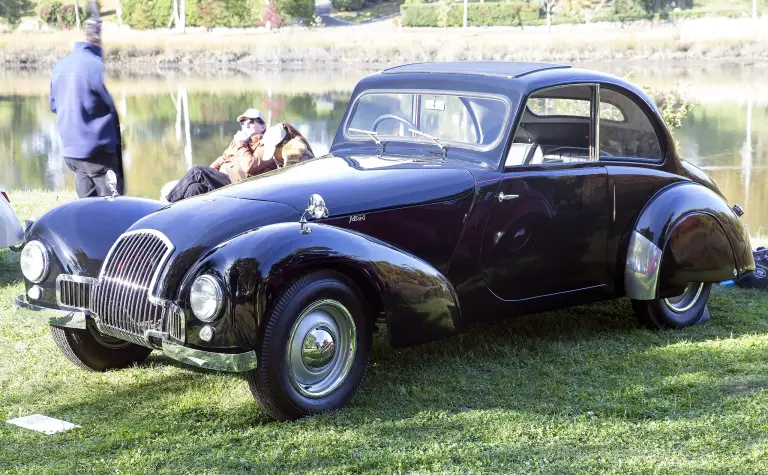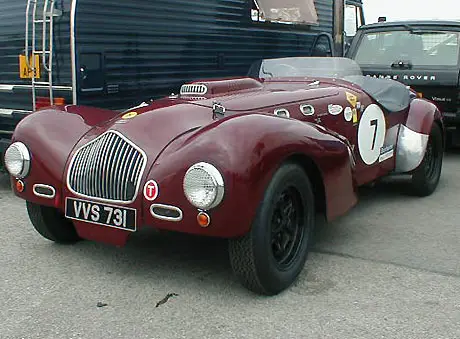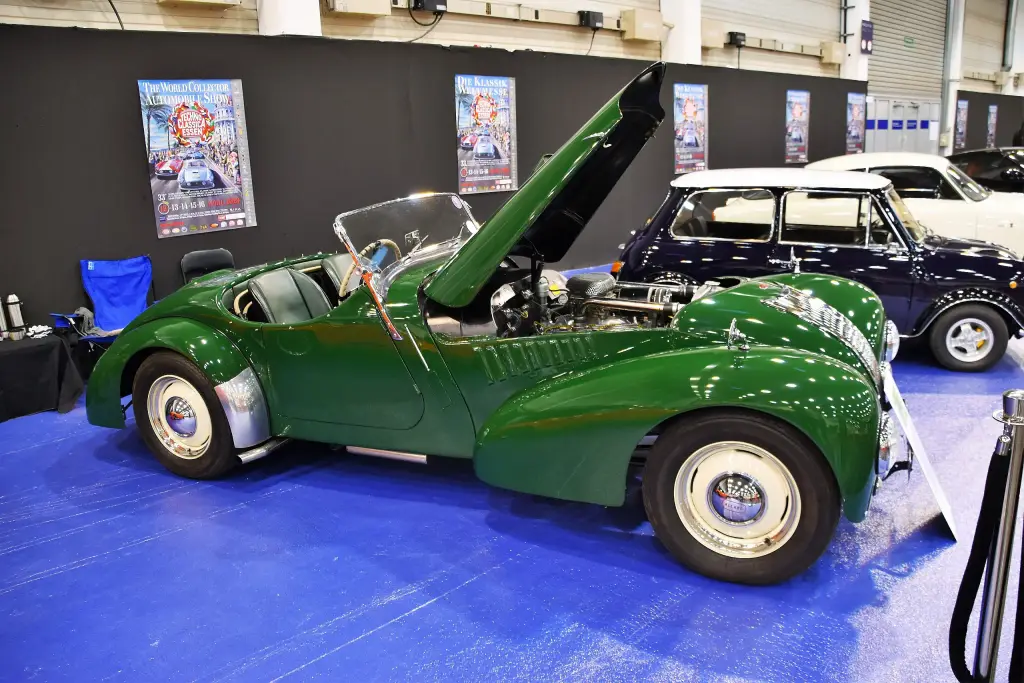
The Allard K-Series was a line of two-seat sports tourers built by the Allard Motor Company from 1946 to 1956 in three versions. Where the J cars were competition machines, the K models were meant for the road: a longer wheelbase, mudguards, bumpers and a slightly more comfortable body over the same Ford-based mechanicals.
Allard K1 and K2 at a glance
| Maker | Allard Motor Company, Clapham, London |
|---|---|
| Series production | 1946–1956 |
| Versions | K1, K2, K3 |
| Body | two-seat sports tourer, aluminium |
| Frame | tubular steel |
| K1 engine | 3,622 cc sidevalve V8, 95 bhp at 3,800 rpm |
| K1 top speed | 149 km/h (93 mph) |
| K2 engine | 3,917 cc sidevalve V8, 100 bhp at 3,800 rpm |
| K2 top speed | 163 km/h (101 mph) |
| Wheelbase | 2,692 mm (K1, K2) |
| Track | 1,422 mm front and rear (K1, K2); 1,486 mm on K3 |
| K3 rear axle | De Dion |
The German Wikipedia article on the K-Serie is the main source; the English Wikipedia article on the Allard Motor Company supplies the description of the post-war range. The K1 and K2 are covered together here because they belong to one series.
History of the Allard K1 and K2
The post-war Allard range used Ford mechanicals and a new steel chassis with light bodywork. The J cars were the competition two-seaters, the K cars slightly larger machines for road use with two or three seats, and the L was the four-seat tourer. All were based on the Ford Pilot chassis and powered by a fairly stock 3,622 cc sidevalve V8 of 85 hp with a single carburettor, a three-speed gearbox and a low-geared rear axle for strong acceleration. Front suspension was the Ballamy swing axle, the rear a Ford solid axle, and the aluminium bodies were made by Allard’s friend Godfrey Imhof.
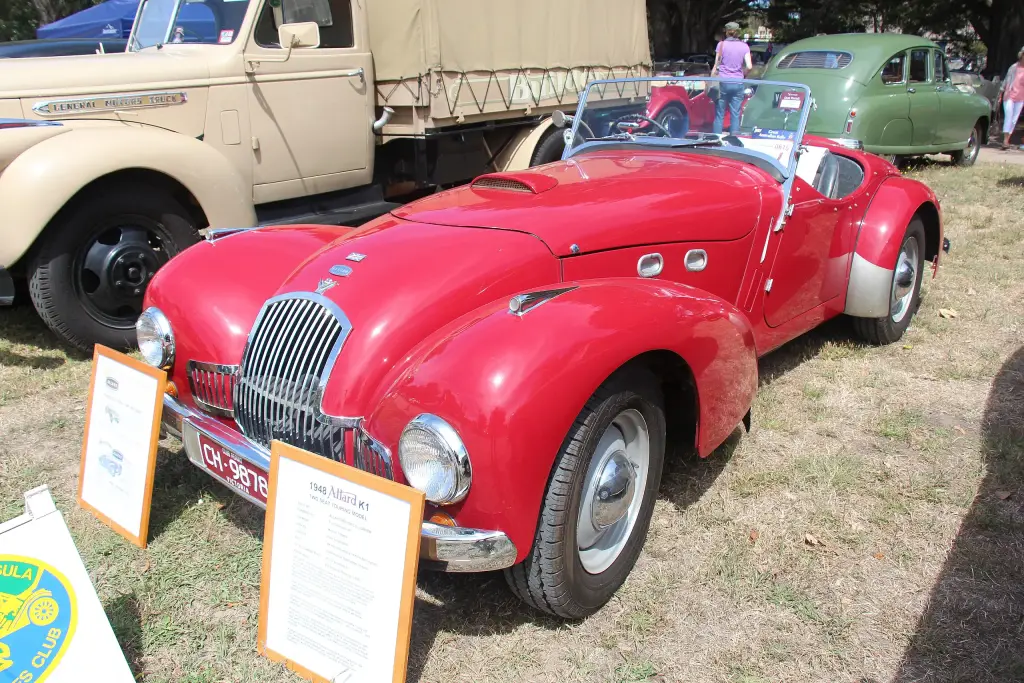
The K1 of 1946 resembled the contemporary J1 racing car and shared its drivetrain and chassis, but had a wheelbase 152 mm longer, a slightly higher compression ratio and a little more power. Unlike the J1 it also had front bumpers and a different roof. Its sidevalve V8 came first from the Ford V8 model 01A/02A and later from the Ford Pilot, with 3,622 cc, a 7:1 compression ratio and 95 bhp at 3,800 rpm, giving a claimed 149 km/h. The front wheels were independently suspended on a transverse leaf spring, the driven rear axle also hung on a transverse leaf, and the frame was made of steel tubes under an aluminium body.
The K2 followed the J2 in the same way, with a wheelbase another 152 mm longer and different carburation giving lower power, plus cycle-type mudguards fixed to the frame, front bumpers and another roof. Technically it differed from the K1 mainly in its engine and in a bonnet with an A-shaped grille. Its 3,917 cc V8 had a 7.5:1 compression ratio and a single Ford carburettor for 100 bhp at 3,800 rpm — the J2 with the same engine but two Solex carburettors made 140 bhp — and top speed rose to 163 km/h, making it a genuine hundred-mile-an-hour car. The front suspension now used coil springs, while the rear axle was unchanged.
The K3 that followed looked like the contemporary Palm Beach, with a longer and narrower pontoon body. It combined the K1’s engine with the K2’s front suspension and added a De Dion rear axle; the wheelbase stayed the same but the track grew by 64 mm to 1,486 mm. The series remained in production in its three versions until 1956.
Design and features
- Road-going J cars: the K1 and K2 used the chassis and drivetrain of the J1 and J2 but with a longer wheelbase and road equipment.
- Ford V8 power: sidevalve engines of 3,622 and 3,917 cc, the second giving 163 km/h.
- Bumpers and roof: front bumpers and a proper roof separated the K models from the stark competition cars.
- Simple suspension: independent front end on a transverse leaf spring (K1) or coil springs (K2), live rear axle.
- Aluminium body on a tubular frame: light construction in the Allard tradition.
Allard K1 and K2 versions
- K1 (1946–): 3,622 cc V8 of 95 bhp, transverse leaf front spring, 149 km/h.
- K2: 3,917 cc V8 of 100 bhp, coil-spring front suspension, A-shaped grille, 163 km/h.
- K3: Palm Beach-style pontoon body, K1 engine, K2 front suspension, De Dion rear axle and a wider track.
The K1 shared its mechanical layout with the J1, and the K2 with the J2; the closed cars of the range are the P1 and M. More cars are in the Allard collection.
Video: 1947 Allard K1 Roadster
Video on YouTube.
Sources
- Allard K-Serie, German Wikipedia: K1, K2 and K3 dimensions, engines and performance
- Allard Motor Company, English Wikipedia: place of the K cars in the range, frame and body