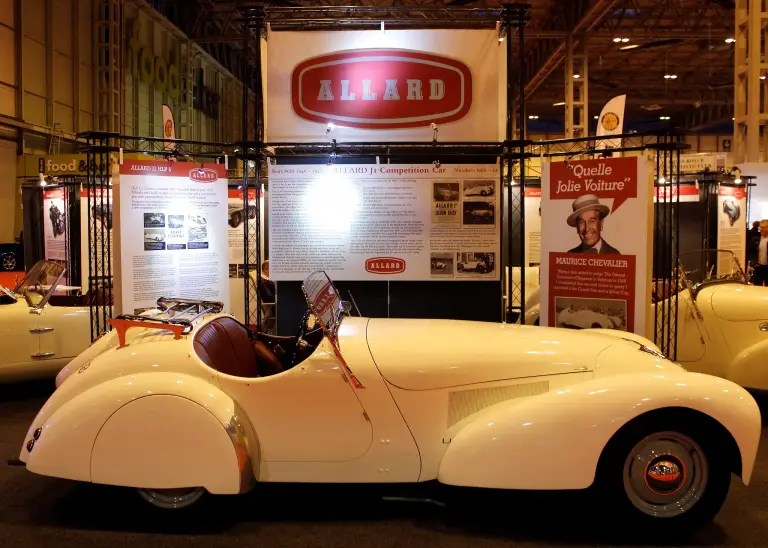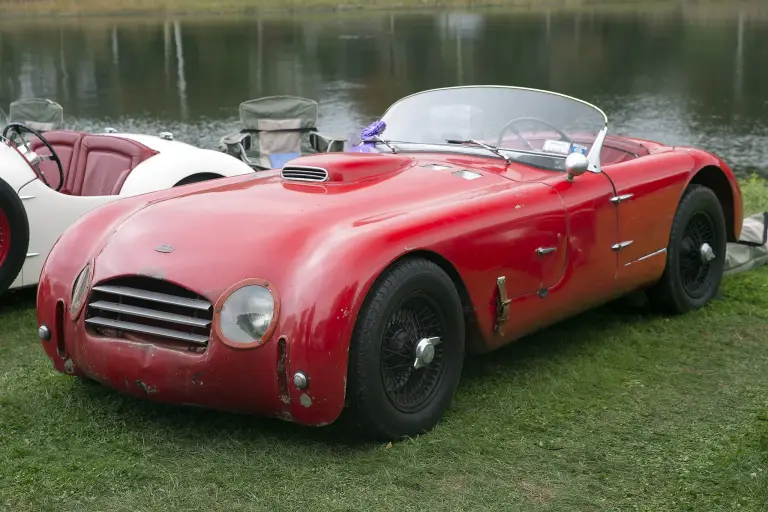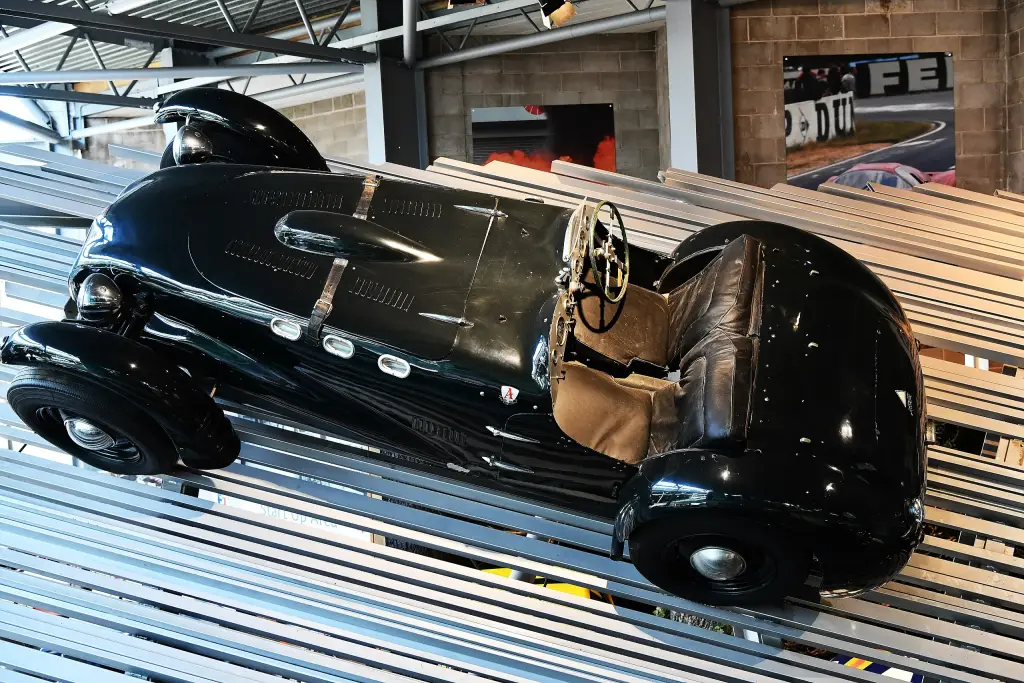
The Allard J2 was a two-seat sports roadster built by the Allard Motor Company in London between 1949 and 1951, mainly for the American market. A light aluminium body over a simple chassis and a large American V8 gave it a power-to-weight ratio that few European sports cars of the period could match.
Allard J2 at a glance
| Maker | Allard Motor Company, Clapham, London |
|---|---|
| Production | 1949–1951 |
| Built | 90 |
| Body | two-seat open roadster, hand-formed aluminium |
| Weight | 2,072 lb (940 kg) |
| Engine in Britain | 3.6-litre Ford Pilot sidevalve V8, 85 hp |
| Engine option | 4.4-litre Mercury V8, 110 hp |
| US engines | Cadillac, Chrysler, Oldsmobile or Buick V8 fitted after arrival |
| Front suspension | swing axle with coil springs |
| Rear suspension | De Dion tube, coil springs, inboard brakes |
| Differential | quick-change ratios available |
| Le Mans 1950 | third overall, Tom Cole and Sydney Allard |
The English Wikipedia article on the J2 is short; the technical and competition details here come from its J2 section and from the article on the Allard Motor Company.
History of the Allard J2
Sydney Allard built the J2 to exploit the American market, which was rich but short of sports cars. The recipe was simple: a lightweight hand-formed aluminium body on a small chassis, new coil-spring front suspension with inclined telescopic dampers, and a De Dion rear axle with inboard brakes and a quick-change differential. In Britain the standard engine was the 3.6-litre sidevalve V8 from the Ford Pilot with 85 hp, with the 4.4-litre Mercury V8 of 110 hp as an alternative.
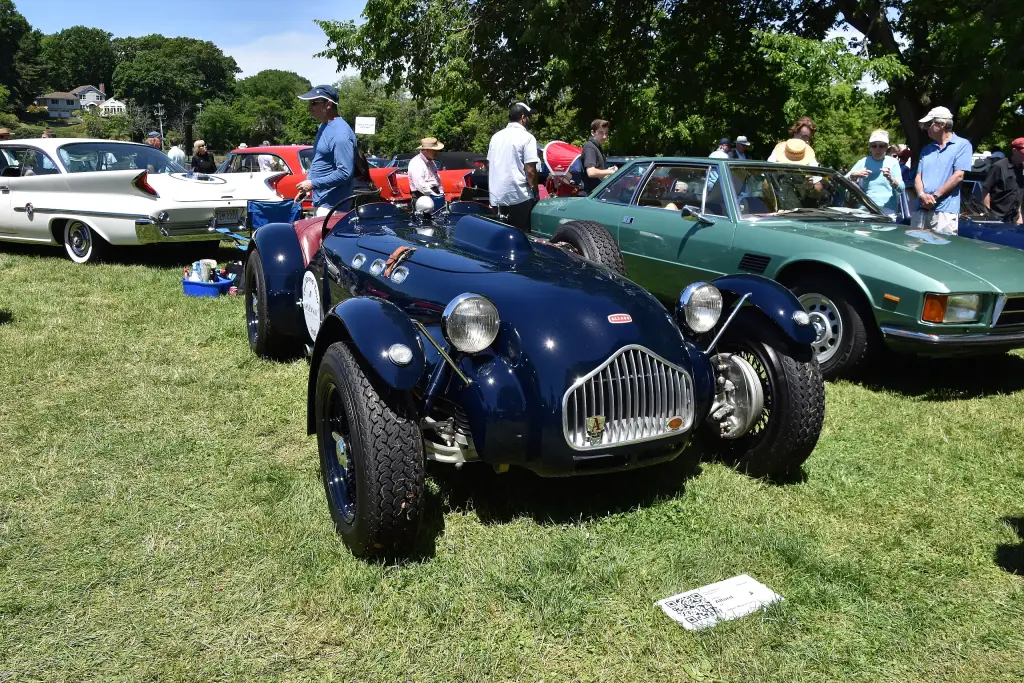
Shipping American engines across the Atlantic and back made little sense, so J2s bound for the United States travelled without engines and were completed there with whatever the owner chose — usually a Cadillac, Chrysler, Oldsmobile or Buick overhead-valve V8. The result was a highly competitive international racing car, most often powered by the 331 cu in Cadillac engine, and parts were easy to find because so much of the car was American.
In 1950 a J2 shared by Tom Cole and Sydney Allard finished third overall at Le Mans at an average of 87.74 mph, and J2s returned in 1951. Bill Pollack won the 1951 Pebble Beach Road Race in a Cadillac-engined car. Zora Arkus-Duntov, later chief engineer of the Chevrolet Corvette, worked for Allard from 1950 to 1952 and raced for the works team at Le Mans in 1952 and 1953. The model was replaced by the J2X in 1952.
Design and features
- Light aluminium body: hand-formed panels kept the complete car down to 2,072 lb.
- De Dion rear axle: inboard brakes and a quick-change differential, unusual sophistication for a low-volume British sports car.
- Engineless export: cars sent to America were completed with Cadillac, Chrysler, Oldsmobile or Buick V8s.
- Racing record: third overall at Le Mans in 1950 and victory at Pebble Beach in 1951.
- Ardun option: the Mercury flathead could be fitted with an Ardun overhead-valve conversion.
Allard J2 versions
- British-specification J2: Ford Pilot 3.6-litre V8 of 85 hp as standard.
- Mercury-engined J2: 4.4-litre V8 of 110 hp, also available with the Ardun hemi conversion.
- American-completed J2: shipped without an engine and fitted with a Cadillac, Chrysler, Oldsmobile or Buick V8.
- J2X (1952–1954): the replacement with a longer nose and the engine moved forward.
The J2 was followed by the J2X, and its competition ancestor was the J1. More cars are in the Allard collection.
Video: Allard J2 onboard Le Mans
Video on YouTube.
Sources
- Allard J2, English Wikipedia: engines, suspension, production
- Allard Motor Company, English Wikipedia: weight, Le Mans results, Duntov