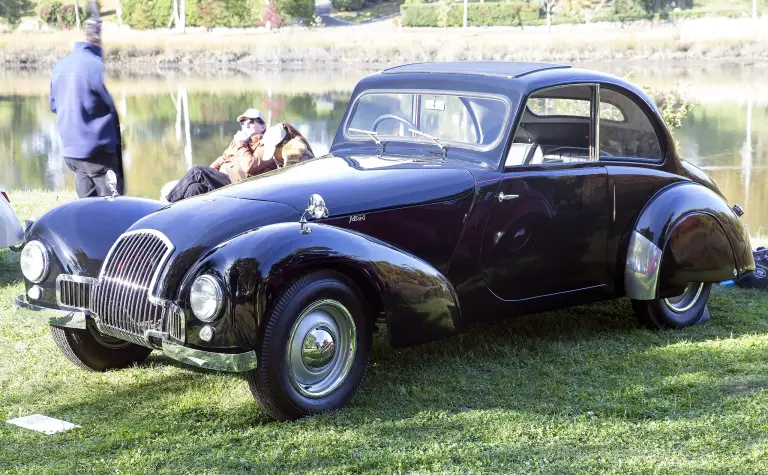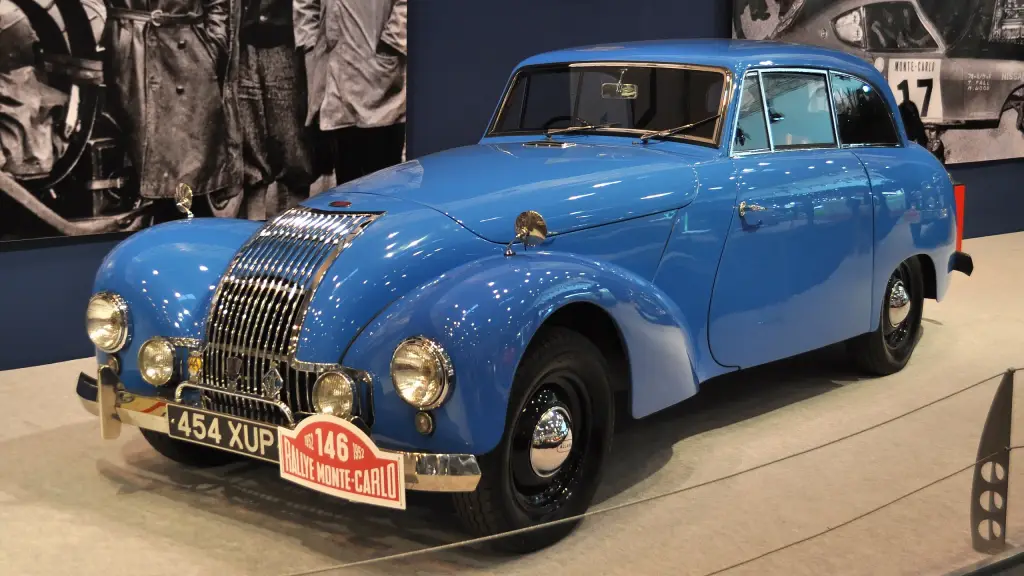
The Allard P1, usually called simply the Allard 3.6-litre Saloon when it was new, was a five-seat two-door sports saloon produced by the Allard Motor Company between 1949 and 1952. It used Ford engines and transmissions, which made service and spare parts easy to find in the American market that mattered so much to Allard.
Allard P1 at a glance
| Maker | Allard Motor Company, Clapham, London |
|---|---|
| Production | 1949–1952 |
| Built | 559 |
| Body | five-seat two-door sports saloon |
| Engine | Ford sidevalve V8, 3.6 litres |
| Competition Series | Mercury 4.4-litre V8, 115 hp |
| Top speed (Autocar, 1949) | 84.5 mph (136 km/h) |
| 0–60 mph (Autocar, 1949) | 23.4 seconds |
| Fuel consumption | 17 mpg (imperial) |
| Price (1949, with taxes) | £1,277 |
| Windscreen | hinged at the top, opened by a central toggle |
| Monte Carlo Rally | won in 1952 by Sydney Allard and Guy Warburton |
This page is based mainly on the English Wikipedia article on the P1, with the explanation of Allard’s model letters from the company article.
History of the Allard P1
The P1 was one of three post-war Allard models built on a new steel chassis with lightweight bodywork, using the stock of Ford parts that Sydney Allard had gathered during the war. The code letters explained the range: J for short-wheelbase two-seaters, K for two- or three-seat tourers, L for four-seat tourers, M for drophead coupés and P for fixed-head cars. The P1 was the closed five-seater, a two-door saloon with room for five.
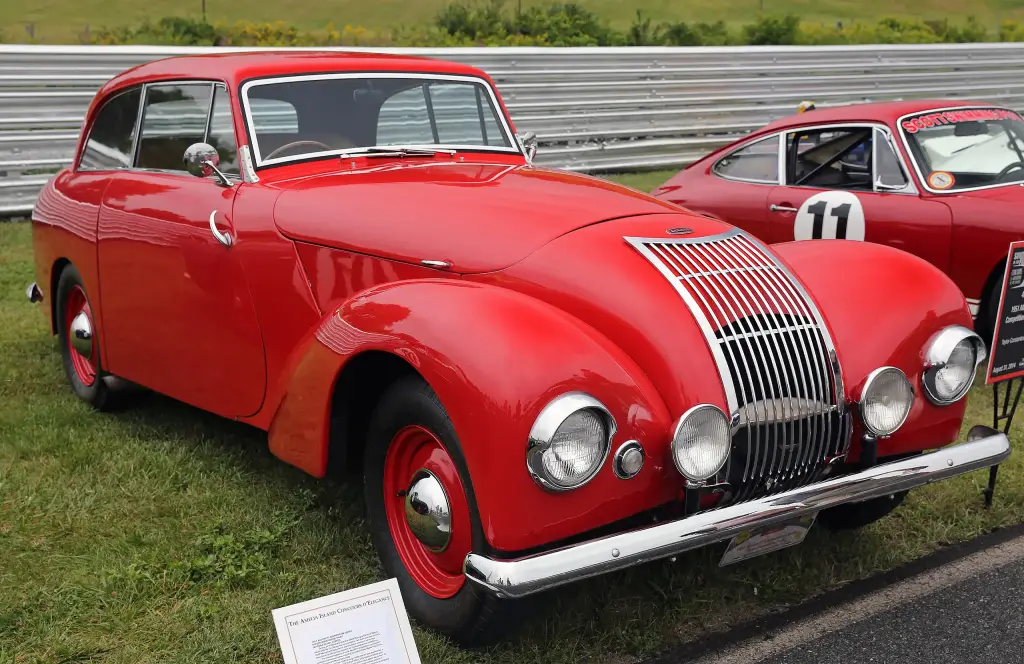
A car tested by The Autocar in 1949 recorded a top speed of 84.5 mph and accelerated from 0 to 60 mph in 23.4 seconds, with fuel consumption of 17 miles per imperial gallon; the test car cost £1,277 including taxes. The Competition Series version received Mercury’s 4.4-litre V8 of 115 hp, and buyers who wanted more could specify aftermarket parts from companies such as Edelbrock or Edmunds.
The P1 was unusual for a post-war design in having a windscreen hinged at the top, which could be opened by means of a central toggle mechanism. The interior showed unusual attention to detail, with a package shelf under the fascia and pockets formed in the thickness of the doors; equipment included a choke control, a screw-type hand throttle and a switch for the engine compartment light. A heater drawing fresh air from outside was standard on exported cars and optional at home.
In 1952 an Allard P1 driven by Sydney Allard himself, with Guy Warburton and Tom Lush as navigator, won the Monte Carlo Rally — the high point of the model’s career.
Design and features
- Ford mechanicals: the engine and transmission came from Ford, so parts were easy to find at home and in America.
- Hinged windscreen: the top-hinged screen opened through a central toggle mechanism, a rare feature in a post-war design.
- Careful interior: a package shelf under the fascia, door pockets, a hand throttle and an under-bonnet light.
- Competition Series: a 115 hp Mercury 4.4-litre V8, with aftermarket tuning parts available.
- Rally winner: Sydney Allard won the 1952 Monte Carlo Rally in a P1.
Allard P1 versions
- Standard P1: Ford-engined five-seat saloon, 1949–1952.
- Competition Series: Mercury 4.4-litre V8 of 115 hp and tuning parts from Edelbrock or Edmunds.
- Export specification: fresh-air heater fitted as standard.
The open Allard M was the drophead version of the same idea, and the estate derivative was the Safari. More cars are in the Allard collection.
Video: Oldtimers – Allard P1 and K1 at Train Station
Video on YouTube.
Sources
- Allard P1, English Wikipedia: body, engines, road test, Monte Carlo Rally
- Allard Motor Company, English Wikipedia: model lettering and chassis