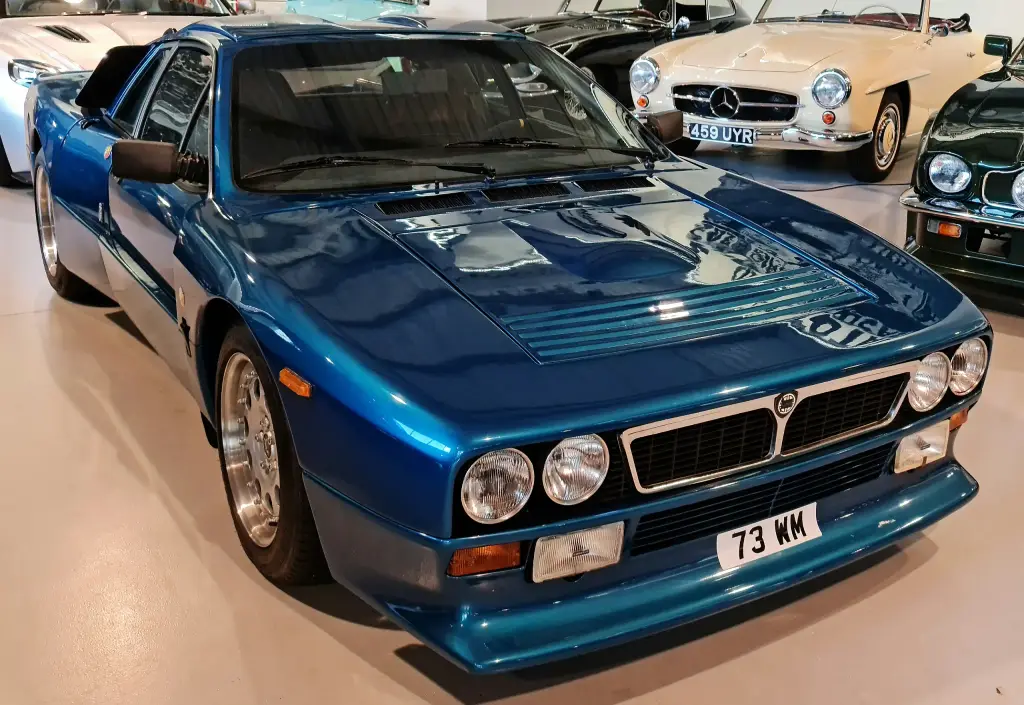
The Lancia Rally 037, also called the Lancia Abarth 037, is a mid-engined, rear-wheel-drive Group B rally car built by Abarth and Lancia in the early 1980s; it won the 1983 World Rally Championship manufacturers’ title. It was the last two-wheel-drive car to win the WRC constructors’ title. This page covers the key figures, the history, the Evolution versions and common questions.
Lancia Rally 037 at a glance
| Builder | Abarth and Lancia (Fiat group); built by Dallara, bodywork by CBC of Turin |
|---|---|
| Production | 1982–1984; 207–222 first-run cars (Stradale and prototypes), 20 each of the Evolution 1 and Evolution 2 |
| Engine | 2.0 L (1,995 cc) four-cylinder, DOHC, 16 valves, Volumex supercharger, rear-mid, dry sump |
| Power | 205 PS (Stradale); 255–280 PS (Evo 1); 310–325 PS (Evo 2, 2.1 L) |
| Gearbox | ZF 5-speed with an Abarth-ZF locking differential |
| Brakes | 300 mm vented discs front and rear |
| Length, width, height | 3,915 mm, 1,850 mm, 1,245 mm |
| Wheelbase | 2,440 mm |
| Weight | 960 kg or 1,170 kg depending on the table (English Wikipedia) |
| Stradale performance | over 220 km/h, 0–60 mph in 7.0 s |
English Wikipedia lists two weights (960 kg and 1,170 kg), probably for the competition car and the Stradale. Russian Wikipedia gives a lower original power of 265 hp and 300 hp for the Evolution 1.
History of the Lancia 037
The project began at Abarth, which belonged to the Fiat group, to build a car for the new Group B rules that came into force in 1982. Under the Abarth project name SE 037 the first prototype, SE 037-001, was completed on 23 September 1980, and the car was named after the project number. The design is based on the Lancia Montecarlo: a tubular frame with body panels, many of them in Kevlar, steel subframes and a mid-mounted engine turned through 90 degrees, which freed up space for the suspension.
The car was homologated in 1982 after the minimum number of road cars was cut from 400 to 200, and officially unveiled at the 1982 Turin Auto Show. It debuted at the Costa Smeralda Rally in 1982 (both cars retired with gearbox problems) and its first WRC event was the Tour de Corse. Martini Racing sponsored the team from 1982.
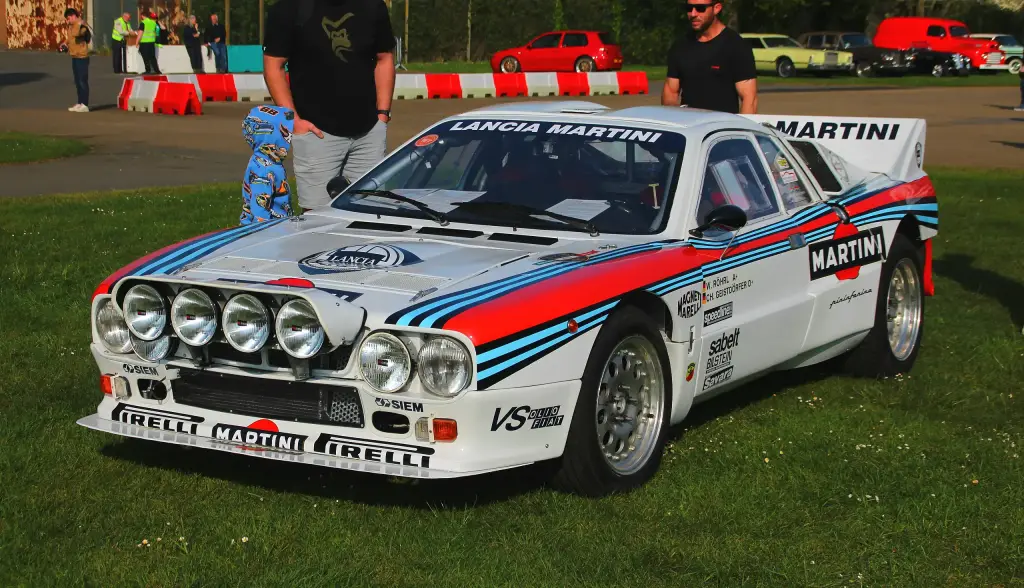
The 1983 championship
In 1983 Lancia won the manufacturers’ title, with Walter Röhrl and Markku Alén as the main drivers, while Hannu Mikkola won the drivers’ title for Audi. The 037 also won the European Rally Championship in 1983, 1984 and 1985. Over its career it took part in 62 races and won 6 WRC rallies. Its last appearance was the 1986 Safari Rally, in place of the Delta S4. Russian Wikipedia says its wide, squat shape earned it the nickname “plastic flatfish”.
Design and features
- Engine: the Tipo 232 AR4, a 2.0-litre twin-cam 16-valve four-cylinder with a Volumex supercharger and dry sump; the Stradale used the smaller R10 supercharger and a carburettor.
- Running gear: five-speed ZF gearbox with a locking differential, 300 mm vented discs and Pirelli P7 tyres.
- Body: a tubular frame with Kevlar panels; the car is 3,915 mm long.
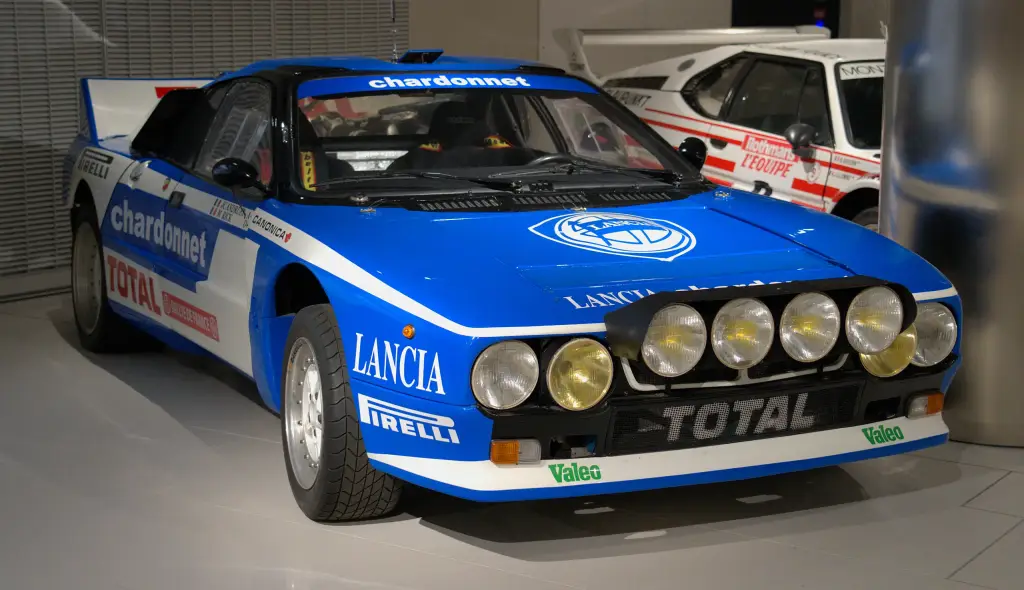
Lancia 037 versions
- Stradale: the road-going homologation model with 205 PS.
- Evolution 1: Brembo brakes, reinforced hubs and suspension arms, lighter crankshaft and flywheel and a larger R18 supercharger, 255–280 PS.
- Evolution 2: 2,111 cc with boost raised to 1 bar and water injection, 310–325 PS; its only win was Alén at the 1984 Tour de Corse.
More Abarth competition cars are in our Abarth collection, for example the Abarth-Osella prototypes and the Abarth OT series.
Lancia Rally 037 questions and answers
Why is it called 037?
The car took its name from the Abarth project number, SE 037.
Was the Lancia 037 four-wheel drive?
No. It was rear-wheel drive and the last two-wheel-drive car to win the WRC manufacturers’ title, in 1983.
What engine does it have?
A 2.0-litre four-cylinder with a Volumex supercharger: 205 PS in the Stradale, up to 325 PS in the Evolution 2.
How many were built?
Estimates of the first run range from 207 to 222 cars (Stradale and prototypes), plus 20 each of the Evolution 1 and Evolution 2.
What does Abarth have to do with the Lancia 037?
The project was developed at Abarth, and Russian Wikipedia says the car was built by Abarth and Lancia together; it is sometimes called the Lancia Abarth 037.
Sources
- Lancia Rally 037, English Wikipedia: development, engine, versions, results
- Lancia Rally 037, Russian Wikipedia: history, design, power figures