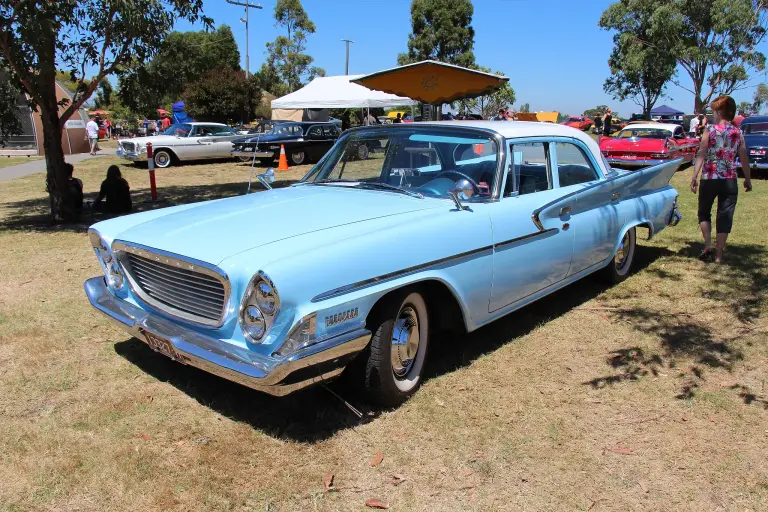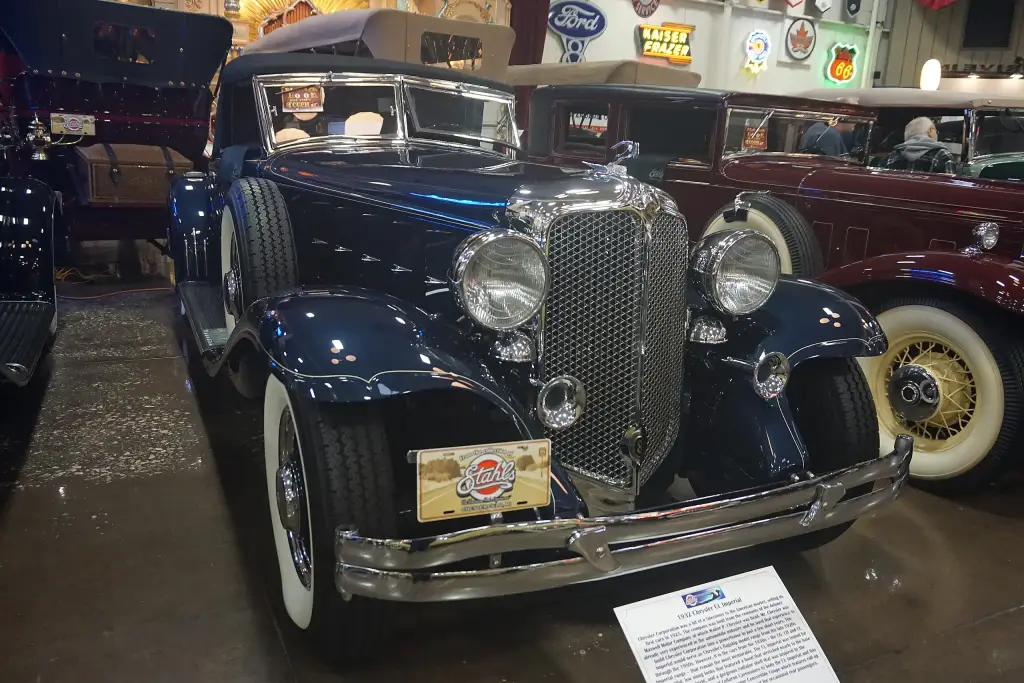
The Chrysler Imperial was Chrysler’s top-of-the-line car for most of its history: produced under the Chrysler name until 1954, as a separate luxury make from 1955 to 1975 and again as a Chrysler from 1990 to 1993. It was built to rival Cadillac, Lincoln, Packard and Duesenberg, and its coachbuilt limousines and phaetons carried government officials, royalty and celebrities.
Chrysler Imperial at a glance
| Introduced | 1926 |
|---|---|
| Chrysler-badged | 1926–1954 and 1990–1993 |
| Separate make | 1955–1975 |
| First engine | 288.6 cu in straight-six, 92 hp |
| First model code | E-80 |
| 1926 body styles | roadster, coupé, sedan, phaeton, seven-passenger limousine |
| Wheelbase | 120 in (3,048 mm) |
| Coachbuilders | Derham, Fleetwood, LeBaron |
| Flagship trim | Imperial LeBaron, 1957–1975 |
| 1990s revival | 1990–1993, on the Y platform |
History of the Chrysler Imperial
Rival to Cadillac
In 1926 Walter P. Chrysler decided to compete with Cadillac, Lincoln, Packard, Pierce-Arrow, Studebaker, Cord and Duesenberg in the luxury field, although his new company had only a large-displacement straight-six to offer. The Imperial’s engine was a 288.6 cu in six with seven bearing blocks and pressure lubrication, rated at 92 brake horsepower. It used a solid front axle with semi-elliptic leaf springs and a differential rear axle on leaf springs, and carried a stylised Viking winged helmet as its radiator cap. The model was coded E-80, the “80” standing for a guaranteed all-day cruising speed of 80 mph. In its first year it set a transcontinental speed record, covering more than 6,500 miles in a week, and was chosen as pace car for the 1926 Indianapolis 500. Body styles ranged from a two- or four-passenger roadster to a seven-passenger limousine with a glass partition; the Berline Limousine listed at US$3,595.
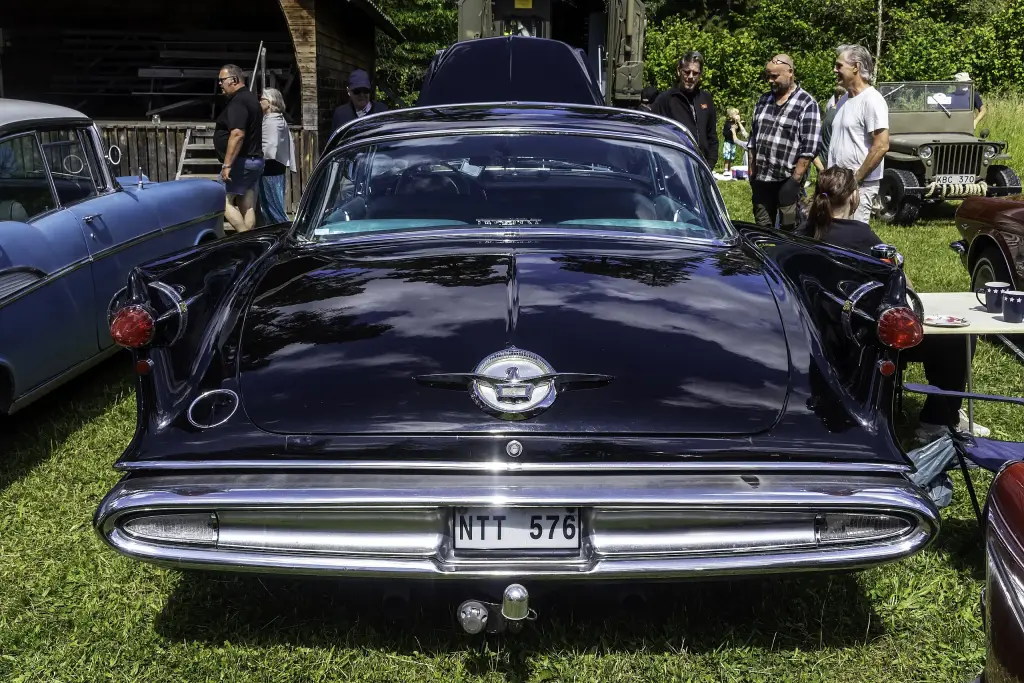
Coachwork and straight eights
The 1927 Series 80 offered the high-compression “Red Head” 288.6 cu in six on wheelbases of 120, 127 or 133 inches, with five two-door and nine sedan, town car, phaeton and limousine bodies; the Town Car listed at US$5,495. In 1927 an Imperial ran non-stop from San Francisco to New York and on to Los Angeles, 6,726 miles at an average of 40 mph. For 1928 the Series 80L grew to a 136-inch wheelbase with bodies from Briggs, LeBaron, Derham, Locke and Dietrich. The 1929 and 1930 cars were essentially unchanged while engineering effort went into the 1931 straight eight, but gained thermostatically controlled radiator shutters, vertical hood louvers and a four-speed gearbox, and hydraulic four-wheel brakes became standard across Chrysler products. Custom coachwork from Derham, Fleetwood and LeBaron remained part of the Imperial’s appeal for decades.
Imperial as a make
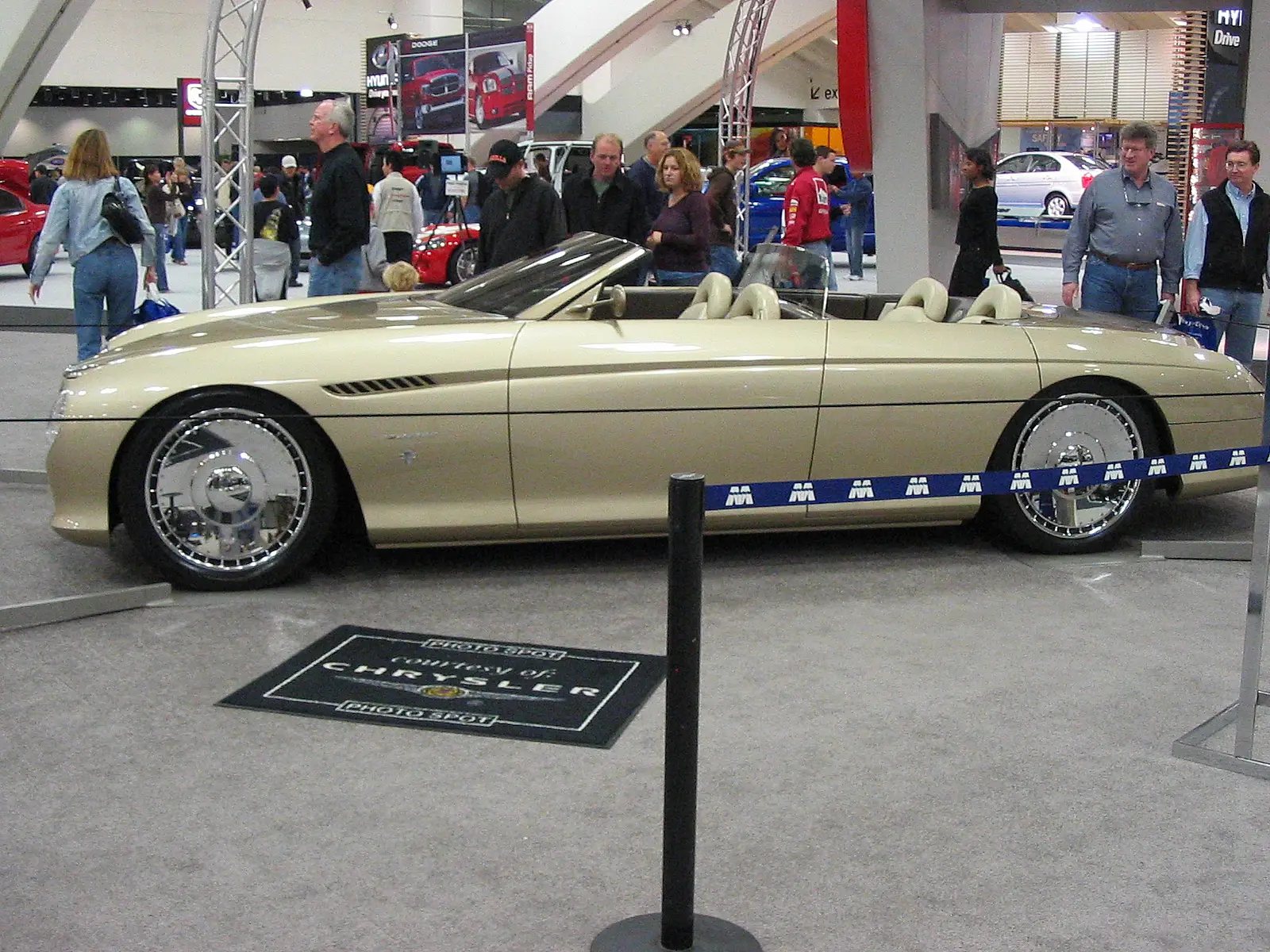
For 1955 Chrysler spun Imperial off as a separate make and division, its flagship luxury brand, named after the original Chrysler Imperial and aimed directly at Cadillac, Lincoln and Packard. Imperial used the Crown as its mid-range line and LeBaron, in deference to the coachbuilder, as its flagship, with Southampton for pillarless hardtops. After the make was retired in June 1975 the Imperial LeBaron was repackaged as the Chrysler New Yorker Brougham. The Imperial name returned to the Chrysler badge from 1990 to 1993, and the Imperial concept of 2006 revisited the idea of a rear-wheel-drive flagship.
Design and features
- Flagship status: Chrysler’s most expensive and most luxurious model for most of the 20th century.
- Coachbuilt bodies: Derham, Fleetwood and LeBaron supplied custom limousines, town cars and convertibles.
- Straight eights: the six of 1926 gave way to the 1931 straight eight and later Hemi V8s.
- Record-breaking: transcontinental speed records in 1926 and 1927 and the 1926 Indianapolis pace car.
- Imperial LeBaron: the top trim from 1957 to 1975, named after the coachbuilder.
Chrysler Imperial versions
- 1926 E-80: the original straight-six Imperial, with wheelbases up to 133 inches.
- Airflow Imperial: the streamlined 1930s model, also sold as a LeBaron-bodied CW series.
- Crown Imperial: the long-wheelbase limousine version of the 1950s and 1960s.
- Imperial LeBaron (1957–1975): the flagship of the separate Imperial make.
- Imperial (1990–1993): the revival on the long-wheelbase Y platform.
- Imperial concept (2006): a rear-wheel-drive show car reviving the name.
The Imperial sat above the New Yorker and Fifth Avenue; its streamlined period is covered by the Chrysler Airflow and its Hemi engines by the 300 letter series. More cars are in the Chrysler collection.
Video: 1967 Chrysler Imperial Crown Coupe
Video by Jay Leno’s Garage on YouTube.
Sources
- Chrysler Imperial, English Wikipedia: origins, models, coachwork, Imperial make
- Chrysler Imperial, Wikimedia Commons: photographs